




 USD
USD
PwC Signals Institutional Turn Toward Crypto as Ripple Gains Recognition as Financial Infrastructure


Regulatory Clarity Pushes Big Four Into Deeper Digital Asset Engagement
TL;DR
- PwC says clearer U.S. regulation, including the 2025 GENIUS Act, is driving a decisive expansion of its crypto and stablecoin advisory work.
- The firm publicly identifies Ripple as financial services infrastructure, highlighting real-time, low-cost cross-border settlement as a core use case.
- The shift reflects growing institutional conviction that blockchain is moving from speculative experimentation to operational finance.
We’ve just launched the all-new COIN360 Perp DEX, built for traders who move fast!
Trade 130+ assets with up to 100× leverage, enjoy instant order placement and low-slippage swaps, and earn USDC passive yield while climbing the leaderboard. Your trades deserve more than speed — they deserve mastery.
PricewaterhouseCoopers is making one of its clearest institutional statements yet on digital assets, signaling that the era of cautious observation is over. The Big Four accounting firm confirmed in early January 2026 that it is significantly expanding its crypto-related work in the United States, citing improved regulatory clarity and concrete demand from corporate and financial clients. Senior leadership framed the move as a strategic response to evolving legislation rather than a sudden change of heart, emphasizing that years of uncertainty had previously constrained deeper involvement in the sector.
Paul Griggs, PwC’s U.S. Senior Partner and CEO, said the firm is now prepared to “lean in” after what he described as a meaningful shift in the regulatory environment. Stablecoin legislation, particularly the GENIUS Act passed in 2025, was singled out as a turning point that reduced legal ambiguity and enabled large professional services firms to engage with digital assets more confidently. Griggs noted that the new framework is creating conviction around stablecoins as a legitimate product category rather than a regulatory gray area, allowing PwC to advise clients without the same level of reputational and compliance risk that existed in prior years.
PwC’s renewed push spans audit, tax, and consulting services, with a specific focus on how crypto and blockchain-based payment rails can improve efficiency in real-world financial operations. Leadership described the firm as “hyper engaged” with clients exploring digital assets, particularly those looking to modernize settlement systems and cross-border payments. Internally, PwC has been reinforcing its crypto expertise over the past year, including the return of Cheryl Lesnik to a partner role after overseeing digital asset client relationships for three years. Griggs stressed that the firm would not expand aggressively without sufficient technical depth, pointing to deliberate investments in talent and infrastructure over the last 10 to 12 months.
Parallel to its broader crypto strategy, PwC has also drawn attention by explicitly recognizing Ripple as a form of financial services infrastructure rather than treating XRP as a purely speculative asset. In a report cited this month, the firm highlighted Ripple’s ability to facilitate near-instant cross-border transfers with low transaction costs, positioning the network as a bridge between traditional financial systems and blockchain-based settlement. The assessment underscores how certain blockchain platforms are being evaluated on operational utility, not price behavior, as institutions search for tools that can address long-standing inefficiencies in global payments.
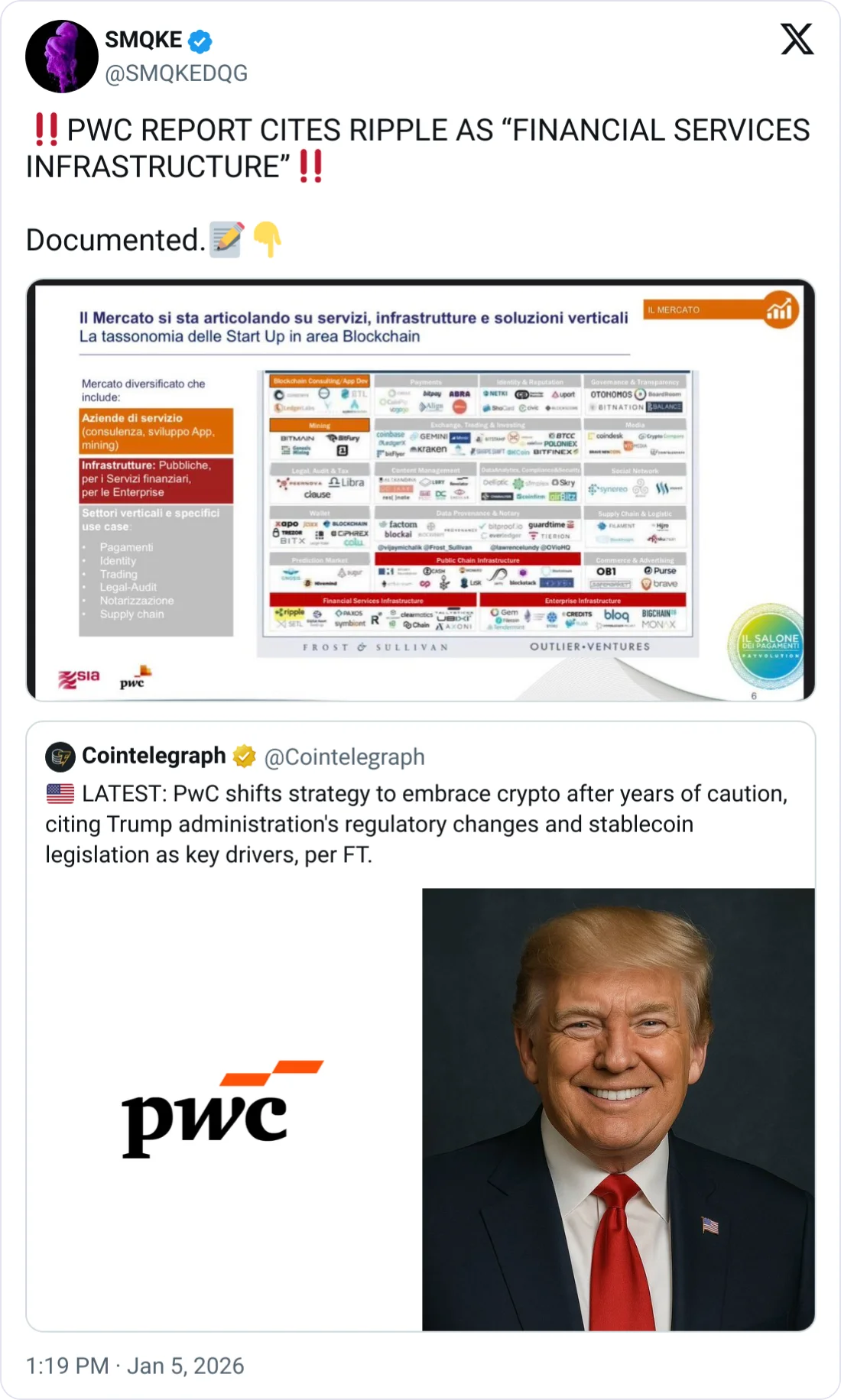
PwC’s analysis emphasizes Ripple’s integration with existing banking and payment frameworks, a factor that has made the technology attractive to financial institutions exploring blockchain adoption without fully abandoning legacy systems. The report points to real-time settlement and liquidity management as key advantages, particularly in contrast to slower, more expensive correspondent banking models. Market observers cited in the coverage argue that such recognition from a major accounting firm signals a broader shift in institutional perception, where blockchain networks are increasingly viewed as core infrastructure components rather than experimental add-ons.
The firm’s evolving stance mirrors a wider movement among large professional services organizations as regulatory pressure gives way to clearer rulemaking. Other Big Four firms have already rolled out digital asset roadmaps, tax tools, and advisory services, reflecting a competitive environment where crypto expertise is becoming table stakes for servicing multinational clients. PwC’s endorsement of Ripple and its emphasis on stablecoins suggest that the next phase of institutional crypto adoption will be driven less by market hype and more by practical applications tied to payments, settlement, and financial plumbing.
This article has been refined and enhanced by ChatGPT.


