




 USD
USD
Quantum Key Break Triggers Bitcoin Security Debate

Project Eleven Award Highlights Early Quantum Progress, Not a Network Breach
TL;DR
- Giancarlo Lelli won Project Eleven’s Q-Day Prize for breaking a 15-bit ECC key.
- The result did not affect Bitcoin wallets or live cryptographic systems.
- Focus has shifted to long-term risks tied to exposed public keys.
We’ve launched the all-new COIN360 Perp DEX, built for traders who move fast!
Trade 130+ assets with up to 100× leverage, enjoy instant order placement and low-slippage swaps, and earn USDC passive yield while climbing the leaderboard. Your trades deserve more than speed — they deserve mastery.
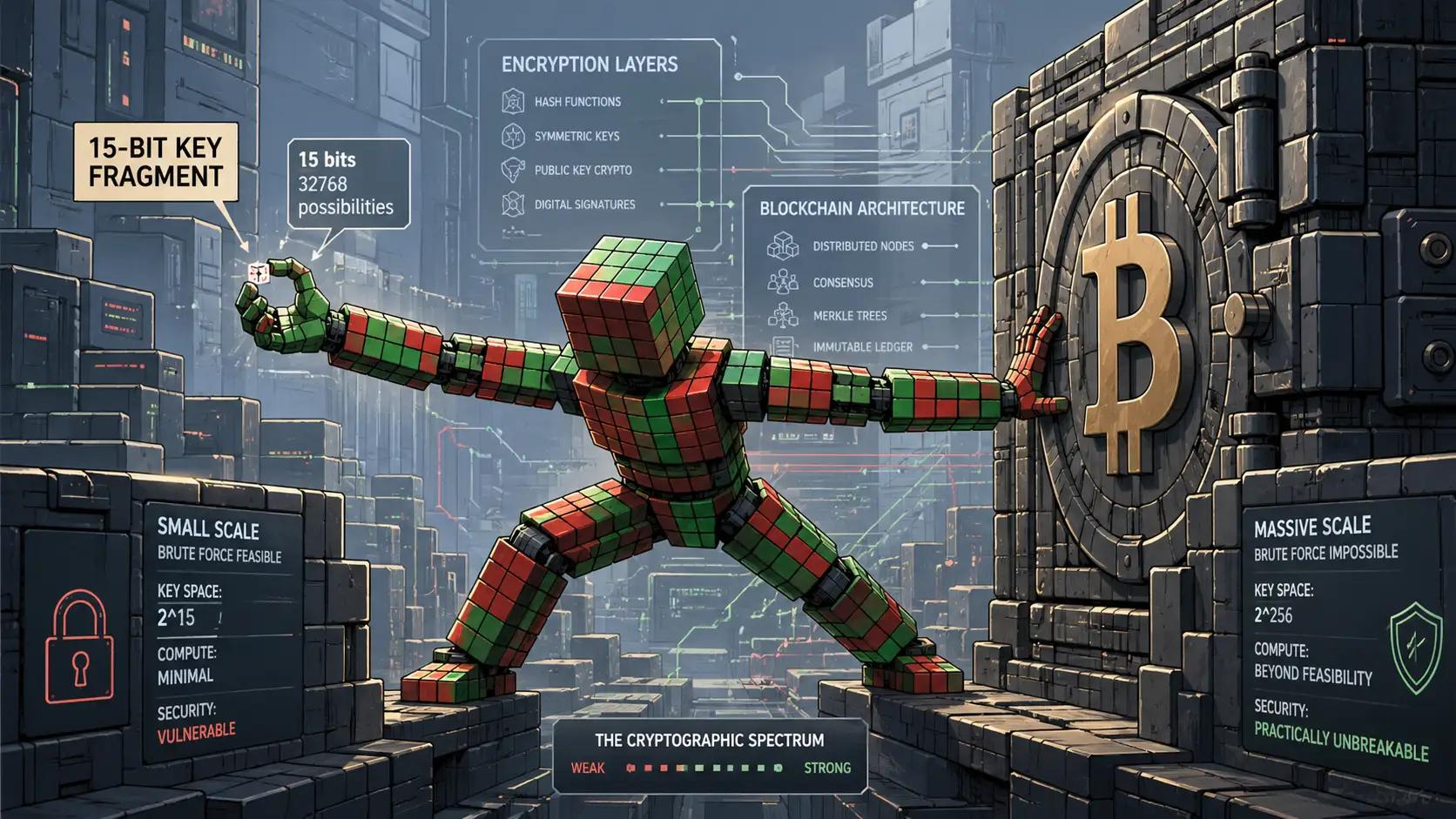
Project Eleven awarded Giancarlo Lelli its Q-Day Prize after he derived a private key from a 15-bit elliptic curve public key using cloud-accessible quantum hardware, marking a controlled benchmark that did not break Bitcoin or compromise any wallets.
The prize was issued on April 24, 2026, with coverage on April 25, 2026, describing the outcome as a measurable step in testing quantum capabilities against cryptographic systems tied to Bitcoin transactions. The challenge was designed to track progress in applying quantum methods to elliptic curve cryptography, which underpins Bitcoin’s security.
Conor Deegan said the prize went to Lelli for “breaking a 15-bit elliptic curve key.” Project Eleven described the milestone as evidence that quantum attacks on elliptic curve cryptography are shifting from theoretical models into early-stage execution. Project Eleven added, “The distance from 15 to 256 bits is large,” emphasizing the gap between the demonstrated capability and Bitcoin’s production-level encryption.
Demonstration Remains Far Below Bitcoin’s Cryptographic Threshold
The achievement involved deriving a private key from a public key using a variant of Shor’s algorithm across 32,767 candidates. A 15-bit key corresponds to 32,768 possible values, while Bitcoin relies on 256-bit elliptic curve cryptography, leaving a substantial gap between the demonstration and real-world attack feasibility.
No Bitcoin wallets were affected, and no live systems were compromised. The result was characterized as a laboratory benchmark rather than a security breach. A later account at 10:07:24 GMT stated the outcome was “far too small to pose any threat to Bitcoin wallets or network security.”
A community note challenged the result, arguing the method relied heavily on classical verification rather than purely quantum computation. That distinction leaves unresolved whether the quantum system independently performed the most complex part of an elliptic curve attack.
Prior Benchmarks Show Incremental Scaling
A previous benchmark cited involved a 6-bit elliptic curve key break by Steve Tippeconnic in September 2025 using an IBM 133-qubit computer. The 15-bit result represents a 512 times larger keyspace compared with that earlier demonstration, reflecting incremental scaling rather than a leap toward breaking production-level encryption.
Project Eleven released the challenge code on GitHub, allowing independent verification of the result. The prize was denominated in Bitcoin to directly link the incentive to the asset whose cryptographic model was being tested.
Attention has shifted to Bitcoin addresses with publicly exposed keys. Approximately 6.9 million BTC, described as roughly one third of all Bitcoin ever mined, is held in addresses where public keys are visible on-chain and could be theoretically vulnerable to sufficiently advanced quantum systems.
These include original P2PK addresses, reused addresses where a transaction revealed the public key, and spent Taproot addresses after 2021, where the key becomes visible during spending. Around 1 million BTC is attributed to Satoshi Nakamoto, held in unmoved wallets since 2009 and described as P2PK-format holdings with publicly visible keys.
Post-Quantum Plans Remain Under Debate
Ethereum, TRON, StarkWare, and Ripple have published post-quantum roadmaps, while Bitcoin’s approach remains unresolved. Two proposals under discussion are BIP-360, which introduces optional quantum-safe address types, and BIP-361, which proposes forced migration with freezing of unmigrated funds.
No confirmed upgrade timeline has been established. The Bitcoin developer community remains divided over how aggressively to respond to potential quantum threats, leaving migration strategy unsettled as quantum benchmarks continue to develop.
FAQ
Did the quantum result break Bitcoin?
No. No wallets or live systems were compromised.
Who won the Q-Day Prize?
Giancarlo Lelli.
What was the key size broken?
A 15-bit elliptic curve key.
What is still unresolved?
Bitcoin’s post-quantum upgrade and migration strategy.
This article has been refined and enhanced by ChatGPT.


