




 USD
USD
Robinhood Chain Revenue Surges as Memecoin Trading Drives Activity

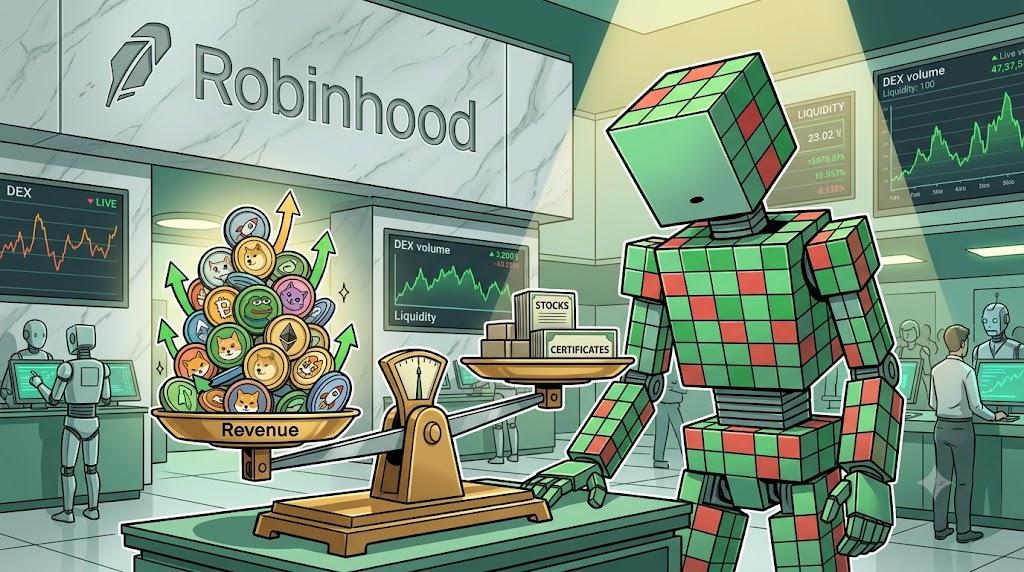
Two-Month-Old Network Hits Transaction, DEX Volume and Liquidity Records
TL;DR
- Robinhood Chain reached 5.52 million daily transactions and nearly $1 billion in daily DEX volume within two months of launching.
- Total value locked climbed to $725 million, while stablecoin supply reached about $770 million.
- Memecoin platforms Pons and GMGN drove much of the network's application revenue and activity.
- Robinhood Chain generated $963,612 in 24-hour chain revenue in one Aug. 31 snapshot, exceeding several major networks.
- Speculative tokens increasingly overlapped with Robinhood's original tokenized-stock strategy through stock-paired memecoins.
Trade smarter on Jupiter, Solana’s leading DEX built for fast execution and deep liquidity.
Swap tokens at competitive rates, route across multiple liquidity sources automatically, and access perpetuals, DCA, and advanced trading tools — all in one place!
Robinhood Chain became one of crypto's busiest revenue-generating networks by Aug. 31, 2026, roughly two months after launching, as memecoin trading drove record transactions, decentralized exchange volume and liquidity.
Robinhood launched the Ethereum-compatible network on July 1 with tokenized stocks and traditional financial assets as its flagship use case.
Within weeks, however, Robinhood-themed memecoins had become a major source of activity.
Robinhood Chain Hits 5.52 Million Daily Transactions
Daily transactions climbed from below 1 million in early July to a record 5.52 million on Aug. 30.
DEX trading reached about $875 million that day after setting another record of $989 million on Aug. 28.
Liquidity increased alongside trading:
- TVL: $725 million, nearly doubling month over month
- Stablecoin supply: $770 million, up 47%
- Daily transactions: 5.52 million at the Aug. 30 peak
July activity had been heavily influenced by memecoin CASHCAT. August also brought greater attention to infrastructure and utility tokens, although speculative trading remained central.
Pons Drives Token Creation
Pons became one of Robinhood Chain's leading token launchpads as its market capitalization rose from about $20 million to more than $200 million during August.
Around 22,600 tokens were launched through Pons in a single late-August day, more than 40% above the previous day.
Most were speculative assets based on memes, animals and internet trends rather than tokenized equities.
That created an unusual growth pattern: a blockchain designed around tokenized financial assets saw one of its busiest applications emerge from rapid speculative token creation.
Application Revenue Reaches $2.66 Million
Applications on Robinhood Chain generated approximately $2.66 million over one 24-hour period.
That trailed Solana applications at roughly $5.07 million but was about twice Ethereum's application revenue and six times Base's.
GMGN and Pons generated approximately $2 million combined, while Uniswap contributed around $307,000.
Together, the three accounted for roughly 88% of Robinhood Chain application revenue.
Application revenue measures fees captured by individual services. It is separate from revenue earned at the blockchain level.
CEO Vlad Tenev had acknowledged the speculative activity, saying Robinhood Chain's infrastructure designed for real-world assets “works great for memes too.”
Chain Revenue Surpasses Several Major Networks
Robinhood Chain's protocol-level revenue also rose rapidly.
One Aug. 31 snapshot showed $963,612 in gas revenue over 24 hours.
During the same comparison period:
- Tron generated $586,688
- Ethereum generated $111,590
- Base generated $93,001
- Solana generated $84,702
Another snapshot cited by Offchain co-founder Steven Goldfeder showed more than $1.222 million in 24-hour transaction revenue.
“The market may not appreciate this yet but L2s are a fantastic business,” Goldfeder said.
He later wrote: “Now over 2 million dollars in 24 hour revenue.”
These figures represent different snapshots and should not be confused with application revenue.
Robinhood Chain operates as an Arbitrum Orbit Layer 2 settling to Ethereum. It transfers 10% of chain revenue to Arbitrum's Expansion Program.
Stock-Paired Memecoins Gain Traction
LONG, or long.xyz, connected memecoin speculation with Robinhood Chain's tokenized-stock infrastructure by allowing tokens to trade against tokenized equities.
Artificial Inu, ticker AI, launched through LONG and paired against tokenized NVDA.
Its market cap rose from roughly $1.5 million on Aug. 1 to $135 million on Aug. 30.
The token accumulated more than $3.3 million in liquidity in its NVDA pool, over three times the liquidity of its WETH pool.
Stock-paired memecoins eventually represented about one-quarter of stock-linked trading volume on Robinhood Chain.
Infrastructure projects Delta, UP and NetNet also increased their valuations by roughly 10 times during August.
Robinhood Chain's first two months therefore developed around two parallel trends: growing infrastructure for tokenized financial assets and a speculative trading boom that supplied much of its early transactions, liquidity and revenue.


