


 USD

Robinhood Backs OKX–ICE Tokenized Stocks as Issuer Objections Reach 67

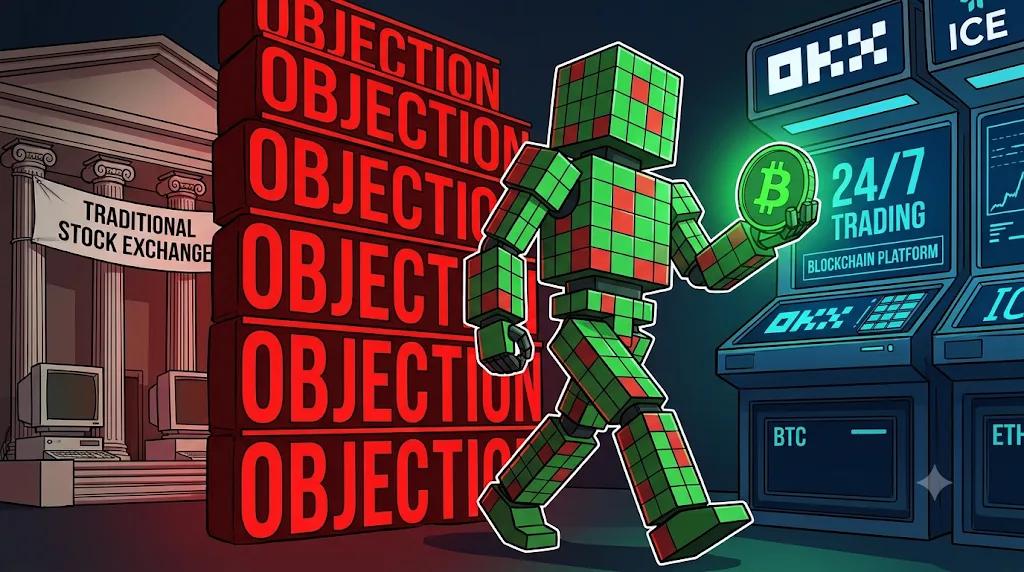
Brokerage supports blockchain-based share trading while major technology and financial companies resist third-party tokenization
TL;DR
- Robinhood confirmed it did not object to tokenized versions of its shares trading on OKXICE, joining Securitize and BitGo in supporting their inclusion.
- Issuer objections to OKXICE reached 67 as of November 5, 2026, with Meta, Palantir and three other companies joining the list.
- The SEC's exemption allows companies to block third-party tokenized stock listings, while requiring qualifying tokens to carry traditional shareholder rights.
Trade smarter on Jupiter, Solana’s leading DEX built for fast execution and deep liquidity.
Swap tokens at competitive rates, route across multiple liquidity sources automatically, and access perpetuals, DCA, and advanced trading tools — all in one place!
Robinhood has confirmed it will not oppose tokenized versions of its shares trading on OKXICE, the planned blockchain-based stock trading venue backed by Intercontinental Exchange (ICE) and crypto exchange OKX, even as corporate objections to the project reached 67 issuers. The brokerage's position, confirmed on November 9, 2026, places it among a small group of companies willing to participate in the initiative while most of the venue's originally proposed issuers have rejected third-party tokenization of their shares.
A Robinhood spokesperson said that the company had not objected to its inclusion on OKXICE, making it the third company known to have explicitly taken that position, alongside Securitize (SECZ) and BitGo (BTGO).
“We think tokenization is the future of financial markets. We would rather be part of building it than sit on the sidelines,” the spokesperson said.
OKXICE is structured as a 50/50 joint venture between ICE, the parent company of the New York Stock Exchange, and OKX's U.S. holding company. The platform aims to facilitate around-the-clock trading of tokenized U.S. stocks against stablecoins, allowing transactions 24 hours a day, seven days a week.
However, its proposed roster has encountered substantial opposition from stock issuers. According to the venue's November 5 public notice, 67 companies have objected to third-party tokenized versions of their shares being traded on the platform.
The latest additions include Meta, Palantir, S&P Global, KLA and Super Micro Computer. Other companies that have objected include Apple, Microsoft, Nvidia, Alphabet, Amazon, Tesla, Netflix, SpaceX, Broadcom, Goldman Sachs and JPMorgan.
The number of objections has risen steadily. Sixteen issuers had objected by October 19, before the count reached 50 on October 30.
The six original companies without disclosed objections were Robinhood, Securitize, BitGo, Circle (CRCL), Coinbase (COIN) and Strategy (MSTR). While Robinhood, Securitize and BitGo are known to have accepted their potential inclusion, the absence of a disclosed objection does not necessarily establish an affirmative decision by the other companies.
A Circle spokesperson declined to comment on whether the stablecoin issuer had objected.
SEC Exemption Gives Stock Issuers the Right to Object
OKXICE plans to operate under the U.S. Securities and Exchange Commission's five-year innovation exemption, which permits qualifying platforms to trade tokenized stocks through automated market makers rather than traditional order books.
Under the SEC's September exemptive order, a venue planning to list tokenized shares created by an unaffiliated third party must notify the underlying stock issuer before making those tokens available for trading.
Companies then have 30 calendar days to object. If an objection is submitted within that period, the venue “cannot make such Tokenized NMS Stock available for trading,” according to the SEC order.
For companies notified on October 4, the objection window closed on November 3. However, the public objection list can continue changing because OKXICE has five business days to disclose an objection, meaning a notice received on the deadline could appear as late as November 10. Individual deadlines also depend on when companies received their notifications.
The SEC identified several potential concerns behind issuer opposition, including the difficulty of maintaining accurate shareholder registers as tokenized securities move across blockchain networks.
Differences between prices in token liquidity pools and conventional stock markets could also affect the underlying shares, according to the regulator.
The restriction specifically applies to third-party-created tokens. Companies can still potentially participate through tokens they issue themselves, meaning an objection to an unaffiliated provider does not automatically prevent the issuer from pursuing its own tokenization arrangements.
Robinhood's Position Follows Dispute Over AMC Stock Tokens
Robinhood's decision comes after a separate disagreement involving its existing tokenized stock products and AMC Entertainment.
In September, AMC Entertainment CEO Adam Aron threatened legal action over Robinhood's tokens linked to AMC shares. Aron argued that the products used the company's name without permission, denied investors shareholder rights and could undermine AMC's ability to raise capital.
Robinhood defended its offering, while co-founder and CEO Vlad Tenev argued that stock issuers should not have veto rights over tokenized products linked to their shares.
The disagreement highlighted an important distinction between Robinhood's existing tokenized stock products and the securities OKXICE intends to trade.
Robinhood Stock Tokens are derivative products offered through an offshore entity. They provide exposure to stock price movements without granting holders the same shareholder rights as investors who own the underlying shares.
By contrast, the SEC's framework for qualifying tokenized stock venues requires the tokens to carry the same rights as the underlying securities, including dividends and voting rights.
Each token must also be backed one-for-one by shares held at a broker-dealer, with an independent accounting firm providing a reserve attestation that OKXICE checks.
The SEC's framework nevertheless preserves an issuer's ability to reject third-party tokenized trading, despite Robinhood's previously stated opposition to such veto rights.
OKXICE Faces Liquidity Requirements and Trading Limits
Beyond issuer objections, OKXICE's trading model depends on outside participants supplying liquidity to its blockchain-based markets.
The platform plans to use Uniswap v4 liquidity pools operating on OKX's XLayer network. Unlike conventional stock exchanges, the proposed system will execute trades through automated pools rather than matching buy and sell orders through an order book.
OKXICE will not hold customer assets or extend credit. Traders must fully fund their transactions, without margin trading or borrowing.
The venue's public notice also states that no OKXICE affiliate will act as a liquidity provider. Independent firms must instead supply both tokenized securities and stablecoins to support trading.
According to the notice, those firms may be “lightly capitalized” and face “no obligation to provide liquidity.”
The arrangement creates the possibility that thinly funded pools could experience substantial price movements when processing large trades or lack sufficient liquidity to complete transactions.
The SEC exemption also imposes restrictions on trading activity. For Tier 1 stocks under the Limit Up-Limit Down framework, qualifying venues may list up to 75 symbols.
Trading volume in each tokenized security cannot exceed 0.25% of the underlying stock's average daily volume during the preceding month. A second breach of that threshold triggers a three-month suspension of trading in the affected token.
Meanwhile, OKXICE co-chairman Andrew Cuomo previously said companies outside the platform's original selection had approached the venture about participating. He declined to identify those companies or provide a count.
OKXICE has not announced a launch date.
This article has been refined and enhanced by ChatGPT.


