




 USD
USD
Robinhood Leads Tokenized Stocks by Users, Trails Rivals in Capital

Retail distribution drives rapid adoption while meme coins dominate the chain’s asset value
TL;DR
- Robinhood Chain became the largest platform for tokenized-stock holders less than four weeks after its July 1, 2026, launch.
- Robinhood leads by user count but holds substantially less tokenized-stock value than Ondo and xStocks.
- Meme coins remain the chain’s largest assets and generate more immediate trading activity than tokenized equities.
Trade smarter on Jupiter, Solana’s leading DEX built for fast execution and deep liquidity.
Swap tokens at competitive rates, route across multiple liquidity sources automatically, and access perpetuals, DCA, and advanced trading tools — all in one place!
Robinhood Chain has become the largest platform for tokenized-stock holders, using Robinhood’s established brokerage distribution to overtake longer-running blockchain networks within its first month. The lead applies to the number of users holding tokenized equities, not the amount of capital invested, as Robinhood’s reported tokenized-stock value remains well below competing platforms serving larger or more institutionally oriented accounts.
Data released July 28, 2026, showed that Robinhood’s rapid adoption followed the launch of its blockchain-based tokenized-stock offering. Token Terminal said the platform accumulated about 329,200 holders. The figures were recorded at different times but pointed to the same market position: Robinhood had moved ahead of Solana and BNB Chain by holder count.
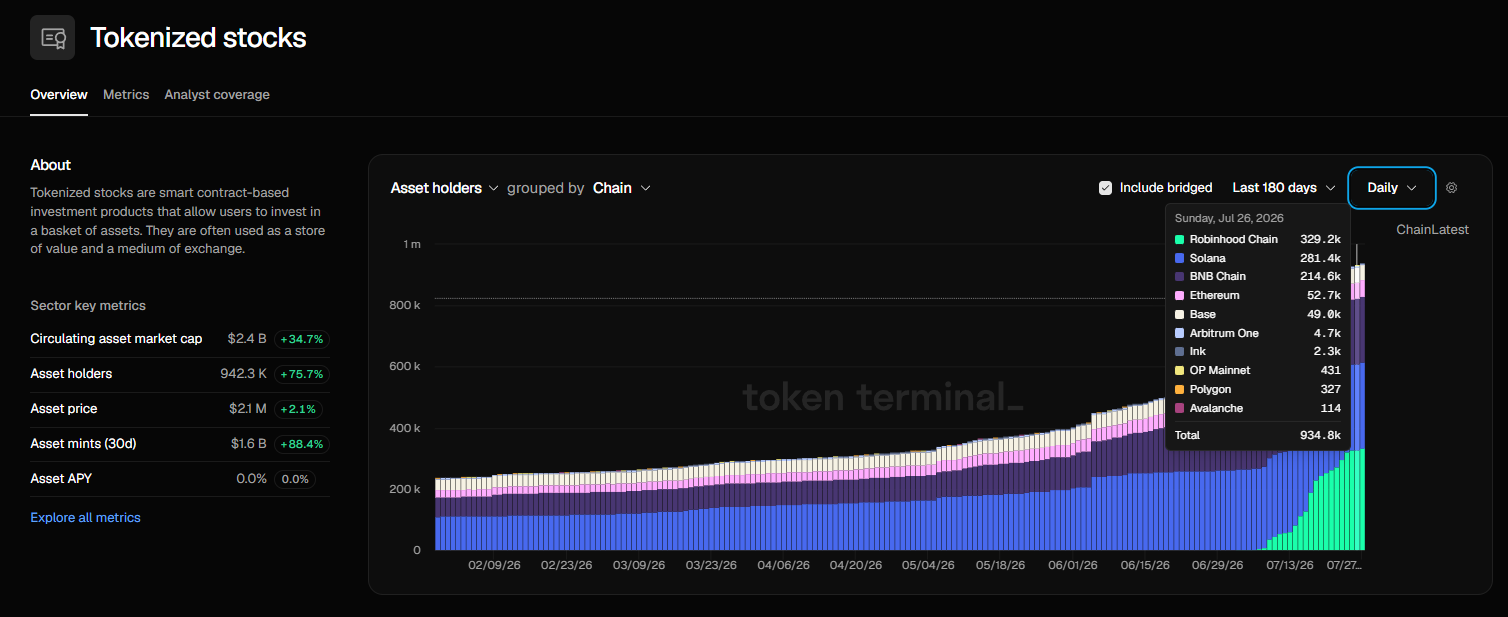
Token Terminal said the broader tokenized-stock market grew from 554,900 holders at the start of the month to 934,800, an increase of approximately 68.5%. DWF Labs used a different market measurement and said the number of tokenized-equity holders had exceeded 752,000 after rising 92% over 30 days.
The two datasets produced different estimates of Robinhood’s market share. Token Terminal’s broader holder total placed Robinhood at about 35% of the sector, while DWF Labs calculated a 44% share. The datasets used different definitions, coverage or collection points and therefore cannot be treated as a single denominator.
Solana had led the category for most of the previous year as established networks gradually accumulated tokenized-stock users. Robinhood overtook those networks after placing the products inside an existing brokerage environment rather than requiring customers to enter a separate crypto-native application.
Token Terminal said Robinhood’s holder count rose almost vertically during the month, contrasting with the more gradual expansion recorded across other networks. “That didn't happen overnight,” Token Terminal said, attributing the result to more than a decade spent building Robinhood’s retail platform.
Robinhood Converts Brokerage Reach Into Onchain Holders
Robinhood’s brokerage customer base of about 28 million users gave the company a large existing audience for tokenized equities. Customers could access the products through a familiar financial application without separately creating a self-custody wallet, bridging assets, acquiring gas tokens, sourcing blockchain-native collateral or navigating a decentralized exchange.
The distribution model allowed customers to gain exposure through a process resembling a conventional brokerage purchase. Robinhood therefore did not need to build its initial holder base exclusively from existing cryptocurrency users or persuade traditional investors to begin with unfamiliar onchain infrastructure.
Approximately 1.2% of Robinhood’s brokerage customer base would be represented by 329,200 tokenized-stock holders if each address corresponded to one unique customer. Wallet counts, however, do not necessarily equal individual users because a person may control more than one address or position.
Robinhood’s adoption demonstrates the strength of customer access and product distribution, but its holder lead does not establish leadership in liquidity, assets under management, institutional participation or total economic activity.
We’ve launched the all-new COIN360 Perp DEX, built for traders who move fast!
Trade 130+ assets with up to 100× leverage, enjoy instant order placement and low-slippage swaps, and earn USDC passive yield while climbing the leaderboard. Your trades deserve more than speed — they deserve mastery.
Robinhood Leads in Breadth but Not Asset Value
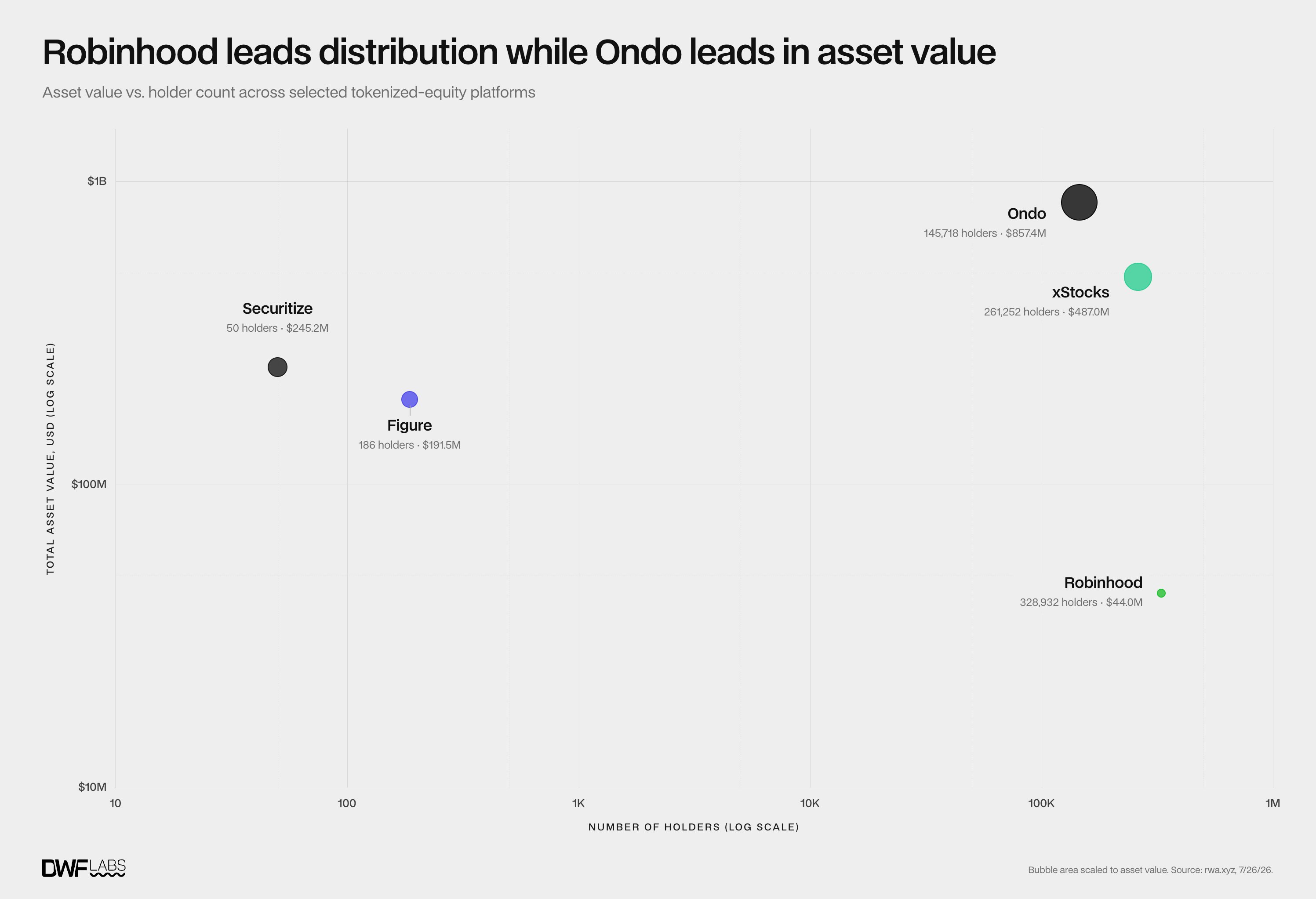
Robinhood’s tokenized-stock assets were valued at about $44 million, giving the platform a large number of holders with relatively small positions. Average holdings were calculated at slightly more than $130 per wallet using Token Terminal’s holder figure, while DWF Labs estimated $134 per holder.
Ondo held about $857 million in tokenized assets, nearly 19.5 times Robinhood’s total. xStocks held approximately $487 million, more than 11 times Robinhood’s value.
Securitize represented the opposite end of the ownership spectrum. Its average position was about $4.9 million across only 50 holders, indicating a much smaller account base with substantially larger balances. The average Securitize account was roughly 36,500 times the size of Robinhood’s estimated average account.
DWF Labs said the market’s ownership patterns reflected the different audiences served by each issuer. “There’s a clear split in holder base across issuers. Securitize and Figure lean institutional. Robinhood towards retail. xStocks and Ondo have a mix of both through strategic integrations and partnerships.”
The holder figures therefore show Robinhood leading the retail distribution race while platforms with smaller user bases continue to hold more capital. Robinhood’s position is broad but financially shallow, while the reported balances on Ondo, xStocks and Securitize reflect deeper average allocations.
Small Robinhood balances were consistent with users opening modest positions in recognizable stocks such as Tesla or Nvidia. The holder data did not show comparable adoption of large portfolios or institutional-sized allocations.
Robinhood’s existing user base could support higher tokenized-stock totals if customers increase their position sizes. An average balance of $500 across the current holder base would represent approximately $164.6 million, while a $1,000 average would represent about $329.2 million.
Matching xStocks’ reported value at the current holder count would require an average balance of approximately $1,479. Reaching Ondo’s total would require an average balance of about $2,604.
Those scenarios illustrate the gap between acquiring users and attracting capital. Holder growth can continue without materially changing Robinhood’s financial position if average balances remain close to current levels.
Meme Coins Hold More Value Than Tokenized Stocks
Meme coins remained the dominant assets on Robinhood Chain even as tokenized equities drove its holder growth. Pons, trading under the PONS ticker, overtook Cash Cat as the network’s largest token by market capitalization.
PONS reached a market capitalization of approximately $44.68 million and generated about $11.4 million in 24-hour trading volume. Its market value alone slightly exceeded the value assigned to Robinhood’s entire tokenized-stock segment.
CASHCAT ranked second with a market capitalization of approximately $39.90 million. The token had exceeded $200 million on July 11, 2026, when it was the chain’s largest asset, meaning its value had fallen by at least 80% from that level.
TENDIES ranked third with a market capitalization of about $11.17 million. The three named meme coins held a combined value of approximately $95.75 million, with PONS and CASHCAT accounting for about $84.58 million.
Robinhood Chain’s 10 largest tokens held roughly $123 million in combined value, nearly three times the value of its tokenized-stock segment. The three largest named meme coins accounted for about 78% of that top-token total.
The figures show two separate forms of activity developing on the network. Tokenized equities are adding holders through Robinhood’s brokerage distribution, while meme coins continue to account for more speculative value and immediate trading activity.
Robinhood Chain has therefore not developed solely as a tokenized-equity network. Its largest assets remain speculative tokens, while the stock products provide a direct connection to Robinhood’s established brokerage business and retail customer base.
FAQ
Why does Robinhood lead the tokenized-stock market?
Robinhood used its existing brokerage platform to distribute tokenized equities to a large retail audience.
Does Robinhood hold the most tokenized-stock value?
No. Ondo and xStocks hold substantially more tokenized-asset value.
Are Robinhood’s tokenized-stock holders mainly institutional?
DWF Labs characterized Robinhood’s holder base as retail-oriented.
What currently dominates Robinhood Chain by asset value?
Meme coins, including PONS, CASHCAT and TENDIES, hold more value than tokenized stocks.
This article has been refined and enhanced by ChatGPT.


