




 USD
USD
RWA and Privacy Tokens Outpace Every Crypto Narrative in 2025 as Institutional Capital Shifts


From speculative hype to real-world value, tokenized and privacy assets dominate returns
TL;DR
- Real World Asset (RWA) tokens emerged as the top-performing crypto narrative in 2025, posting average gains of about 186% while most other sectors recorded steep losses.
- Institutional adoption, regulatory progress, and maturing tokenization infrastructure—not retail speculation—drove RWA’s outperformance.
- Grayscale identified Chainlink as critical infrastructure for scaling RWA tokenization, estimating the sector could grow up to 1,000× from current levels.
We’ve just launched the all-new COIN360 Perp DEX, built for traders who move fast!
Trade 130+ assets with up to 100× leverage, enjoy instant order placement and low-slippage swaps, and earn USDC passive yield while climbing the leaderboard. Your trades deserve more than speed — they deserve mastery.
Real World Assets became the defining crypto narrative of 2025, delivering performance that sharply diverged from the broader digital asset market and signaling a decisive shift in investor priorities. Data aggregated across major crypto narratives showed RWA-linked tokens recording average year-to-date gains of roughly 186%, placing them far ahead of every other sector. By contrast, Layer 1 networks gained around 80%, U.S.-focused crypto narratives advanced about 30.6%, and nearly all speculative segments—including AI tokens, memecoins, DeFi, Layer 2 networks, GameFi, and DePIN—ended the year deeply in negative territory. Losses across those categories ranged from roughly 30% to more than 75%, underscoring how isolated RWA’s performance was in an otherwise challenging market environment.
Market observers described the divergence as a clear rotation away from momentum-driven themes that dominated 2024 and toward assets tied more directly to real economic activity and institutional participation. AI-related tokens fell by about 50% over the year, memecoins declined more than 30%, DeFi dropped nearly 35%, and decentralized exchange tokens slid more than 55%. Layer 2 ecosystems lost over 40%, while GameFi and DePIN registered some of the steepest drawdowns, approaching 75%. Even ecosystems that had previously benefited from strong retail interest, such as Solana-based narratives, ended the year down more than 60%. Against that backdrop, RWA’s gains stood out not only for their magnitude but for what they suggested about where capital was moving.
The drivers behind the RWA surge differed materially from prior crypto cycles. Rather than being fueled by short-term retail speculation, the narrative was supported by growing institutional involvement, improving regulatory clarity, and the maturation of infrastructure required to bridge on-chain systems with traditional financial markets. Tokenization of real-world assets—ranging from bonds and funds to equities and other financial instruments—was increasingly viewed as a long-term structural shift rather than a niche experiment. Analysts pointed to the appeal of blockchain-based settlement, round-the-clock markets, and programmable financial instruments as factors attracting institutional capital during a period when risk appetite for purely speculative tokens had waned.
Grayscale Investments added weight to that interpretation in late December, when its head of research, Zach Pandl, outlined the firm’s view on the future of RWA tokenization. Pandl highlighted Chainlink as essential infrastructure for the sector, describing it as the connective layer that enables blockchains to interact reliably with off-chain data and traditional financial systems. Grayscale has already moved to convert its Chainlink investment vehicle into an exchange-traded fund, a step aimed at making exposure to the protocol more accessible within regulated investment frameworks. The firm has also been expanding its ETF lineup beyond Bitcoin and Ethereum to include assets such as XRP, Solana, Dogecoin, and Chainlink, reflecting broader institutional interest across crypto subsectors tied to infrastructure and real-world integration.
Pandl framed recent market pullbacks in flagship assets like Bitcoin as routine rather than alarming, noting that drawdowns of 10% to 30% have historically been common even during long-term uptrends. His focus remained on the scale of opportunity implied by tokenization itself. According to Grayscale’s estimates, tokenized real-world assets currently represent only about $30 billion to $35 billion of the roughly $300 trillion global equity and bond markets. That disparity, Pandl argued, leaves room for growth on the order of hundreds or even thousands of times as traditional finance increasingly adopts blockchain-based rails. He suggested that, over the next five years, tokenized assets could expand by as much as 1,000× if institutional adoption continues and regulatory frameworks remain supportive.
Developments in tokenized equities reinforced the broader narrative. On-chain representations of stocks built on high-throughput networks reached new highs toward the end of the year, with total value on some platforms climbing to around $185 million. Infrastructure providers and issuers emphasized regulatory alignment, faster settlement, and lower operational costs as key selling points, positioning tokenized equities as complements rather than competitors to traditional markets. The growth of these products added another data point supporting the idea that real-world financial instruments are gradually migrating on-chain, aligning closely with the momentum seen across RWA-focused tokens.
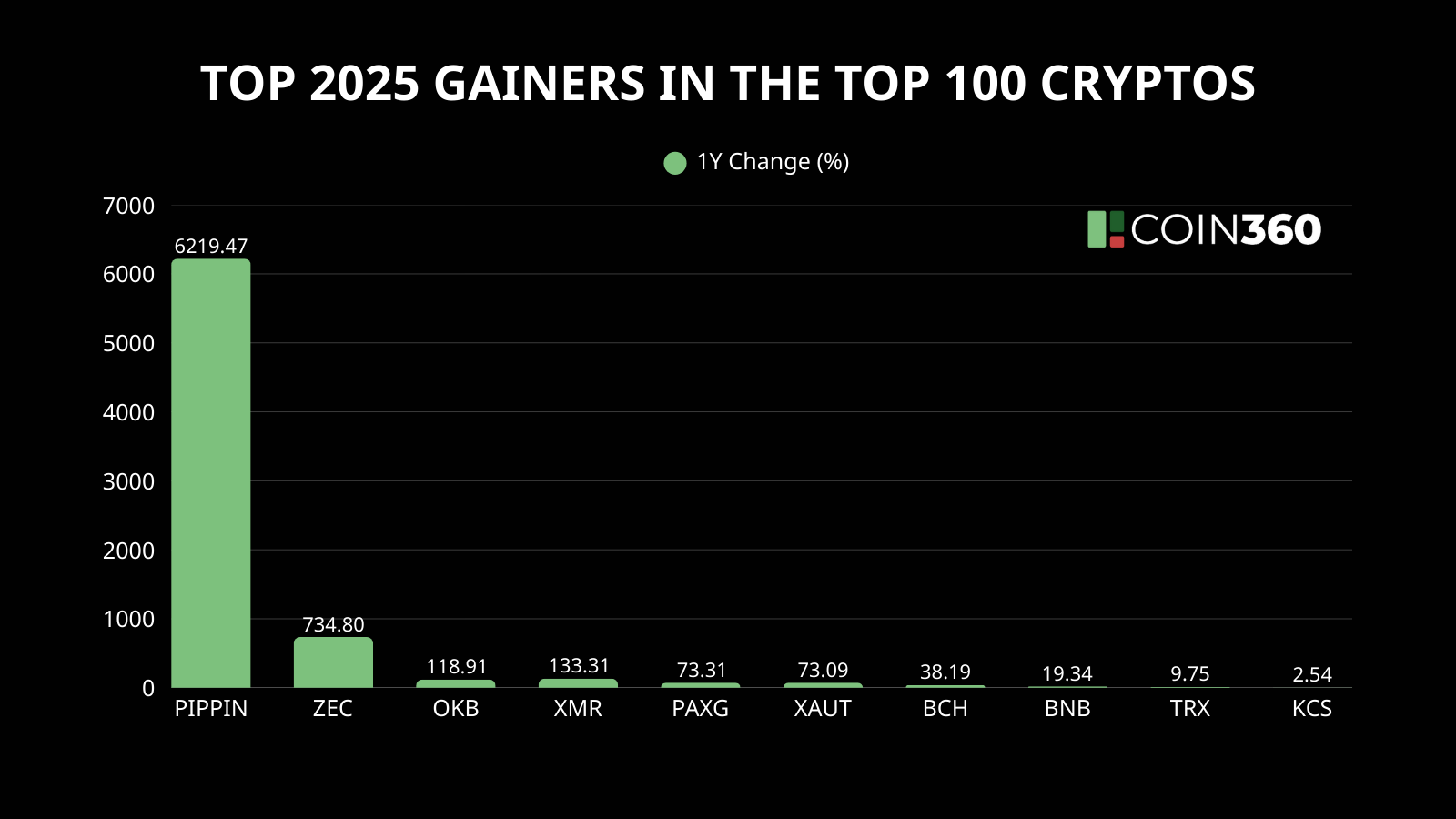
Another narrative quietly delivering outsized returns in 2025 was privacy-focused cryptocurrencies, which emerged as one of the strongest-performing sectors of the year despite limited mainstream attention. Privacy coins such as Zcash (ZEC) and Monero (XMR) recorded sharp year-end price increases, placing them among the biggest gainers within the top 100 cryptocurrencies on a year-to-date basis. Market data showed privacy assets outperforming most major sectors as renewed interest in censorship resistance, transaction confidentiality, and financial autonomy gained traction amid tightening regulatory scrutiny and increased on-chain surveillance across public blockchains.
This article has been refined and enhanced by ChatGPT.


