




 USD
USD
SBF Drops New Trial Bid, Maintains Judge Removal Request as $114B FTX Counterfactual Surfaces

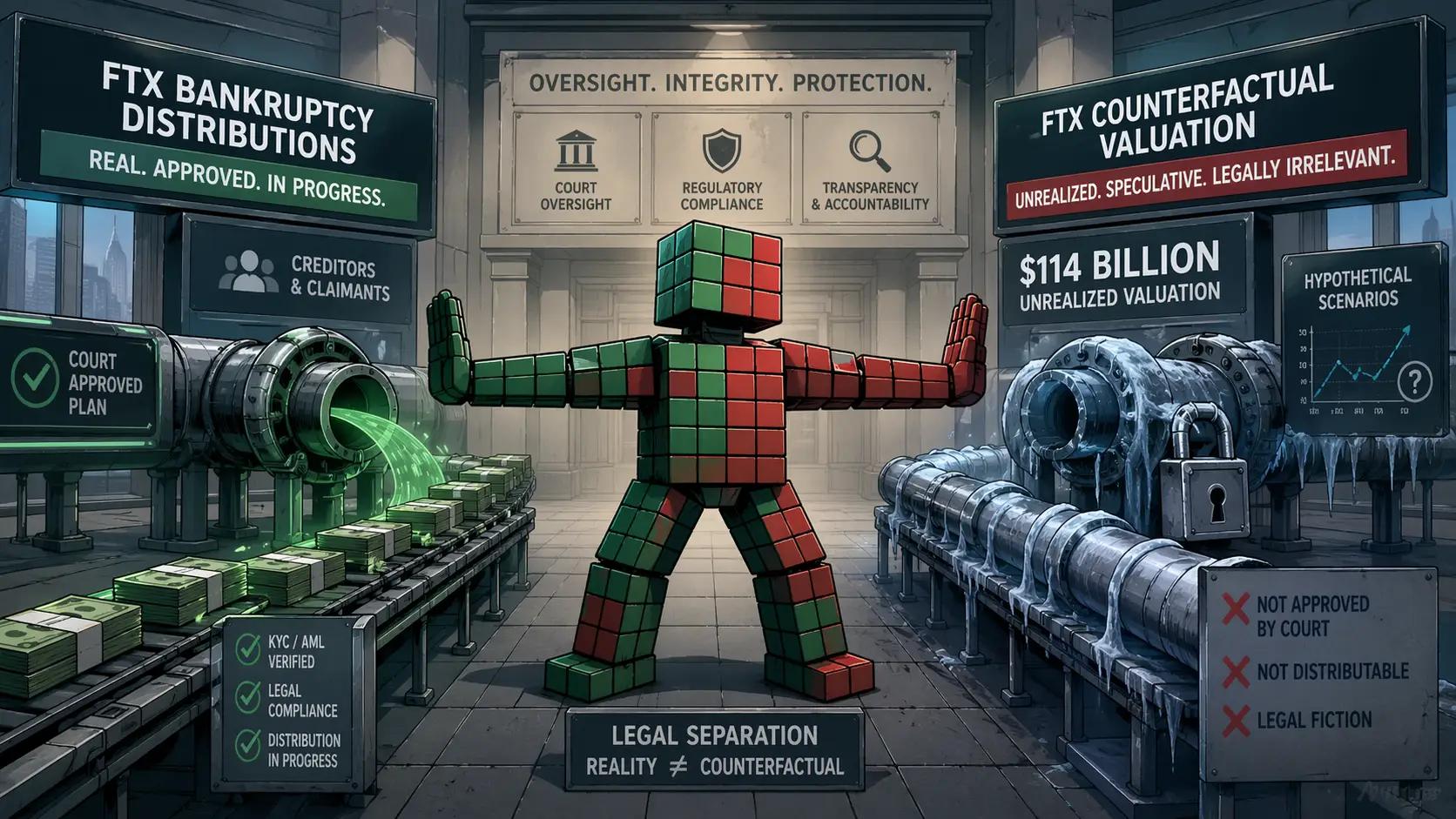
Convicted Founder Files From Prison Days After Analysis Projects $114 Billion in Unrealized Estate Value
TL;DR
- Sam Bankman-Fried withdrew his Rule 33 motion for a new trial Wednesday in federal court, preserving the right to refile after his direct appeal concludes, while keeping a separate request for a new judge alive.
- An analysis published April 23, 2026 projects FTX's estate would hold $114 billion today had six key venture positions — dominated by Anthropic at $82.3 billion — not been liquidated during bankruptcy.
- Creditors are being repaid at petition-date valuations under US bankruptcy law; the $114 billion figure changes nothing about recoveries, and the FTX Recovery Trust has already returned more than $6 billion.
We’ve launched the all-new COIN360 Perp DEX, built for traders who move fast!
Trade 130+ assets with up to 100× leverage, enjoy instant order placement and low-slippage swaps, and earn USDC passive yield while climbing the leaderboard. Your trades deserve more than speed — they deserve mastery.
Sam Bankman-Fried, the convicted founder of the collapsed FTX crypto exchange, withdrew his motion for a new trial in a Wednesday filing in the US District Court for the Southern District of New York, while separately preserving his pending request for a new judge and continuing to pursue his appeal of his conviction and 25-year sentence. The filing arrived on the same day his X account published an analysis projecting that FTX's bankruptcy estate would be worth approximately $114 billion today had lawyers not liquidated early positions in Anthropic, SpaceX, Solana, Robinhood, Genesis Digital Assets, and Cursor during the wind-down process.
Bankman-Fried is currently housed at the Federal Correctional Institution, Lompoc I, in California, where he has been serving his sentence following a November 2023 conviction on seven counts of fraud and charges related to the misuse of customer funds at FTX.
SBF Withdraws Rule 33 Motion, Cites Bias and Procedural Conflict
The withdrawal of the Rule 33 new trial motion was framed by Bankman-Fried as both a procedural response and an expression of distrust toward the presiding judge. Judge Lewis Kaplan had issued a March 23 order demanding that Bankman-Fried explain whether he received legal assistance in drafting an earlier pro se filing — a motion submitted on his own behalf, without an attorney — after US prosecutors raised doubts about whether Bankman-Fried had filed it independently. The scrutiny followed a separate letter sent to the court by his mother, Barbara Fried, who lacked standing to submit it.
Bankman-Fried confirmed in the filing that he consulted his parents while drafting the extension request. "I am the author of this letter, but did consult with my parents about it, since it concerns both of them," he wrote, before explaining his decision to pull the motion: "As I have had to focus on responding to these questions rather than drafting a response to the prosecution's opposition, and because I do not believe I will get a fair hearing on this topic in front of you, I am now requesting to withdraw the Rule 33 motion, without prejudice to renewing it after my direct appeal and the related request for reassignment have been ruled upon."
The Rule 33 motion, now withdrawn, had alleged that the Biden-era Justice Department "threatened multiple witnesses into silence or into changing their testimony" at Bankman-Fried's criminal trial. A separate February filing requesting that a different judge handle the case — on grounds that Kaplan showed "extreme prejudice" — was not affected by Wednesday's withdrawal and remains pending. Bankman-Fried's appeal of his conviction and sentence in the US Court of Appeals for the Second Circuit also remains active.
On the question of a presidential pardon, Donald Trump stated in a January New York Times interview that he had no intention of pardoning Bankman-Fried, despite the convicted founder publicly praising Trump's crypto policies and military actions in Iran through posts on X since his incarceration.
The $114 Billion Counterfactual: What FTX Left on the Table
The analysis, posted April 23, 2026, assembled a back-of-envelope projection of what FTX's estate would hold today if the six most significant venture positions had never been sold. The figures illustrate an order-of-magnitude appreciation across nearly every position since the liquidations were executed.
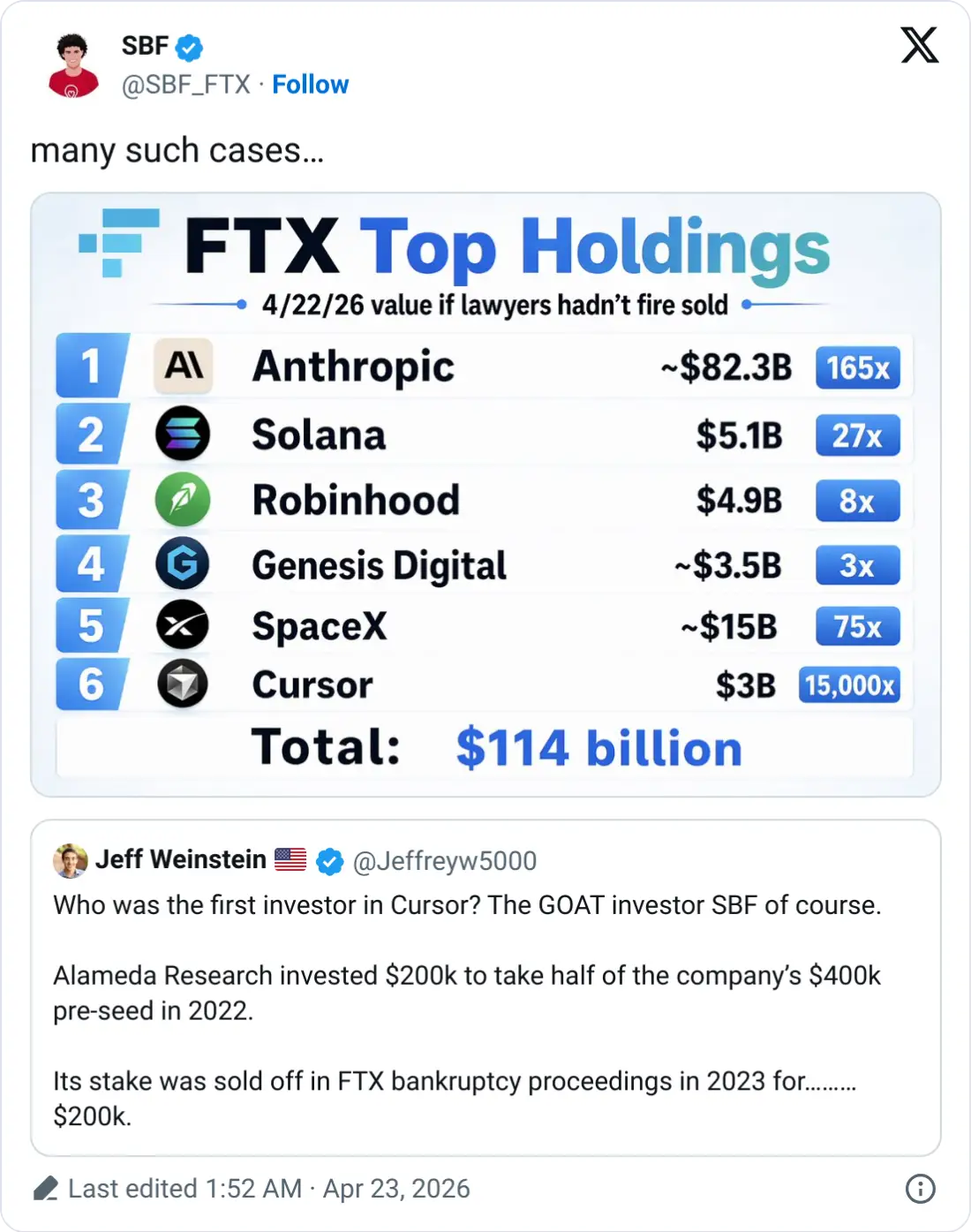
Anthropic accounts for over 70% of the $114 billion total. FTX's original Anthropic position was acquired for $500 million, representing approximately 13.56% ownership at the time of investment; subsequent funding rounds diluted the stake to approximately 7.8% by the time the bankruptcy estate exited it. The position was sold in two tranches in 2024 — $884 million in the first and $450 million in the second — generating $1.34 billion in total, which became one of the largest single liquidity events for the estate.
Bankman-Fried has publicly attacked the handling of that specific sale, posting on X: "The lawyer who filed FTX for bankruptcy said Anthropic was worth 'nothing' and sold the stake for $1.3b." He went further in a separate post: "FTX was never bankrupt. I never filed for it. The lawyers took over the company and 4 hours later they filed a bogus bankruptcy so they could pilfer it for money."
On the Solana side, FTX and its trading arm Alameda Research originally held approximately 58 million SOL tokens. Bankruptcy administrators sold between 25 and 30 million of those locked tokens in 2024 at $64 each, raising approximately $1.9 billion, with Galaxy Trading and Pantera Capital among the buyers. According to COIN360 crypto price data, SOL was trading at $86.62 on April 23, 2026 — with BTC at $78,269.74, up 4.97% on the week, and ETH at $2,366.42. The Fear and Greed Index printed 61, placing sentiment in Greed territory on the same day the counterfactual analysis was published.
Why the $114 Billion Does Not Change Creditor Recoveries
The legal architecture of the FTX bankruptcy insulates creditor outcomes from the counterfactual entirely. When FTX filed for Chapter 11 in November 2022, Bitcoin was trading around $16,000 and SOL was below $15.
Under US bankruptcy precedent, creditor obligations are fixed in dollar terms at the petition date, meaning any appreciation above those petition-date valuations accrues to the estate rather than to customers. The Sullivan and Cromwell team running the FTX wind-down operated under a fiduciary duty to convert assets to cash quickly enough to fund the case and pay creditors — not to manage a venture portfolio with an eye toward maximum value capture.
That structure produced what has been described as a legally defensible but commercially costly outcome. Several creditor groups challenged specific Solana OTC sales at the time of execution, arguing that lockup discounts were priced too aggressively; those objections were largely overruled.
The $114 billion figure does not reopen those rulings. The FTX Recovery Trust had already distributed more than $6 billion to creditors as of late March 2026, following a $2.2 billion repayment tranche that began on March 31. Customers are being made whole at petition-date dollar values plus interest — the applicable legal standard — regardless of where the underlying assets have traded since.
The analysis explicitly flags the figure as a counterfactual rather than a live balance sheet, and notes that its full methodology was not published. Applying current private-market marks and live crypto price index data to disclosed position sizes is the core math behind the number; it produces a large result primarily because Anthropic's valuation has moved by an order of magnitude since 2023.
FAQ
Does the $114 billion projection mean FTX creditors will receive more money?
No. Creditor claims are fixed at petition-date valuations under US bankruptcy law; estate appreciation does not increase individual recoveries.
What legal actions does Bankman-Fried still have pending?
His request for a new judge and his appeal of conviction and sentence in the Second Circuit both remain active.
How much has the FTX estate already paid out to creditors?
The FTX Recovery Trust has returned more than $6 billion, including a $2.2 billion tranche that began March 31.
Is a presidential pardon possible for Bankman-Fried?
Donald Trump stated in January he had no intention of pardoning Bankman-Fried.
This article has been refined and enhanced by ChatGPT.


