




 USD
USD
SEC, CFTC Declare Most Crypto Assets Non-Securities in 68-Page Joint Guidance as CLARITY Act Debate Intensifies


Regulators Outline Five-Category Token Framework, Classify Major Assets as Commodities While Lawmakers Remain Deadlocked
TL;DR
- SEC and CFTC issued a 68-page joint interpretation on March 17, 2026, stating most crypto assets are not securities and introducing a five-part taxonomy
- Major tokens including BTC, ETH, SOL, XRP, ADA, AVAX, DOT, LINK, DOGE, SHIB classified as digital commodities
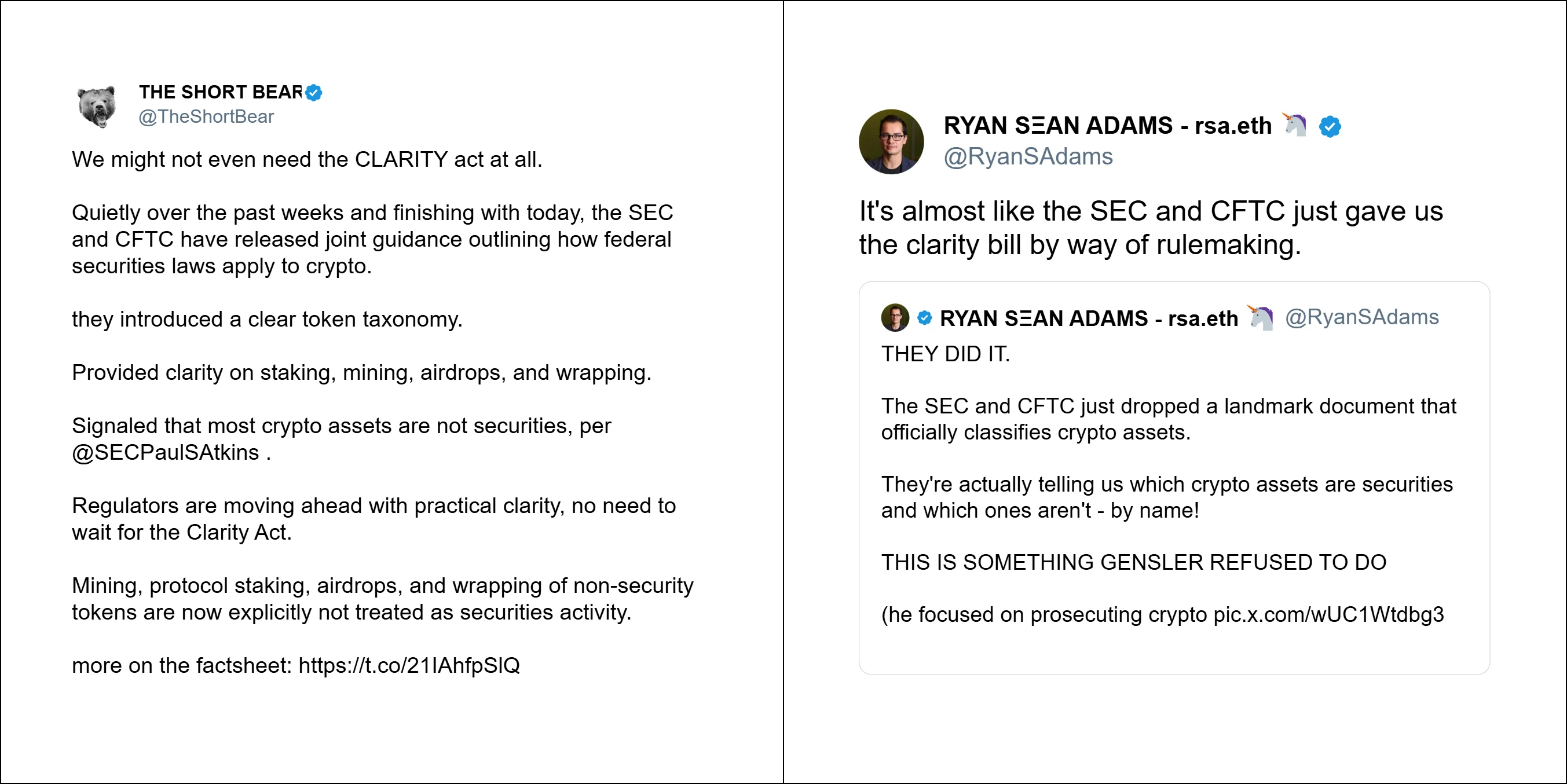
- Market commentators raised questions as the guidance looks heavily overlapped with CLARITY Act provisions, which passed the House 294–134 in July 2025 but remains stalled in the Senate
We’ve launched the all-new COIN360 Perp DEX, built for traders who move fast!
Trade 130+ assets with up to 100× leverage, enjoy instant order placement and low-slippage swaps, and earn USDC passive yield while climbing the leaderboard. Your trades deserve more than speed — they deserve mastery.
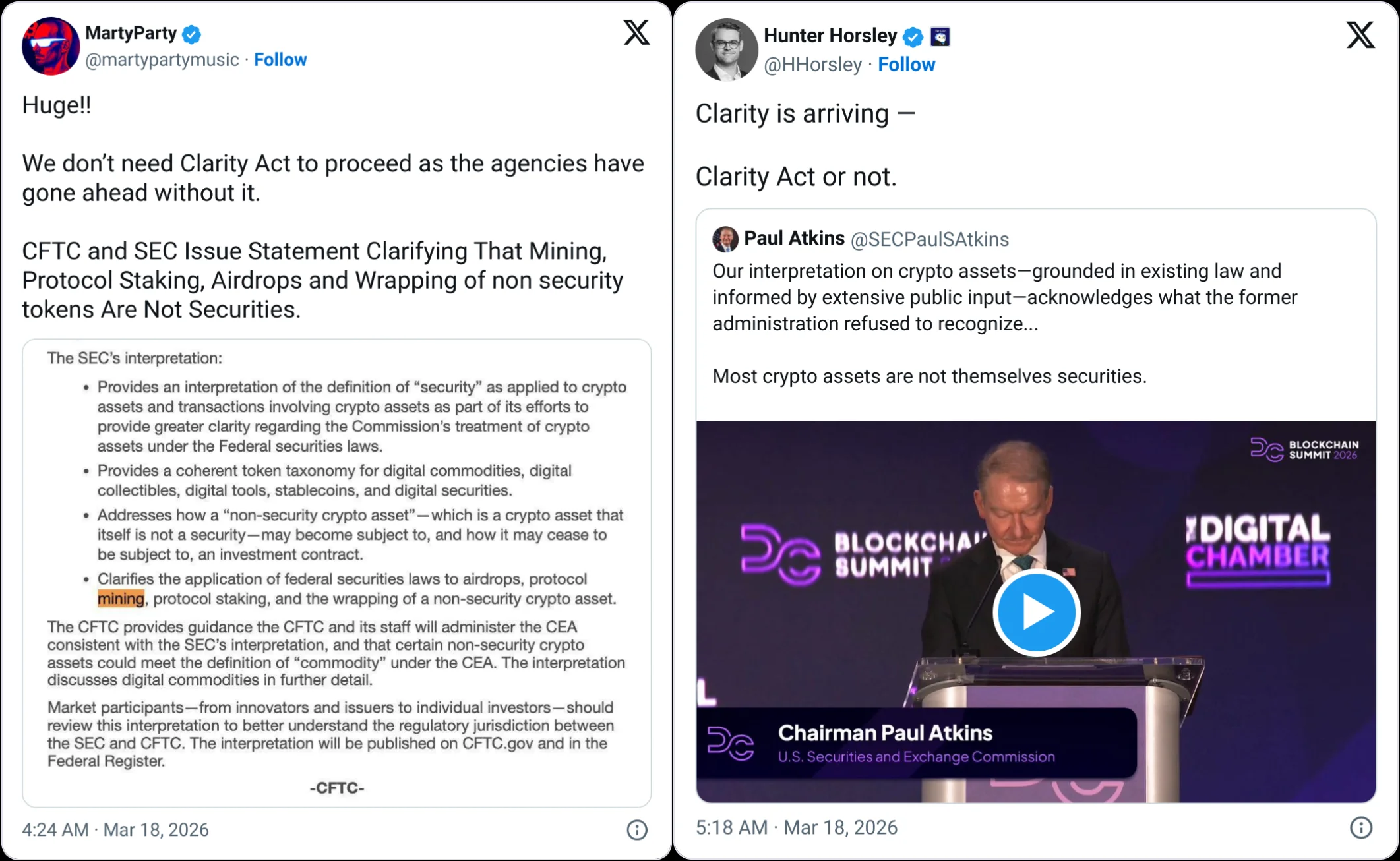
The U.S. Securities and Exchange Commission and the Commodity Futures Trading Commission jointly released a 68-page interpretive guidance on March 17, 2026, establishing that most crypto assets fall outside securities classification and introducing a formal taxonomy dividing digital assets into five categories: digital commodities, digital collectibles, digital tools, stablecoins, and digital securities. Only digital securities remain under SEC jurisdiction, while other categories shift primarily toward CFTC oversight. The interpretation explicitly names Bitcoin, Ether, Solana, XRP, Cardano, Avalanche, Polkadot, Chainlink, Dogecoin, and Shiba Inu as digital commodities.
Specifically, digital commodities, which gain value from decentralized systems and open market dynamics, are categorized as non-securities. Examples include Bitcoin, Ether, Solana, and XRP. Similarly, digital collectibles like NFTs that represent ownership rights to art, music, or trading cards also fall into this category. Additionally, digital tools serving as memberships, tickets, or identity credentials—such as ENS domains—are included in the non-security classification. Payment stablecoins that adhere to the GENIUS Act complete this group of non-securities.
The framework introduces what regulators describe as an “attach-and-detach” doctrine, under which a token may initially qualify as a security during fundraising phases but later transition out of that classification once its underlying network becomes functional and independent. The interpretation outlines a lifecycle model distinguishing between early-stage investment contracts and mature tokens operating within decentralized systems, formalizing a concept that has previously been debated in court but not codified through regulatory interpretation.
Additional provisions extend beyond classification to address network activities including staking, airdrops, and mining, placing them within defined regulatory boundaries. These inclusions establish clearer treatment for participation-based activities that had previously been subject to enforcement ambiguity, particularly in cases involving validator rewards and token distribution mechanisms tied to protocol operation.
The guidance arrives as lawmakers continue to debate the Digital Asset Market CLARITY Act of 2025, which passed the House of Representatives with a 294–134 bipartisan vote in July 2025 but has yet to advance through the Senate. Legislative delays have been attributed to disagreements between traditional financial institutions and crypto firms, particularly concerning stablecoin yield structures, as well as procedural fragmentation between Senate committees, including a separate draft introduced by the Senate Agriculture Committee on Jan. 29.
Regulatory officials framed the joint interpretation as a response to prolonged uncertainty. SEC Chairman Paul Atkins said, “After more than a decade of uncertainty… this interpretation will provide market participants with a clear understanding… This is what regulatory agencies are supposed to do: draw clear lines in clear terms.” CFTC Chairman Michael Selig stated, “For far too long, American builders… have awaited clear guidance… With today’s interpretation, the wait is over.”
Policy analysts note that the interpretation delivers substantial overlap with provisions proposed in the CLARITY Act, including a formal token classification system, a delineation of SEC and CFTC jurisdiction, and recognition of non-security activities such as staking and mining. The guidance does not establish statutory authority or enforcement frameworks, leaving areas such as exchange registration, broker compliance, and anti-money laundering requirements unaddressed within the interpretive document.
Legal observers have emphasized that the interpretation does not replace legislative action, as it remains subject to revision and does not carry the same enforceability as congressional statutes. The CLARITY Act includes provisions for formal registration regimes covering digital commodity exchanges and intermediaries, as well as compliance obligations for entities interacting with decentralized finance protocols.
Still, debate continues among policy experts over whether the joint guidance reduces the urgency for congressional action or reinforces the need for statutory clarity. The interpretive framework establishes definitions and jurisdictional boundaries within existing regulatory authority, while pending legislation would formalize those structures into law.
This article has been refined and enhanced by ChatGPT.


