




 USD
USD
SEC Tokenized Stock Exemption Could Reshape Equity Trading

Crypto platforms may get limited pathway for tokenized securities
TL;DR
- The SEC is preparing an innovation exemption for tokenized stocks.
- The framework could allow crypto platforms to test tokenized securities trading.
- Investor rights, counterparty risk and market fragmentation remain key concerns.
Trade smarter on Jupiter, Solana’s leading DEX built for fast execution and deep liquidity.
Swap tokens at competitive rates, route across multiple liquidity sources automatically, and access perpetuals, DCA, and advanced trading tools — all in one place!
The U.S. Securities and Exchange Commission is preparing an “innovation exemption” that could allow tokenized stocks to trade through crypto-native infrastructure, creating a temporary pathway for digital versions of securities while longer-term rules are developed.
The planned framework would let qualifying firms test tokenized securities trading on novel venues, including automated market makers and potentially public permissionless blockchains. The exemption would operate under defined limits rather than immediately opening unrestricted on-chain stock trading.
SEC Chair Paul Atkins and Commissioner Hester Peirce outlined the concept in February as a temporary, limited framework with volume caps, white-listed buyers and sellers, automated market makers and temporary relief while the agency builds longer-term regulation. Atkins said in April that the agency was “on the cusp” of releasing a cabined framework for compliant on-chain trading of tokenized securities.
Tokenized Stocks Would Not Necessarily Match Shareholder Rights
Tokenized stocks are digital representations of the public shares they track, but the framework may allow tokens that are not backed or approved by the underlying public companies. These instruments may function more like blockchain-based price exposure products than direct shareholder instruments.
The distinction matters because tokenized equity products may not grant traditional shareholder rights such as voting power or dividends. SEC staff defined tokenized securities in January 2026 as traditional securities represented as crypto assets, with crypto networks maintaining ownership records in whole or in part.
The legal status of the asset follows it regardless of whether it sits on a blockchain or in a traditional securities account. The framework could embed compliance into smart contracts, including resale restrictions, issuer-holder communications, eligibility rules, transfer restrictions and automated compliance logic applied directly at the moment of transfer.
Tokenization is being framed as an extension of securities-market plumbing upgrades after U.S. equities moved from T+2 to T+1 settlement in 2024. Tokenized equities could push that shift further by enabling longer trading windows, near-instant settlement, fractional access and programmable post-trade processing.
Nasdaq received SEC approval in March 2026 to allow certain DTC-eligible securities to trade in tokenized form on the same order book as traditional shares while preserving T+1 settlement. ICE, the parent company of the New York Stock Exchange, is developing a tokenized securities platform targeting 24/7 operations, instant settlement, dollar-sized orders and stablecoin-based funding, pending regulatory approval.
Coinbase sought SEC approval in 2025 to offer tokenized equities, which would put the crypto exchange in direct competition with retail brokerages if the SEC gives crypto-native platforms a viable U.S. pathway. Kraken’s xStocks platform already offers 100 fully backed tokenized U.S. stocks and ETFs outside the U.S. market, while Robinhood has launched EU stock tokens and is building a layer-2 blockchain for real-world asset tokenization.
We’ve launched the all-new COIN360 Perp DEX, built for traders who move fast!
Trade 130+ assets with up to 100× leverage, enjoy instant order placement and low-slippage swaps, and earn USDC passive yield while climbing the leaderboard. Your trades deserve more than speed — they deserve mastery.
Market Structure Risks Remain Unresolved
The biggest market-structure risk is fragmentation, because multiple third parties could issue different tokenized versions of the same public stock. A Microsoft-linked token on one venue may not carry the same legal claim or investor rights as another Microsoft-linked token elsewhere.
Robinhood’s EU stock-token disclosures show the legal-risk gap because those instruments are described as derivatives that expose investors to counterparty and insolvency risks tied to Robinhood’s financial position.
Peirce warned that third-party tokenized stocks can expose holders to counterparty and insolvency risks tied to the tokenizing intermediary’s own financial position. That concern gives regulators a reason to keep crypto-native pilots narrow if investor-protection concerns dominate.
The World Federation of Exchanges, whose members include Nasdaq, Cboe and CME Group, warned the SEC in a November 2025 letter that exemptions could “dilute” existing investor protections and “distort” competition by giving crypto exchanges a regulatory shortcut unavailable to traditional markets.
The World Federation of Exchanges also warned that granting legitimacy to tokenized stocks before full compliance implementation would “undoubtedly have negative – potentially acute – consequences” for U.S. markets.
Tokenized stocks remain a small part of the wider tokenized real-world asset market, with one dataset placing tokenized equities at about $1.43 billion and just over 4% of tokenized RWAs on-chain. Another cited figure puts the segment at $1.45 billion and a 4.3% share of distributed TVL.
Tokenized U.S. Treasuries remain the dominant RWA category, representing 46% of a $15.5 billion segment. Ethereum and its layer-2 networks account for more than 60% of tokenized RWA market share, while the broader on-chain RWA market is close to $30 billion, equal to only 0.02% of SIFMA’s 2024 global equity market capitalization of $126.7 trillion.
DeFi analyst Ignas said the development could benefit tokenization and on-chain finance projects including Ondo Finance, Centrifuge, Pendle, Hyperliquid, Aave, Morpho and Fluid, especially lending protocols that accept tokenized collateral.
Token Terminal said, “We’ve entered a global race to tokenize money and capital markets,” and argued that the economic advantages of asset tokenization are strong enough that other major nations and economic zones will try to follow the U.S. playbook on stablecoins and asset tokenization.
Token Terminal also said the U.S. is effectively “all in” on tokenization because tokenized dollars can increase demand for Treasuries while tokenized securities can expand access to U.S. financial markets globally.
Ondo Finance is positioned as a major beneficiary of the SEC’s move because Ondo Global Markets reportedly holds more than 70% market share in tokenized equities, offers more than 260 live assets and has processed more than $18 billion in cumulative trading volume.
Ondo has pursued a multi-chain strategy across Solana, Hyperliquid, Ethereum, BNB Chain and other networks. Recent institution-grade adoption included partnerships with Mastercard, BlackRock and Fidelity.
Ondo Finance was also tied to a recent 24/7 tokenized treasury settlement involving Ripple, Mastercard, J.P. Morgan and Ondo Finance. The settlement highlighted how tokenized securities infrastructure is being tested across crypto rails and major financial institutions.
An Ondo Finance executive said, “I wouldn’t be surprised if we surpassed $5 billion by year-end. We have a lot of interest, and we’re building up quite a pipeline.”

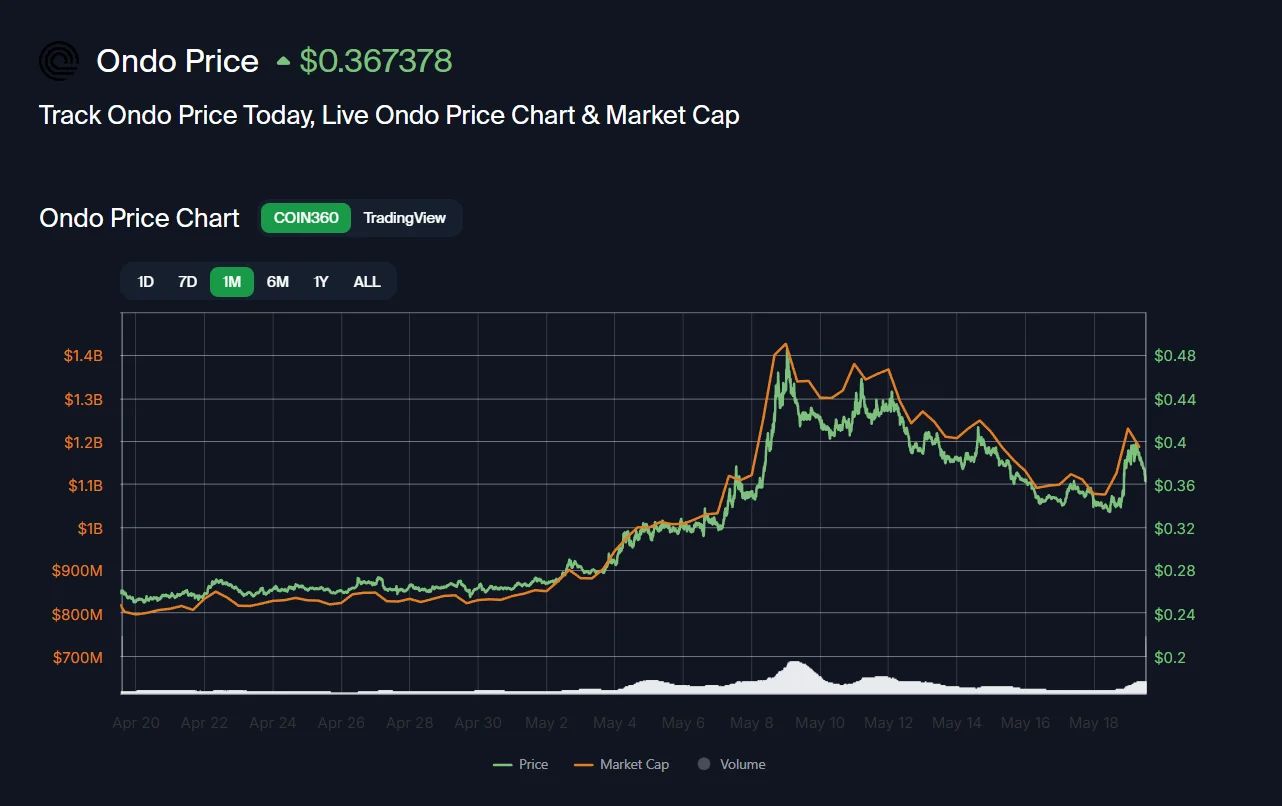
ONDO reached $0.38 after a 13% rally in 24 hours and extended its monthly gain to 49%, though it remained far below its 2024 all-time high of $2.14.
FAQ
What is the SEC preparing?
An innovation exemption for tokenized stocks trading through crypto-native infrastructure.
Would tokenized stocks always include shareholder rights?
No. They may not grant voting power or dividends.
Which firms are active in tokenized equities?
Nasdaq, ICE, Coinbase, Kraken, Robinhood and Ondo Finance are cited.
What is the main risk?
Fragmentation, counterparty exposure and uneven investor protections across tokenized stock products.
This article has been refined and enhanced by ChatGPT.


