


 USD

Senate Unanimously Passes DEATH BETS Act to Restrict Prediction Markets

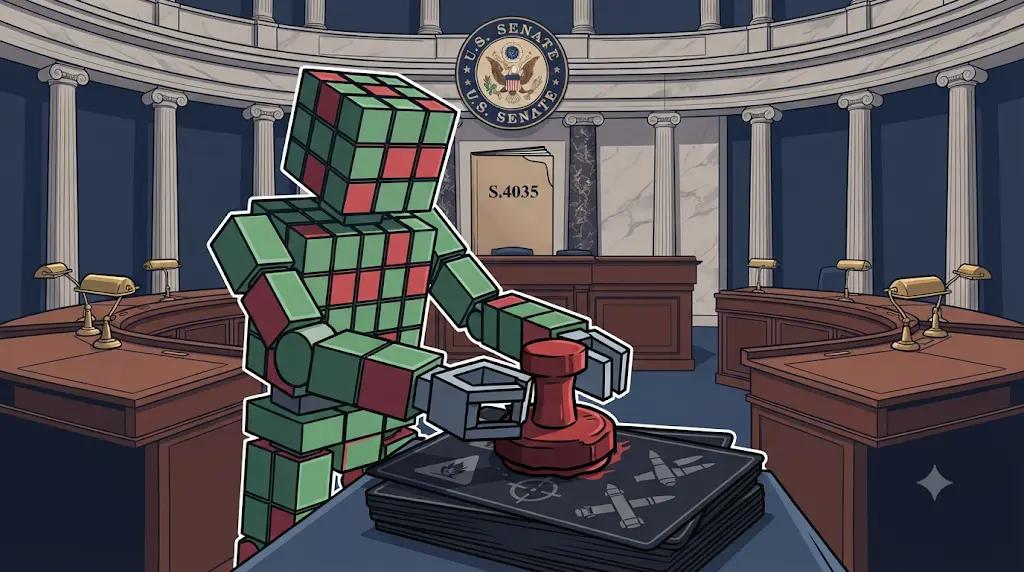
Bipartisan legislation targets contracts tied to fatal events while preserving ongoing sports-betting disputes
TL;DR
- The U.S. Senate unanimously passed the bipartisan DEATH BETS Act, which would prohibit prediction market contracts tied to death, terrorism, assassination, and war.
- Senators Adam Schiff and John Curtis backed the legislation, which would impose statutory restrictions on certain event contracts and now heads to the House.
- A last-minute amendment preserves existing legal disputes over sports betting as the CFTC and several states continue fighting over prediction market jurisdiction.
Trade smarter on Jupiter, Solana’s leading DEX built for fast execution and deep liquidity.
Swap tokens at competitive rates, route across multiple liquidity sources automatically, and access perpetuals, DCA, and advanced trading tools — all in one place!
The U.S. Senate unanimously passed the bipartisan DEATH BETS Act on November 19, 2026, advancing legislation that would prohibit Commodity Futures Trading Commission (CFTC)-registered entities from listing or clearing prediction market contracts tied to death, terrorism, assassination, and war. The measure, formally designated S.4035, now heads to the House of Representatives and would require presidential approval before becoming law.
The legislation, formally titled the "Discouraging Exploitative Assassination, Tragedy, and Harm Betting in Event Trading Systems Act," was introduced in March 2026 by Democratic Senator Adam Schiff of California, with Republican Senator John Curtis of Utah serving as co-sponsor. It would amend the Commodity Exchange Act (CEA) to establish explicit prohibitions on controversial event contracts that lawmakers argue create risks involving insider trading, public safety, and national security.
What the DEATH BETS Act Would Prohibit
The proposed legislation would bar registered entities from offering contracts linked to specified violent events, strengthening existing restrictions under federal commodities law. Its language states that a registered entity "shall not list for trading or accept for clearing on or through the registered entity" contracts involving "terrorism, assassination, war, or any similar activity."
The prohibition would also cover contracts related to "an individual’s death or could otherwise be construed as correlating closely to an individual’s death." Under the existing CEA framework, the CFTC already has authority to block contracts involving war, terrorism, and assassination, but those determinations remain at the regulator's discretion. Supporters of the DEATH BETS Act argue that the current level of flexibility is insufficient.
Speaking before the Senate vote, Schiff criticized the risks associated with such markets, warning that they create a "system with the most perverse incentives," which would "reward betting on a mass casualty event, a market event that would encourage lethal events and jeopardize our national security for the right amount of money."
Schiff also said the contracts "create rampant opportunities for insider trading, and perhaps worst of all, they're offered with no regard for national security and, in far too many cases, even basic morality." He characterized the broader prediction market industry as operating in a "Wild West" and being "desperately in need of regulation and guardrails."
The legislation follows controversy surrounding prediction markets offering contracts involving potentially catastrophic events. Earlier this year, Polymarket removed a market allowing users to wager on the likelihood of a nuclear weapon detonation following criticism on social media. Contracts concerning U.S. military action also appeared on prediction market platforms, adding to concerns about the types of events available for trading.
The CFTC introduced related safeguards on June 10 through a modernization of Regulation 40.11, establishing a framework for assessing contracts involving "terrorism, assassination, war, gaming, or conduct that is unlawful under federal or state law" before determining whether they should be prohibited.
Schiff Amendment Keeps Sports Betting Legal Battles Separate
The Senate's action also addressed the continuing dispute over whether sports-related prediction contracts are federally regulated derivatives or gambling products subject to state restrictions.
Schiff, who said he had been misled about the CFTC's stance on prediction markets, introduced a last-minute amendment clarifying that the DEATH BETS Act would not affect ongoing litigation between federal regulators and states challenging the legality of sports event contracts.
"If sports contracts are impermissible under federal or state law today, as I and many others believe they are, it will remain impermissible after this legislation is enacted," Schiff said.
He further emphasized that passage of the legislation should not be interpreted as congressional support for either side in disputes over the legal status of sports-related prediction markets.
"We are aware there’s active litigation across the country on swaps and preemption issues. Nothing in the DEATH BETS Act should have any effect on those lawsuits, and it would be improper to draw any inference from this bill that other federal statutes and regulations should be interpreted in a particular way, or that Congress has expressed any intent on how the issues and litigation should be decided," Schiff said.
The amendment addresses legal proceedings in which states argue that certain sports event contracts constitute gambling activities requiring licenses under state law. Federal regulators, meanwhile, maintain that qualifying derivatives fall under the CFTC's jurisdiction.
CFTC and States Continue Fighting Over Prediction Market Oversight
The Senate vote comes amid growing legal pressure on prediction market operators. More than a dozen states have taken legal or enforcement action against Kalshi over alleged violations of state gambling laws.
The jurisdictional dispute has also prompted federal intervention. The CFTC and the Department of Justice (DOJ) recently filed lawsuits against several states, including Utah, Arkansas, and Louisiana, seeking to block state-level enforcement actions against prediction market platforms.
CFTC Chairman Michael Selig addressed the dispute during a Thursday interview at The Hill and The Block's Capitol Crypto Forum, stating that the agency would work with the Justice Department to defend its regulatory authority in court.
"If it's a legal and lawful derivative, it should be regulated by the market regulator. It's not something that goes to the state," Selig said.
The CFTC maintains that prediction markets fall within its jurisdiction under the Commodity Exchange Act, while state authorities continue to challenge contracts they consider unlawful gambling products. The Senate-approved DEATH BETS Act addresses contracts involving death and violent events while leaving those broader jurisdictional disputes to the existing legal proceedings.
This article has been refined and enhanced by ChatGPT.


