




 USD
USD
Singapore Overtakes Global Rivals as 2025 Crypto Adoption Front-Runner


Report Signals Rapid Uptick in Retail Participation, Tokenization Growth, and Shifting Adoption Patterns Across 79 Countries
TL;DR
- Singapore ranks #1 globally in crypto adoption for 2025, supported by ownership rates reaching as high as 24.4% depending on methodology.
- Bybit and DL Research highlight surging real-world utility through tokenized assets and stablecoin payments.
- Diverging global rankings show a gap between grassroots adoption and on-chain economic scale led by larger markets like the U.S. and India.
We’ve just launched the all-new COIN360 Perp DEX, built for traders who move fast!
Trade 130+ assets with up to 100× leverage, enjoy instant order placement and low-slippage swaps, and earn USDC passive yield while climbing the leaderboard. Your trades deserve more than speed — they deserve mastery.
Singapore’s crypto trajectory continues accelerating as multiple 2025 studies rank the city-state at the top of global digital-asset adoption, citing a sharp rise in ownership, strong institutional frameworks, and increasing user engagement. A comprehensive assessment from Bybit and DL Research places Singapore first among 79 countries in its World Crypto Rankings, attributing the position to the highest user penetration rate globally at more than 11%, while a separate dataset shows crypto ownership climbing to 24.4% of the population—double the share reported four years ago.
The reports highlight that retail participation in Singapore has broadened while remaining risk-conscious; a consumer study from SingSaver and Coinbase shows 61% of local retail investors hold crypto, though 74% keep exposure below 10% of their portfolios, suggesting widespread ownership but limited concentration. Younger demographics dominate the landscape, with more than 70% of crypto holders between 18 and 34 years old and only a small minority above 45.
Singapore’s climb is also reinforced by search-interest metrics and infrastructure-driven scoring systems used in global adoption indexes, with one dataset showing roughly 2,000 crypto-related searches per 100,000 people. Comparative rankings place the UAE and the United States directly behind Singapore, each scoring near the top for different reasons: the UAE for high ownership—reported at 25.3%—and the U.S. for a sprawling infrastructure footprint supported by the world’s largest network of crypto ATMs. Regional dynamics reflect a broader Asia-Pacific surge, with six APAC countries landing in the top 20. Markets such as Vietnam and Hong Kong show rapid adoption fueled more by remittances and savings behavior than by institutional maturity, underscoring how motivations differ sharply across regions.
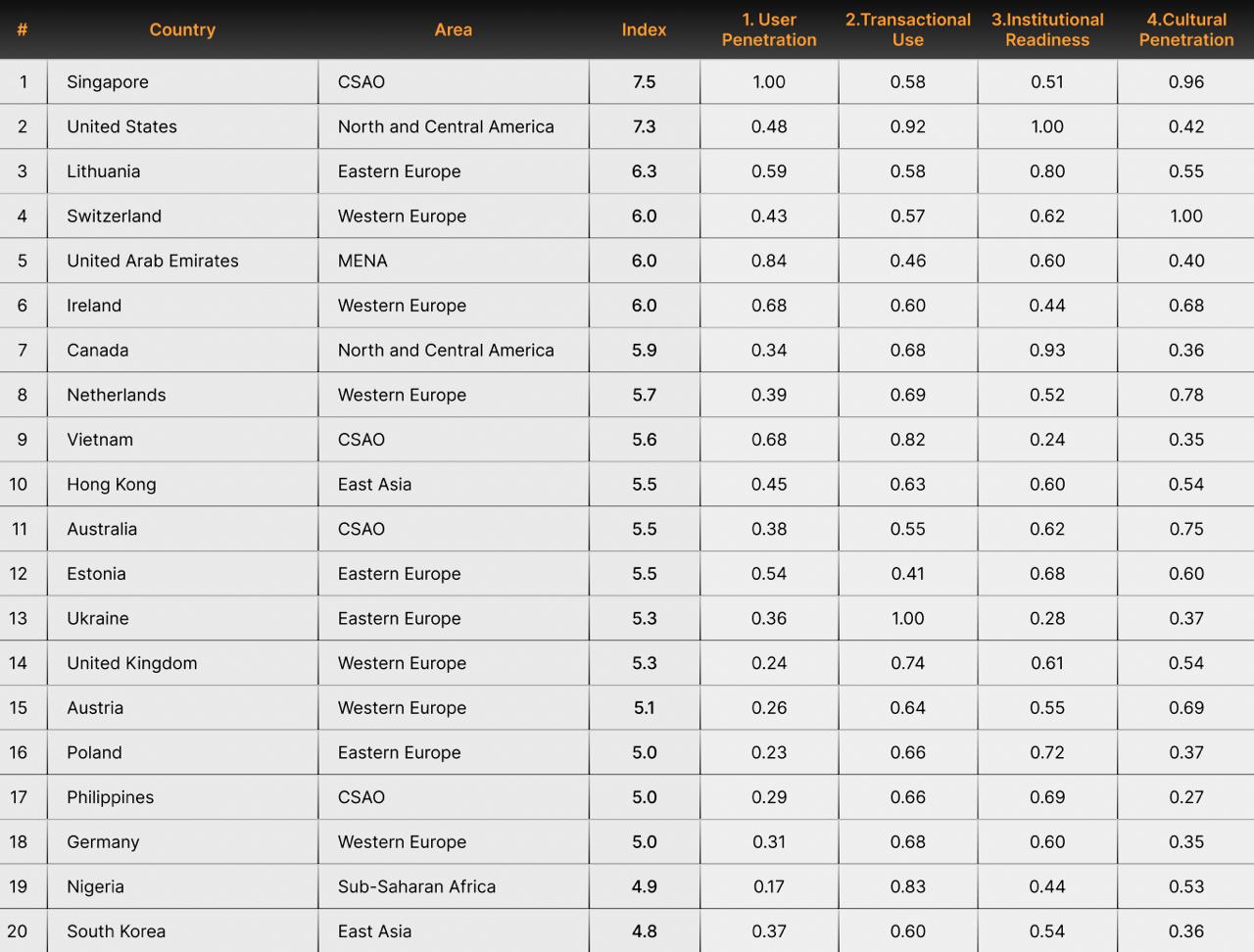
The Bybit–DL Research report adds further context by identifying three macro trends shaping the 2025 cycle: a 63% expansion in tokenization activity pushing the total value of tokenized physical assets to $25.7 billion, accelerating development of local-currency stablecoins, and a jump in crypto payment acceptance from roughly 3% to 9.6%, led primarily by stablecoin usage. These developments strengthen the thesis that crypto is moving beyond pure speculation and edging into mainstream economic infrastructure. The report frames these shifts as early but notable steps toward integrating blockchain-based settlement and digital representations of real-world assets into day-to-day financial activity.
Global comparisons reveal structural differences in how “adoption” is measured. While Singapore leads in penetration and enthusiasm indicators, Chainalysis data for 2025 continues to show India and the U.S. at the top of on-chain economic activity when ranked by transaction value and normalized web-traffic patterns. The methodology notes limitations stemming from VPN usage and location attribution, though it argues that the scale of the dataset—millions of transactions and billions of web visits—helps offset distortions. The contrast underscores a dual-track ecosystem: countries with high grassroots ownership and search activity often differ from those dominating capital flows and transaction volume.
The narrative emerging from the combined datasets paints a picture of Singapore as a rapidly scaling crypto hub defined by high adoption, strong regulatory clarity, and shifting consumer behavior. Yet the underlying data also reveal a cautious investor base, limited exposure depth, and an ecosystem still shaped heavily by youth-driven participation. Across the broader global market, tokenization growth and expanding stablecoin payments signal early infrastructural progress, while large-scale activity remains concentrated in major economies. The combined findings position 2025 as a year marked not only by rising participation but by a gradual transition toward real-world financial utility—a shift that continues to redefine how adoption is measured and where influence in the digital-asset economy truly resides.
This article has been refined and enhanced by ChatGPT.


