




 USD
USD
SoFi Moves $25 Billion Card Program to Stablecoin Settlement on Mastercard

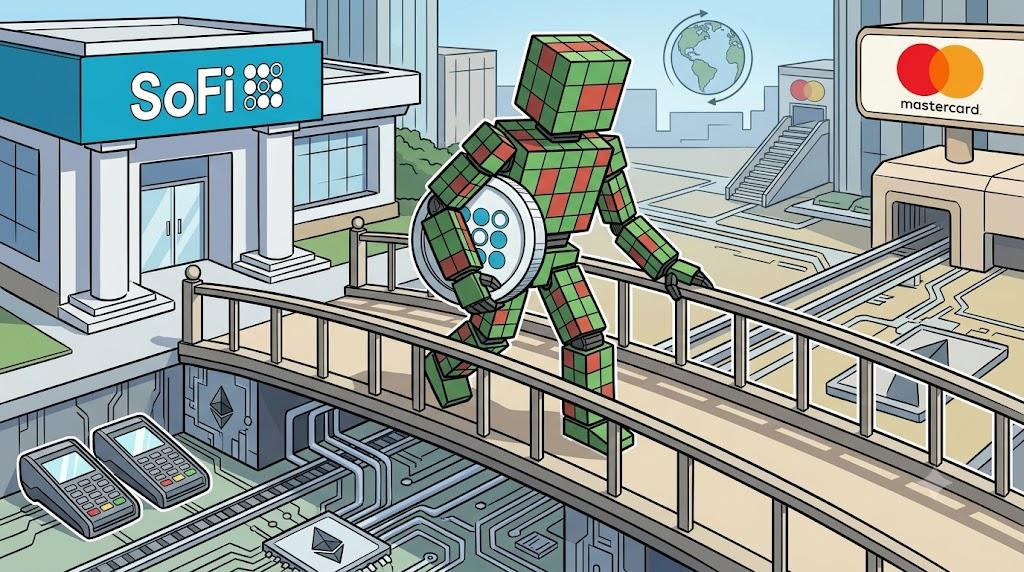
SoFiUSD goes live for debit and credit card settlement as bank targets merchants and broader payment uses
TL;DR
- SoFi Bank has begun using SoFiUSD to settle debit and credit card transactions across Mastercard’s global payments network.
- SoFi is migrating its entire card program to the system, with expected annualized transaction volume exceeding $25 billion.
- Merchants can receive settlement funds through SoFi Bank without holding stablecoins or changing their existing payment infrastructure.
Trade smarter on Jupiter, Solana’s leading DEX built for fast execution and deep liquidity.
Swap tokens at competitive rates, route across multiple liquidity sources automatically, and access perpetuals, DCA, and advanced trading tools — all in one place!
SoFi Technologies and Mastercard said on September 22, 2026, that stablecoin settlement is live across SoFi Bank, N.A.’s debit and credit card program, moving settlement onto blockchain infrastructure through SoFiUSD. SoFi said it is the first bank to go live with stablecoin settlement across Mastercard’s global payments network, with transactions already running onchain.
SoFi Bank is migrating its entire $25 billion card program to settlement using SoFiUSD. The program is expected to process more than $25 billion in annualized transaction volume. The companies said the launch brings a stablecoin issued by a federally regulated bank into Mastercard’s payment infrastructure and allows card issuers, acquirers and merchants to manage settlement and liquidity through that system.
The rollout follows a partnership announced in March 2026, when SoFi and Mastercard agreed that SoFi would use SoFiUSD to settle its own Mastercard transactions. The companies also outlined plans to make the settlement option available to other issuing banks through SoFi’s Galileo technology platform.
Anthony Noto, CEO of SoFi, said the companies moved quickly from the original agreement to production.
“In six months, SoFi and Mastercard took stablecoin settlement from an idea to a live product that materially improves how money moves for businesses,” Noto said. “Merchants do not need to hold stablecoins, build new infrastructure or change how they operate. Through SoFi’s Big Business Banking platform, any merchant can receive settlement funds instantly in a SoFi Bank account and withdraw to cash around the clock and at zero cost. That means businesses have faster access to their money via the speed of blockchain, with the safeguards of a bank.”
The structure allows merchants to use the settlement service without directly holding SoFiUSD. Settlement funds can instead arrive in a SoFi Bank account, where merchants can access cash through the bank’s platform.
SoFiUSD Expands From Bank Stablecoin to Card Settlement
SoFiUSD launched in December 2025 and became available to users of SoFi’s banking app in May 2026. The stablecoin is issued by SoFi Bank, N.A., an OCC-regulated, nationally chartered U.S. bank, and is available for institutional use as well as for SoFi members across payments, settlement and other financial applications.
SoFiUSD is redeemable 1:1 for U.S. dollars, subject to applicable terms, and is supported by reserves consisting primarily of cash. The accompanying disclosure identifies SoFiUSD, or SOFID, as a payment stablecoin rather than a deposit. It is not insured by the FDIC or SIPC, is not bank guaranteed, is not legal tender and may lose value.
Sherri Haymond, Global Head of Digital Commercialization, Mastercard, said the deployment moves the companies beyond experimentation with stablecoin settlement.
“Stablecoins become meaningful when they solve real problems that businesses face every day,” Haymond said. “With SoFi, we're moving beyond exploration to implementation, bringing regulated stablecoin settlement into a live production environment while preserving the trust, scale and safeguards expected from Mastercard. This is another step toward giving businesses more choice in how money moves.”
The launch forms part of Mastercard’s broader stablecoin settlement effort involving banks, fintech companies, stablecoin issuers and other partners. Mastercard expanded those capabilities in June 2026 to include USDC, PYUSD, RLUSD and other regulated stablecoins across multiple blockchains, with support for intraday, weekend and holiday settlement for issuers and acquirers.
SoFiUSD is available on Ethereum and Solana. Mastercard’s wider stablecoin settlement infrastructure spans eight blockchain networks.
SoFi Targets Large Merchants and Cross-Border Payments
SoFi said the stablecoin settlement product is not limited to its own banking operations. The company is in active discussions with large U.S. merchants about stablecoin-based settlement arrangements, including multinational retailers and technology service platforms.
SoFi and Mastercard also plan to explore additional uses for SoFiUSD across Mastercard’s network, including cross-border payments, remittances and other money-movement applications.
The initial deployment focuses on settlement rather than changing how consumers make card purchases. Merchants do not have to accept SoFiUSD at checkout or directly manage stablecoin balances under the model described by SoFi. Blockchain infrastructure instead sits within the settlement process while merchants can receive funds through conventional SoFi Bank accounts.
SoFi said it has 15.8 million members using its financial-services products, including borrowing, saving, spending, investing, protection services and crypto services. Banks, fintech companies and brands use SoFi Tech Solutions to serve more than 134 million global accounts. Mastercard operates in more than 200 countries and territories worldwide.
The companies identified several parts of the rollout as forward-looking, including expectations for transaction volumes, future products, merchant adoption, expansion of the partnership and additional settlement arrangements.
SoFi and Mastercard said future results could be affected by changes in the regulatory environment for digital assets, government policy, regulatory agency staffing and resources, and the complexity of complying with evolving rules and guidance.
Other listed risks include the companies’ ability to manage planned products, expand their businesses, forecast demand, develop competitive features that meet market needs, and maintain the security and reliability of their products. Legal or governmental proceedings involving either company could also affect results.
The companies said the forward-looking statements reflect information, forecasts and assumptions available as of the announcement date and generally will not be updated for later events except where required by securities laws.
This article has been refined and enhanced by ChatGPT.


