


 USD

Solana Ends 'Mainnet Beta' Era, Adopts Protocol Version 1.0 After Six Years

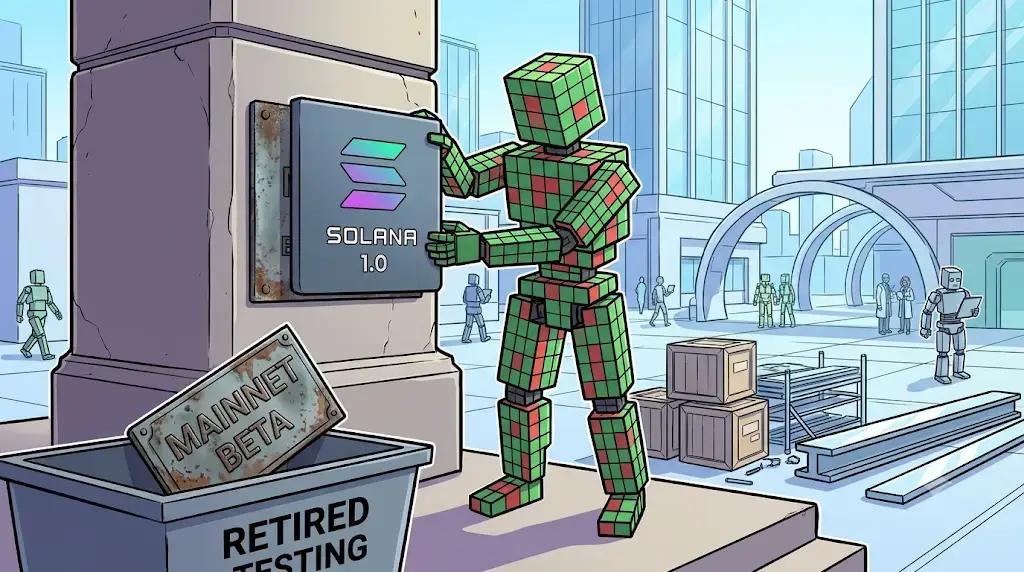
New Designation Aligns Validator Software as Network Advances Beyond Its Original Launch Status
TL;DR
- The Solana Foundation retired the "mainnet beta" designation on November 16, 2026, adopting Solana 1.0 after more than six years.
- The shared protocol version helps Agave and Firedancer validators coordinate upgrades without changing existing SOL holdings or accounts.
- The announcement follows the Alpenglow consensus upgrade and Firedancer deployment but does not itself activate new network features.
Trade smarter on Jupiter, Solana’s leading DEX built for fast execution and deep liquidity.
Swap tokens at competitive rates, route across multiple liquidity sources automatically, and access perpetuals, DCA, and advanced trading tools — all in one place!
The Solana Foundation officially retired Solana's "mainnet beta" designation on November 16, 2026, introducing Solana 1.0 as a shared protocol version after more than six years of operating under the previous label. The change establishes a common reference point for the blockchain's underlying rules across different validator clients, including Agave and Firedancer. It does not introduce a new network upgrade, alter transaction processing, or require users to take action.
Solana originally launched its mainnet beta on March 16, 2020, maintaining the designation while its blockchain supported token trading, decentralized applications, and asset transfers. The foundation said the new terminology reflects technical progress while separating protocol-level changes from the independent software releases maintained by validator client developers.
"Solana 1.0 recognizes the progress on network performance, resilience, and developer experience," the foundation said. "That progress continues with this simplification of nomenclature."
What Solana 1.0 Changes for Validators and Users
Solana 1.0 establishes a common versioning system for the network protocol rather than replacing existing validator software. Solana currently has two major validator clients: Agave, developed by Anza, and Firedancer, independently developed by Jump Crypto. Both clients operate with different codebases, release schedules, and software version numbers, making a shared protocol designation useful for tracking compatibility across the network.
Under the new naming system, an Agave release and a Firedancer release can support the same Solana protocol version without using identical client version numbers. The foundation coordinated the change with Anza and the Firedancer development team, allowing developers, validators, and infrastructure operators to identify network-level changes independently of their chosen software implementation.
However, adopting Solana 1.0 does not automatically enable all improvements associated with a particular protocol version. Validator operators must continue checking the compatibility of individual client releases and following the relevant instructions when network upgrades are activated.
"Announcing a protocol version does not activate every associated improvement at once," the foundation warned.
For ordinary users, the transition does not affect existing assets or how they interact with the blockchain.
"Your SOL, accounts, assets, applications, and transaction history remain the same," the foundation said.
Users do not need to exchange tokens, transfer funds to new wallets, or install additional software. Network documentation and block explorers will gradually adopt the new mainnet terminology.
Alpenglow and Firedancer Mark Earlier Network Upgrades
Solana's designation change follows major infrastructure developments, particularly the Alpenglow consensus upgrade and the deployment of Firedancer as an alternative validator client. These improvements preceded the renaming rather than being introduced through the new protocol version.
Alpenglow went live on October 21, replacing the consensus system Solana had used since launch. The upgrade targets transaction finality of approximately 150 milliseconds, compared with 12.8 seconds under the previous system. Transaction finality refers to the point at which a transaction is considered settled. The targeted improvement comes from the consensus upgrade itself, rather than the adoption of the Solana 1.0 label.
Firedancer reached Solana mainnet in December 2025, providing validators with a separately developed alternative to Agave. Maintaining independent client implementations reduces reliance on a single software codebase. A problem affecting one client does not necessarily affect every validator, although the resilience benefit depends partly on how widely different clients are deployed.
The network has previously experienced extended service interruptions, including an outage lasting nearly five hours in February 2024 and another lasting almost 19 hours a year earlier. Software diversity can help reduce common vulnerabilities, but it does not guarantee uninterrupted network availability.
Solana's upgrade tracker continues to list Agave 4.4 as planned for November and Agave 4.5 for December. Both releases retain their own software requirements and activation procedures, separate from the shared protocol designation.
Institutional Tokenization Projects Expand on Solana
The protocol naming change also comes amid a series of institutional announcements involving Solana-based tokenization and financial infrastructure.
The Depository Trust & Clearing Corporation (DTCC) announced plans last week to connect its tokenization service to Solana in the second half of 2027. Formation Securities has separately notified the U.S. Securities and Exchange Commission (SEC) of plans to operate a tokenized securities trading venue on the network, targeting an early 2027 launch.
Asset manager Schroders also launched a tokenized emerging-markets debt fund on Solana through Centrifuge earlier in November. Other developments during the year included the introduction of USDC accounts for U.S. Samsung Galaxy users and an integration with Polygon Labs' Open Money Stack.
These projects are separate from the protocol naming change, which standardizes how developers and validators identify network rules across independent client implementations.
This article has been refined and enhanced by ChatGPT.


