




 USD
USD
South Korea Moves to Legalize Stablecoins, Open Crypto ETFs, and Greenlight Bitcoin Seizures Under Supreme Court Ruling

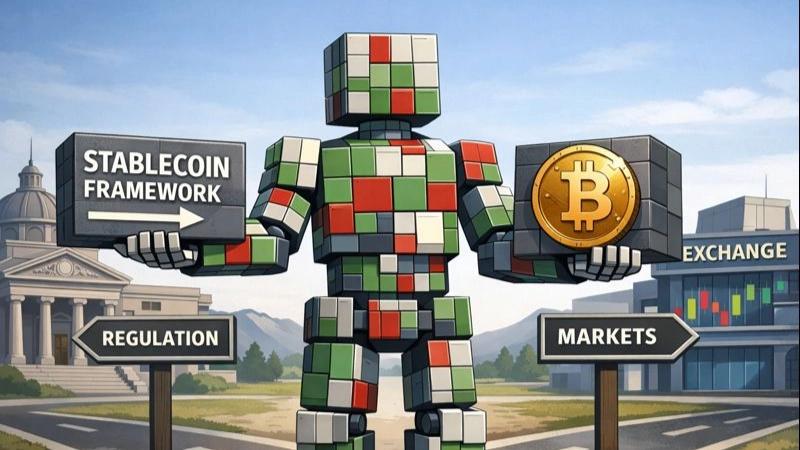
Regulators and Courts Align as Seoul Redefines Crypto’s Legal and Financial Role in 2026
TL;DR
- South Korea plans to finalize stablecoin legislation in Q1 2026, requiring full reserves, issuer authorization, and guaranteed redemptions.
- Authorities confirmed plans to allow spot Bitcoin ETFs in 2026, signaling a shift toward institutional crypto adoption.
- The Supreme Court ruled Bitcoin held on exchanges is legally seizable, classifying it as property with enforceable economic value.
We’ve just launched the all-new COIN360 Perp DEX, built for traders who move fast!
Trade 130+ assets with up to 100× leverage, enjoy instant order placement and low-slippage swaps, and earn USDC passive yield while climbing the leaderboard. Your trades deserve more than speed — they deserve mastery.
South Korea is entering a decisive phase in its approach to digital assets, pairing forward-looking financial reforms with judicial clarity on crypto enforcement. Regulatory authorities have outlined plans to pass stablecoin legislation by the first quarter of 2026 while opening the door to spot Bitcoin exchange-traded funds later in the year. At the same time, the country’s Supreme Court has delivered a landmark ruling confirming that Bitcoin held on centralized exchanges can be seized under existing criminal law. Together, these developments mark one of the most comprehensive recalibrations of crypto policy seen in a major Asian economy since the fallout from the Terra collapse.
Financial regulators, led by the Financial Services Commission, revealed that the upcoming stablecoin framework will form the core of the government’s so-called Digital Asset Phase 2 initiative. The legislation is designed to place stablecoin issuers under formal licensing requirements, forcing them to meet capital thresholds, maintain reserves equal to 100% of outstanding tokens, and guarantee redemption at face value. Officials have explicitly framed these safeguards as a response to the 2022 Terra-Luna implosion, which erased roughly $40 billion in market value and exposed the risks of undercollateralized and algorithmic stablecoins. The new rules are intended to eliminate ambiguity around issuer obligations and provide legal certainty to users who rely on stablecoins for payments, transfers, and settlement.
Beyond private issuers, the government is preparing to experiment with blockchain-based “deposit tokens” tied to traditional bank deposits. Pilot programs are scheduled for the first half of 2026, beginning with public-sector use cases such as subsidies for electric vehicle charging infrastructure. According to official planning documents, authorities aim to expand these tokenized payment rails gradually, with a long-term target of handling up to 25% of national treasury disbursements via blockchain systems by 2030. Amendments to the Bank of Korea Act and the National Treasury Act are expected by the end of 2026 to provide statutory backing for these initiatives, signaling that digital assets are being integrated directly into state financial operations rather than treated as fringe instruments.
Parallel to the stablecoin push, regulators have confirmed intentions to approve spot crypto exchange-traded funds in 2026, starting with Bitcoin. Domestic rules previously prevented such products by excluding digital assets from the list of eligible underlying assets for ETFs. That position has now shifted, aligning South Korea more closely with jurisdictions that already allow spot crypto ETFs and potentially unlocking demand from institutional investors, including asset managers, pension funds, and corporate treasuries that have been barred from direct crypto exposure.
Judicial developments have moved just as decisively. On January 9, 2026, South Korea’s Supreme Court ruled that Bitcoin held in exchange-custodied accounts qualifies as seizable property under Article 106 of the Criminal Procedure Act. The decision stemmed from a money laundering case dating back to 2020, where prosecutors seized 55.6 Bitcoin—valued at approximately 600 million Korean won at the time—from an exchange account linked to the defendant. Lower courts upheld the seizure, but the case escalated to the Supreme Court after the defense argued that cryptocurrencies, as intangible assets, fell outside the scope of property subject to confiscation.
The court rejected that argument, concluding that Bitcoin constitutes electronic information with independent economic value, manageability, and transferability. Judges emphasized that exchange-held crypto remains effectively controlled by the account holder, satisfying the legal criteria for seizure. The ruling builds on earlier decisions that recognized Bitcoin as intangible property but goes further by removing lingering uncertainty over law enforcement’s authority to confiscate crypto assets during criminal investigations.
Legal analysts note that the decision carries significant implications in a country where more than 16 million people maintain accounts at domestic crypto exchanges. While the ruling directly addresses custodial holdings rather than self-custodied wallets, it reinforces the principle that cryptocurrencies are no longer operating in a legal gray zone. Enforcement agencies now have explicit backing from the highest court to treat exchange-held digital assets similarly to other forms of property in criminal proceedings.
This article has been refined and enhanced by ChatGPT.


