




 USD
USD
S&P Global Agrees to Acquire OpenZeppelin in Onchain Security Push

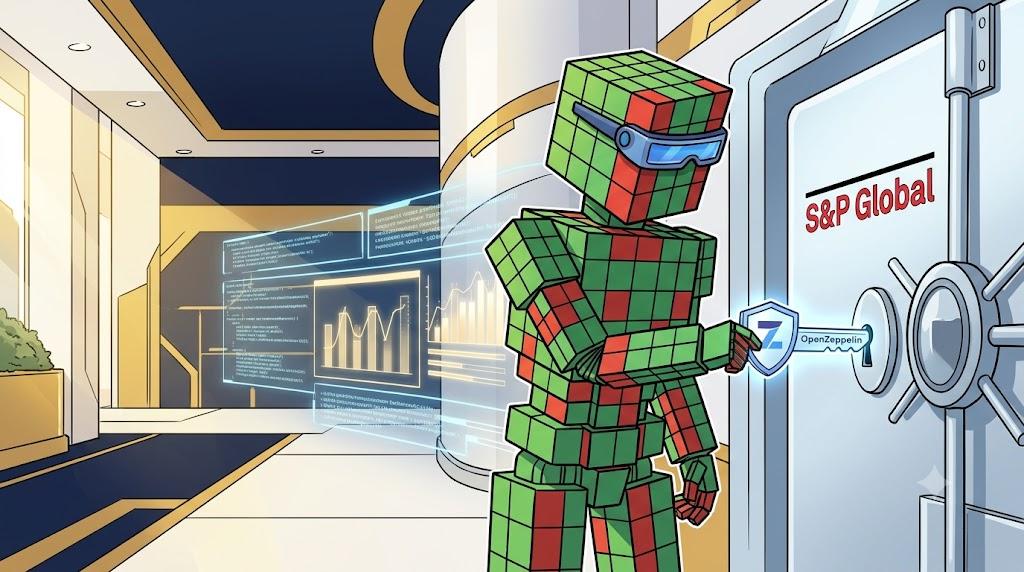
Deal Expands Ratings Company's Digital-Asset Strategy Into Smart-Contract Security
TL;DR
- S&P Global agreed to acquire OpenZeppelin to expand its digital-asset risk business into smart-contract and onchain security.
- OpenZeppelin's libraries have supported more than $37 trillion in cumulative transfers, while its security work has identified over 10,000 vulnerabilities before production.
- OpenZeppelin will remain a standalone business unit led by co-founder and CEO Demian Brener.
- The deal follows S&P Global's broader expansion across crypto market data, indices, tokenized benchmarks and digital-asset ratings.
Trade smarter on Jupiter, Solana’s leading DEX built for fast execution and deep liquidity.
Swap tokens at competitive rates, route across multiple liquidity sources automatically, and access perpetuals, DCA, and advanced trading tools — all in one place!
S&P Global agreed on September 17, 2026, to acquire smart-contract security company OpenZeppelin, extending its digital-asset strategy from financial-risk analysis into the technology underlying onchain markets.
Financial terms were not disclosed, and the transaction remains subject to closing conditions.
The acquisition adds smart contract security to S&P Global's existing work across stablecoin assessments, DeFi credit ratings, digital-asset indices and tokenized financial benchmarks.
S&P Global said the deal would help it develop “the next generation of onchain security assessments, benchmarks, and deliver essential intelligence as capital markets transition onchain.”
OpenZeppelin Adds Smart-Contract Security Expertise
Founded in 2015, OpenZeppelin provides open-source smart-contract libraries, security assessments and secure-development services.
Its libraries are widely used across stablecoins, tokenized funds and decentralized-finance applications.
S&P Global said contracts using OpenZeppelin libraries have supported more than $37 trillion in cumulative value transferred.
That figure represents transfers processed through contracts using the libraries, not assets owned or managed by OpenZeppelin.
The company has also completed more than 900 security engagements.
Those reviews identified over 10,000 vulnerabilities before affected code entered production, according to S&P Global.
OpenZeppelin CEO Demian Brener said:
“OpenZeppelin's standards, technology, and expertise already power the infrastructure behind the world's leading stablecoins, tokenized funds, DeFi protocols, and onchain markets.”
He said joining S&P Global would extend those capabilities to more traditional institutions, blockchain networks and DeFi protocols.
OpenZeppelin Will Remain a Standalone Business
OpenZeppelin will continue operating under its existing name after the acquisition closes.
Co-founder and CEO Demian Brener will remain in charge, reporting to S&P Global Ratings President Yann Le Pallec.
Le Pallec said S&P Global's digital-asset strategy focuses on bringing trusted data, benchmarks and transparent risk assessment into onchain markets.
“As digital assets and tokenized markets continue to mature, OpenZeppelin's technology and expertise will complement our smart contract and onchain technology risk assessment capabilities,” he said.
The acquisition expands S&P Global's analysis beyond an issuer's financial condition.
Smart-contract vulnerabilities can create technology risks even when an issuer has strong reserves or credit characteristics. OpenZeppelin gives S&P Global tools to evaluate that additional layer of blockchain infrastructure.
Deal Builds on S&P Global's Digital-Asset Expansion
S&P Global had already expanded its crypto business across several areas.
Its work included stablecoin stability assessments and the first credit rating of a DeFi protocol, Sky.
On September 14, 2026, S&P Global also led a strategic investment that expanded crypto market-data company Kaiko's Series B to $110 million.
BNP Paribas, Nasdaq Ventures, Coinbase Ventures and Royal Bank of Canada participated.
Earlier in September, S&P Dow Jones Indices and Kaiko launched a co-branded digital-asset index suite.
The companies had also tokenized the iBoxx U.S. Treasuries Index in March 2026.
Together, those initiatives expanded S&P Global's digital-asset presence across:
- Market data
- Crypto indices
- Tokenized benchmarks
- Credit ratings
- Stablecoin assessments
- Smart-contract security
S&P Global was described as a company valued at roughly $120 billion at the time.
What the OpenZeppelin Acquisition Means
The OpenZeppelin deal gives S&P Global direct exposure to the security layer supporting onchain financial products.
Rather than assessing only financial risks such as reserves, creditworthiness or market performance, S&P Global would also gain expertise in evaluating the code used to issue and manage tokenized assets.
OpenZeppelin, meanwhile, gains access to S&P Global's institutional reach while retaining its brand and existing leadership.
S&P Global said the transaction is not expected to have a material effect on its financial results.
If completed, the acquisition would connect two increasingly important parts of institutional digital assets: financial-risk assessment and the security of the smart contracts on which tokenized markets operate.


