




 USD
USD
Strategy’s STRC Falls as Investors Question Bitcoin-Backed Yield

Preferred stock trades below par while dividend, cash reserves and Bitcoin exposure draw scrutiny
TL;DR
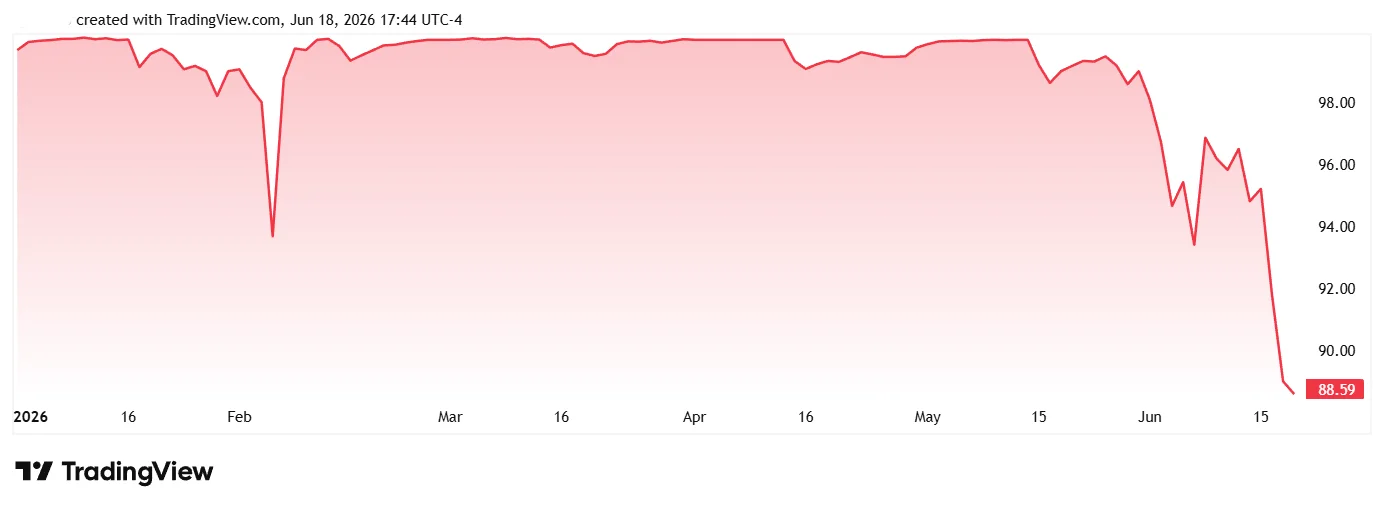
- Strategy’s STRC preferred stock fell as low as $82.53 on June 18, 2026, well below its $100 par value.
- STRC carries an 11.5% annual dividend, but its discount has pushed the effective yield above 13%.
- Analysts and investors are split over whether the decline reflects a mechanical yield reset or rising concern over Strategy’s Bitcoin-backed financing model.
Trade smarter on Jupiter, Solana’s leading DEX built for fast execution and deep liquidity.
Swap tokens at competitive rates, route across multiple liquidity sources automatically, and access perpetuals, DCA, and advanced trading tools — all in one place!
Strategy’s STRC preferred stock is under pressure after falling far below its $100 par value on June 18, 2026, as investors questioned whether the Bitcoin-focused company can keep funding dividend obligations while maintaining confidence in its capital-raising model.
STRC, also called Stretch, was designed as Strategy’s largest dividend-paying preferred equity product. The security was aimed at income-focused investors who wanted regular distributions from a product tied to Strategy’s Bitcoin accumulation strategy rather than direct exposure to spot Bitcoin or common shares.
The product pays an 11.5% annual dividend and drew interest from everyday savers, retirees, traditional income investors and retail buyers seeking a brokerage-accessible way to receive income while participating indirectly in Strategy’s Bitcoin strategy. STRC traded at or above its $100 par value several times after launch, allowing Strategy to raise billions of dollars through new share offerings.
STRC has not traded at par since mid-May. Its weakness also followed the product’s ex-dividend date, the cutoff after which new buyers no longer qualify for the next distribution. Strategy was expected to distribute roughly $100 million to investors at the end of the month alongside STRC’s next payout date.
Analysts split over whether STRC is signaling stress
James Butterfill, head of research at CoinShares, said STRC’s continued weakness appears to be driven less by Bitcoin itself and more by uncertainty over how Strategy plans to fund and manage its growing fixed obligations. “A Bitcoin rebound improves the value of the assets supporting Strategy, but it does not automatically increase the cash available,” Butterfill said.
Butterfill said any Bitcoin sale by Strategy would complicate the company’s broader positioning. “Until then, the core narrative was that Strategy issued capital to accumulate Bitcoin. Selling even a small amount to meet distributions reverses that flow and adds complexity to its overall strategy, albeit temporarily,” he said.
Butterfill said he did not view the current pressure as an existential threat. “I do not view this as existential at this stage. It is a sign that Strategy’s financing model has become less efficient and that investors want a higher return for accepting the risk,” Butterfill said.
Benchmark-StoneX Managing Director and Senior Research Analyst Mark Palmer offered a different view, saying STRC’s weakness is mechanical rather than distress-driven because the product’s dividend rate is below where the market is currently clearing. “That is the structure doing exactly what it was built to do,” Palmer said.
Palmer said STRC may still offer value at current levels. “At its current price level, we see STRC as offering investors an attractive total return opportunity, pairing a high current yield with a built-in mechanism that works to pull the price back toward par,” he said.
Benchmark-StoneX analysts expect Strategy to raise STRC’s dividend at the start of July 2026. Palmer said they expect that move to “support the price back toward par.” Strategy has indicated that when STRC remains below $100, it can raise the dividend to increase demand.
Strategy’s Bitcoin reserve is central to the debate
Since launching STRC, Strategy has issued more than $10 billion worth of preferred shares, accelerating its Bitcoin purchases and helping expand its treasury to 846,842 BTC. At a Bitcoin price below $62,500, that treasury was valued at about $53 billion, while Bitcoin was down more than 5% over the past day.
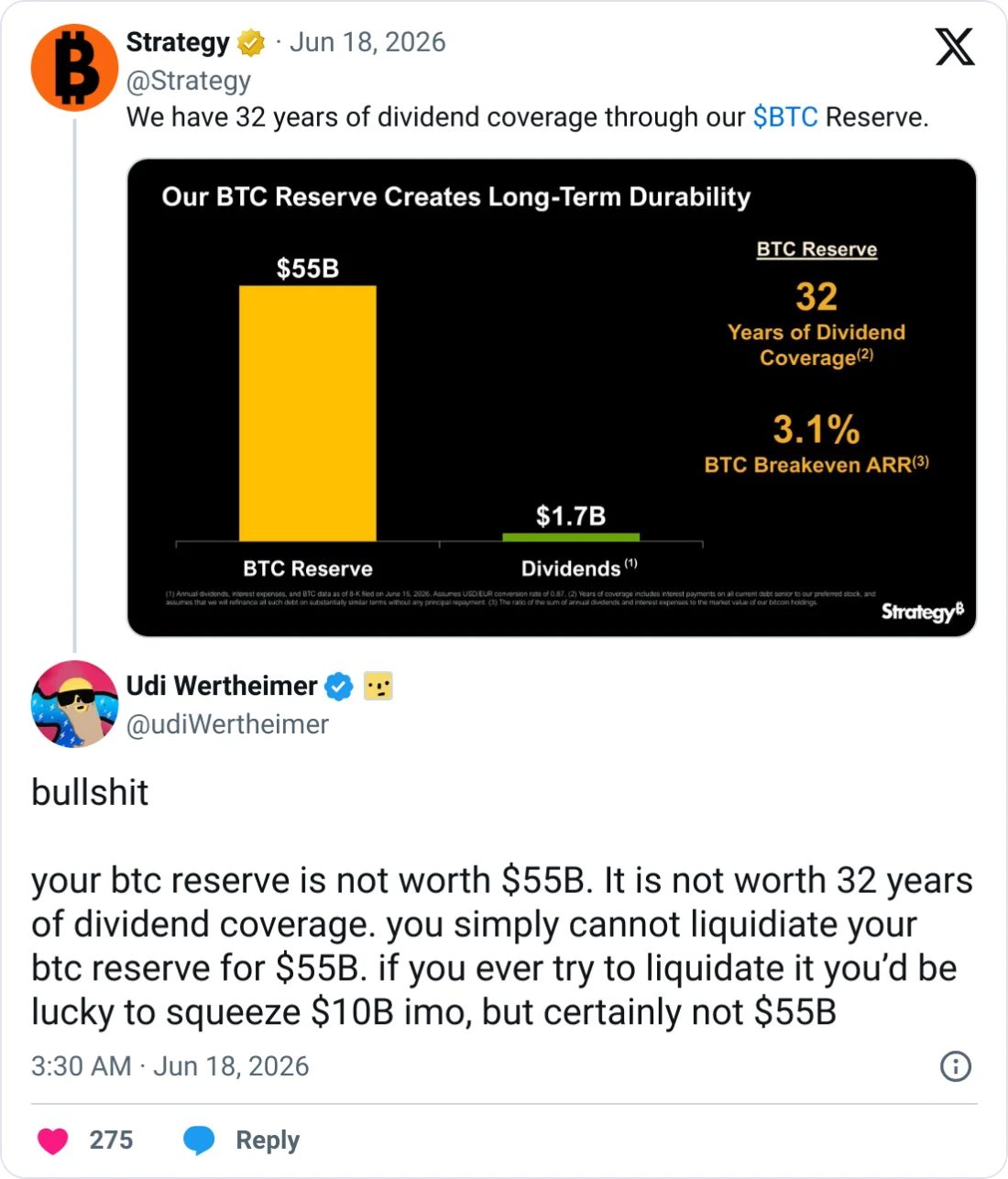
Strategy said on June 17, 2026, that it had “32 years of dividend coverage through our BTC Reserve,” comparing roughly $55 billion in Bitcoin with $1.7 billion in annual dividends and interest expenses. Critics focused on whether the company could convert that reserve into cash during stress without hurting market confidence.
Taproot Wizards CEO Udi Wertheimer noted on X that if Strategy tried to leverage or monetize its Bitcoin stash, it would likely receive much less as the market absorbed the supply. That observation raised the question of whether Strategy’s treasury is less liquid in practice than its headline value suggests.
Strategy’s common shares also fell alongside STRC. The stock dropped as low as $109.36 on Thursday, its lowest point in four months. Strategy’s common equity was cited as down about 32% over the past month, while also trading around $110 after reaching $457 roughly 11 months earlier.
Strategy’s downturn deepened after the company sold 32 BTC for $2.5 million last month. The sale had been telegraphed in advance and was intended to show Strategy’s willingness to pay preferred stockholders, but it also challenged the company’s Bitcoin accumulation narrative and coincided with its worst weekly performance since November 2022.
Strategy established cash reserves last year to manage debt and dividend obligations. The company set aside $2.25 billion at the beginning of this year before reducing the reserve to $1.1 billion after repurchasing part of its debt at a discount. Another cited figure said Strategy’s USD Reserve had grown to approximately $1.1 billion.
We’ve launched the all-new COIN360 Perp DEX, built for traders who move fast!
Trade 130+ assets with up to 100× leverage, enjoy instant order placement and low-slippage swaps, and earn USDC passive yield while climbing the leaderboard. Your trades deserve more than speed — they deserve mastery.
Retail buyers describe different reactions to the selloff
Emery Redenius, a 44-year-old newly retired slot-machine technician from Las Vegas, bought STRC on day one and accumulated more than $400,000 worth of STRC and SATA, a similar preferred stock from Strive. Redenius said the product fit his income strategy. “I have an income portfolio, so this was just a great addition to it,” he said.
Redenius said he viewed STRC’s semi-monthly distributions as tax-deferred because levies are delayed until shares are sold. “I’m gonna probably pay no tax on this investment forever,” he said. Redenius remained bullish despite STRC’s price swings and described the decline as a buying opportunity.
Redenius also said investors who bought STRC at par should have understood the entry risk. “That’s the problem with people buying it at $100—they freak out when it drops a little bit. You bought it at perfection. You should’ve waited and bought it at a discount,” he said.
A 40-year-old IT worker in California, who requested anonymity, said he accumulated around $425,000 worth of STRC starting in May and now feels misled. His position was roughly $42,000 underwater, and he said he was still holding after selling bonds to buy STRC.
“I was always skeptical of Strategy. But the community was so dogmatic about its stability that, for a brief time, I was tricked into thinking STRC would be different,” the anonymous IT worker said. He said he had become focused on Strategy’s operations, including the use of cash reserves to repurchase debt before trying to rebuild the reserve.
“Traditional investors like me don’t like the instability that comes from having a small cash reserve. It could force them to sell Bitcoin,” the anonymous IT worker said. His comments contrasted with Redenius’ view that the discount created a better entry point for income investors willing to hold through volatility.
Saylor frames STRC as a new income product
Michael Saylor, Strategy’s co-founder and executive chairman, has compared STRC to money market funds and FDIC-insured bank accounts. Critics have pointed to the product’s lack of insurance, Bitcoin dependence and dividend suspension risk.
At a Bitcoin conference in April, Saylor said retail buyers owned around 80% of STRC. “We estimate three million households right now are benefiting from STRC,” he said. “Our vision is to power millions and then tens of millions and then hundreds of millions of households with a high-yield savings account. It’s a straightforward thing.”
Glenn Cameron, head of institutional at Onramp Bitcoin, said STRC is fragile and highly dependent on Bitcoin’s price. Cameron said he had spoken to investors including a nurse and a truck driver, and he worries those holders do not fully understand the downside risk.
“At some point, the pain is going to be too much,” Cameron said. He did not make a hard prediction, but warned that a sharp Bitcoin drawdown could leave STRC investors with steep losses and no income when they may need it most.
Cameron noted that STRC has no insurance, unlike bank deposits, and is tied to a company that generates little cash and pays dividends that can be suspended indefinitely. Prospectus risk disclosures cited in the source set said STRC’s value and liquidity are subject to significant market volatility, interest-rate fluctuations, lack of an established trading market and junior standing to company debt.
Saylor says AI helped design STRC
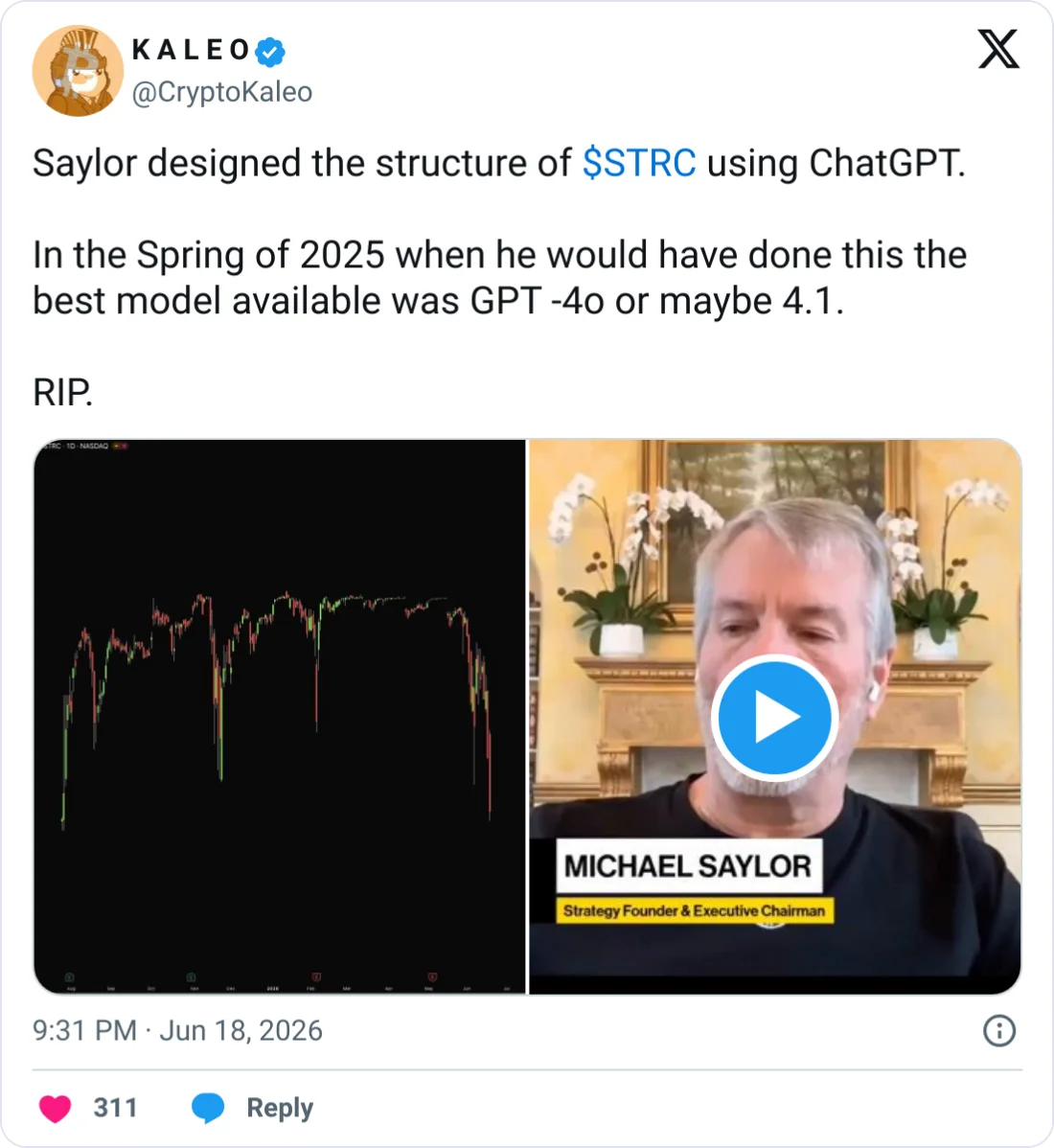
Saylor said he used artificial intelligence to help design STRC. In a recent CoinDesk interview shared on X, Saylor said, “I designed all these with AI, you know, I couldn’t have done it myself. I literally said… I used artificial intelligence and I went back and forth with the AI for a few hours.”
Saylor described working through the STRC structure conversationally with AI, asking whether a monthly preferred share that stayed stable near $100 was possible and whether anyone had ever done it. The AI detail was presented as part of Saylor’s broader effort to design financial products around Strategy’s Bitcoin balance sheet.
K A L E O said on X on June 18, 2026, that Saylor designed the structure of $STRC using ChatGPT and speculated that in Spring 2025 the best available model would have been GPT-4o or possibly GPT-4.1.
Corporate treasury instruments are usually structured by investment-banking teams over weeks of legal and financial review. The STRC structure was presented as an example of Saylor using conversational AI to iterate on a financial product tied to Strategy’s Bitcoin-backed capital strategy.
Strategy’s financial product suite separates Bitcoin exposure across investor types. MSTR common stock targets Bitcoin bulls, STRC / Stretch targets income investors, other preferred shares such as STRK and STRF target more conservative institutional investors, and convertible debt targets fixed-income investors.
Saylor’s central yardstick is Bitcoin per share, meaning Strategy evaluates capital raises, preferred issuance and treasury activity by whether they increase the amount of Bitcoin backing each common shareholder. Recent filings cited a year-to-date BTC Yield of 13.3% and highlighted the company’s ability to fund purchases through equity, credit or capital instruments.
Saylor has also described STRC as a “perpetual swap” with no liquidation or redemption right, structured so the market, rather than Strategy, provides liquidity. The unresolved question is whether STRC becomes a breakthrough income wrapper for Bitcoin adoption or a warning about selling crypto-linked credit risk to retail investors under a stable-yield narrative.
FAQ
Why is STRC falling?
STRC is trading below par as investors demand higher compensation for Strategy-linked credit and Bitcoin exposure.
What dividend does STRC pay?
STRC carries an 11.5% annual dividend, with effective yield above 13% at lower prices.
What did Strategy claim about dividend coverage?
Strategy said it had “32 years of dividend coverage through our BTC Reserve.”
Who warned about retail risk?
Glenn Cameron warned some retail holders may not fully understand STRC’s downside risk.
This article has been refined and enhanced by ChatGPT.


