




 USD
USD
Tether Faces S&P Downgrade as Risk Exposure Rises and Uruguay Exit Confirms Operational Strains

A Week of Pressure for the World’s Largest Stablecoin Issuer
TL;DR
- S&P Global Ratings cut USDT’s stability score to the lowest tier, citing rising Bitcoin and gold exposure and limited transparency.
- Tether leadership dismissed the downgrade as flawed and politically motivated, while profits and U.S. Treasury holdings remain immense.
- The same week saw Tether confirm withdrawal from Uruguay, walking away from a once-ambitious $500M infrastructure and mining plan.
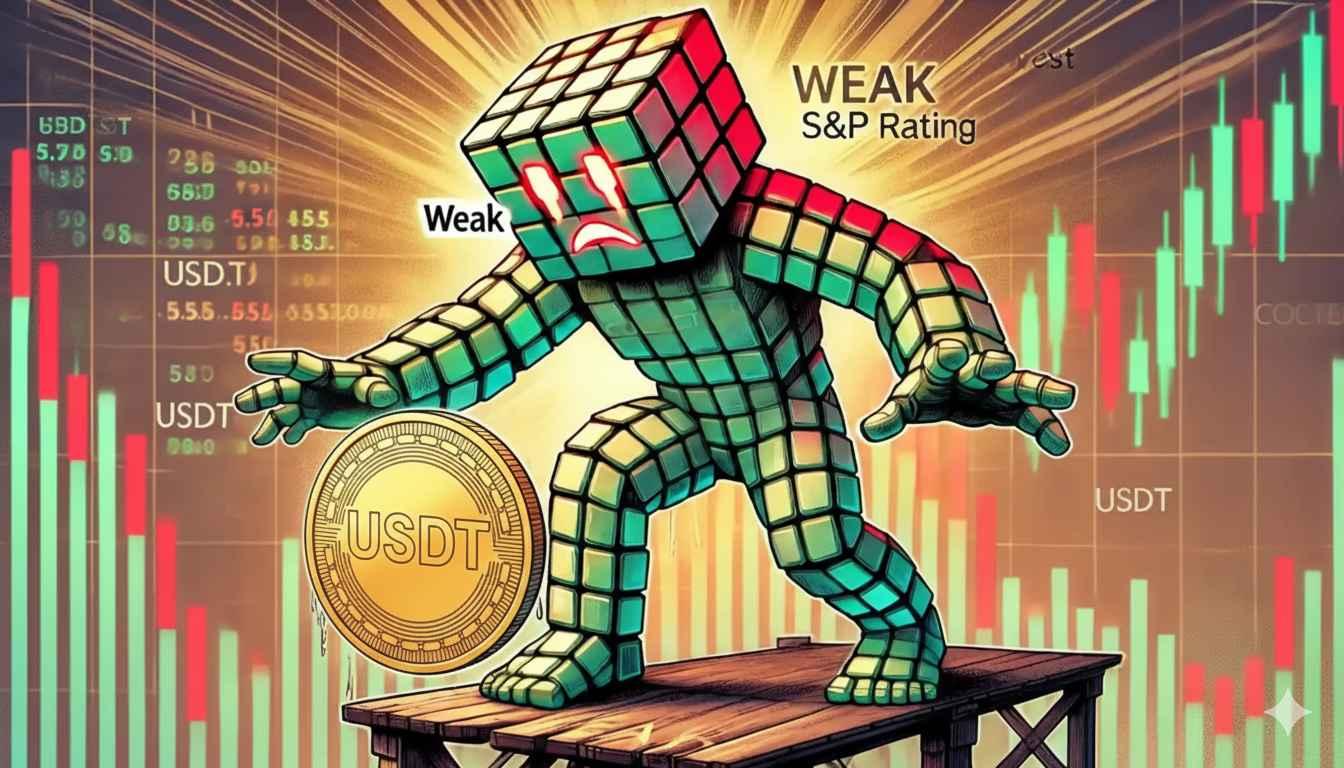
S&P Global Ratings reduced USDT’s peg-stability score on November 26, 2025, downgrading the dollar-linked asset from 4 to 5 on its one-to-five risk scale and marking it as “weak” — the lowest classification available. The agency described an imbalance between Tether’s growing exposure to high-volatility reserves and the company’s stated over-collateralization of 103.9%, noting that with reserves valued at $181.2 billion and liabilities estimated at $174.4 billion, the margin for error remains thin if major risk assets fall sharply. Bitcoin now represents roughly 5.6% of USDT reserves, with gold accounting for an additional 7%, combining for nearly 13% of asset backing. Tether’s latest attestation shows about $9.9 billion in Bitcoin and $12.9 billion in gold, alongside approximately $14 billion in secured loans and other risk-sensitive holdings — a climb to 24% of the asset base compared to 17% one year earlier.
S&P’s analysis acknowledged that U.S. Treasuries still make up approximately three-quarters of reserves and that the firm’s Treasury holdings, totaling between $112 and $135 billion, place it among the world’s top sovereign-debt holders. The agency maintained its concern centered less on dollar quantity than on disclosure practices, independent auditing limitations, reserve segmentation, custodian clarity, and the regulatory framework governing the firm’s El Salvador-based oversight under CNAD, which it described as looser than higher-rigor financial jurisdictions. A possible upgrade remains open if asset composition shifts toward lower risk and if transparency improves in future reserve breakdowns.
Tether’s response reflected open defiance rather than concession. Corporate statements rejected the validity of the rating methodology, calling the analysis “misleading” and unrepresentative of USDT’s historical resilience. Paolo Ardoino, serving as CEO, adopted an even sharper tone across interviews and social posts, suggesting the downgrade signaled frustration from legacy finance. His commentary challenged conventional rating logic by arguing traditional models failed investors in past cycles and are not designed for digital-native monetary systems.

Ardoino asserted that Tether is “the first overcapitalized entity in finance,” repeatedly stressing profitability and claiming that none of its reserves consist of “toxic holdings.” He framed the episode as philosophical conflict between centralized lenders and a decentralized, highly liquid dollar rail that has processed redemptions through crises without refusal. The company recorded more than $10 billion in profits in the first three quarters of 2025, powered largely by Treasury yield flows, and continued using retained earnings to accumulate hard-asset reserves. Internal strategy calls Bitcoin, gold, and real-world assets a defensive store of value as macro volatility increases — a stance reflected materially in its metals portfolio.
China’s reaction amplified the systemic tone behind the downgrade. Despite prohibitions issued against crypto activity, more than twenty million citizens reportedly maintain Bitcoin exposure via offshore exchanges, OTC desks, and informal P2P liquidity routes, almost all denominated in USDT as the circulation layer between yuan and offshore capital. Discussion channels surged with conflicting sentiment: some traders viewed S&P’s downgrade as recurring “Tether FUD” that historically surfaced near market bottoms without lasting impact, while others warned that destabilization of USDT would collapse crypto liquidity worldwide. Weibo and WeChat chatter circulated remarks like “If this bomb goes off, the cryptocurrency market is completely finished,” capturing the dependence and vulnerability that accompanies USDT’s dominant global share.
Tether’s gold acquisition program further illustrates the company’s structural pivot. Analysts reported that the firm became the world’s largest single gold buyer in Q3 2025 with roughly 26 tonnes acquired, scaling total holdings to approximately 116 tonnes. Only around 12 tonnes back XAUT, while the remaining 104 tonnes reinforce USDT reserves. That accumulation followed quarterly buying patterns that accelerated from 3–7 tonnes in 2024 up to 23.5 tonnes in Q2 2025 and 25.9 tonnes by Q3, a period tracking gold’s price appreciation from roughly $3,000 toward $4,300. Tokenized metals supply swelled past $3.9 billion, driven mostly by XAUT and PAXG expansion, and Tether has reportedly hired metals-trading veterans from HSBC to professionalize accumulation and hedging. The move aligns with leadership’s stated plan to convert profits into hard stores of value — gold, Bitcoin, land, and energy-linked assets — in anticipation of prolonged economic uncertainty.
The Uruguay chapter brought the week into sharp relief. After nearly two years of public positioning and industrial buildup, Tether confirmed to Uruguay’s Ministry of Labor and Dinatra that operations would shut down, with 30 of 38 employees let go and all mining and data-center development paused. Original plans projected up to $500 million in investment across three data centers spanning Florida and Tacuarembó with 165 MW in computing power and a 300 MW renewable wind-solar plant intended to feed the facilities. Approximately $100 million was deployed before progress stalled, along with another $50 million earmarked for grid-transfer infrastructure.
Disputes over power tariffs proved terminal, as the company pushed to shift from a 31.5 kV rate band to a lower 150 kV transmission model to achieve viable margins. Local reports documented energy supply suspension following unpaid electricity balances nearing $5 million — with $2 million in overdue consumption and $2.8 million tied to related operational obligations — leading to shutdown of facilities and withdrawal from expansion phases previously characterized by Ardoino as clear signals of Uruguay’s reliable and renewables-rich energy grid. The surrender of a high-visibility, renewable-powered mining hub contrasted notably with the narrative of global scaling, landing within the same news cycle as USDT’s rating downgrade and raising questions about execution and infrastructure friction behind Tether’s off-chain footprint.
The confluence of events — a stability downgrade with explicit warnings over asset-mix volatility, aggressive leadership rhetoric, massive gold accumulation, and a halted $500 million industrial expansion — underscored how deeply Tether now anchors global crypto liquidity while simultaneously balancing scale with regulatory tension, market exposure, and real-world operational limits.
This article has been refined and enhanced by ChatGPT.


