


 USD

Tron, Tether Launch Chainalysis Crime Task Force After Previous Alliance Collapses

New Initiative Targets Illicit USDT Transfers as AI-Driven Crypto Scams Accelerate
TL;DR
- Tron, Tether, and Chainalysis have launched the Digital Crime Task Force to detect illicit USDT activity and coordinate faster asset freezes with law enforcement.
- The initiative replaces the T3 Financial Crime Unit, which froze more than $450 million before dissolving amid coordination problems.
- Chainalysis said AI-enabled scams were 4.5 times more profitable than conventional schemes in 2025, while impersonation scams surged more than 1,400%.
Trade smarter on Jupiter, Solana’s leading DEX built for fast execution and deep liquidity.
Swap tokens at competitive rates, route across multiple liquidity sources automatically, and access perpetuals, DCA, and advanced trading tools — all in one place!
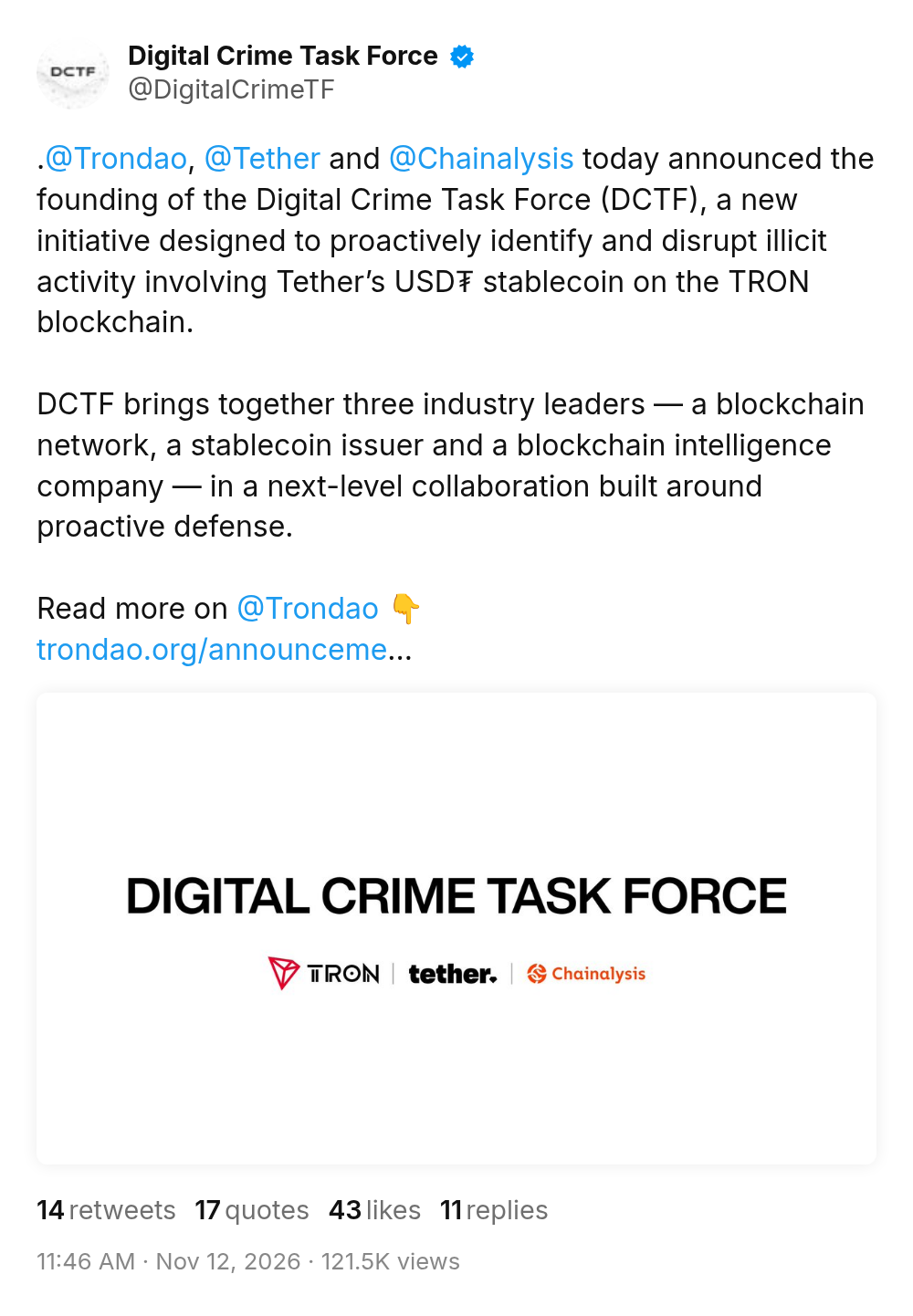
Tron, Tether, and blockchain analytics firm Chainalysis have launched the Digital Crime Task Force to combat illicit activity involving USDT on the Tron blockchain, replacing a similar partnership with TRM Labs that dissolved amid operational problems. Announced Wednesday, November 11, 2026, the initiative aims to identify suspicious transactions earlier and help law enforcement freeze criminal funds before they can be transferred, using blockchain intelligence and AI-powered investigative tools.
The new task force is designed to shift crypto crime prevention from a largely reactive approach toward proactive monitoring. Rather than waiting for victims to report fraud or investigators to identify suspicious funds, the partners plan to trace criminal networks, gather intelligence, and coordinate with authorities to accelerate enforcement. The initiative will also accept tips and asset-freeze requests from law enforcement agencies, according to the participating companies.
Tether CEO Paolo Ardoino emphasized the need for faster action as criminals increasingly use artificial intelligence to carry out financial fraud. "Criminals are using AI to move faster than ever, and waiting for a victim to report a crime is no longer good enough," Ardoino said. "Tether has already frozen more than $7 billion linked to illicit activity, working with more than 360 law enforcement agencies across 73 countries."
Tron founder Justin Sun highlighted the importance of protecting users who depend on stablecoins for everyday transactions. "Millions of people rely on USDT on Tron to support their families, sustain their businesses, and build a more secure future," Sun said. "As digital finance reaches more people, the ability to protect them must grow with it." More than $94 billion in USDT circulates on the Tron blockchain, making the network a central focus of the new enforcement initiative.
Previous T3 Alliance Ended Over Coordination Problems
The Digital Crime Task Force follows the dissolution of the T3 Financial Crime Unit, a partnership established in 2024 by Tron, Tether, and blockchain analytics firm TRM Labs. Binance later joined the operation, which collectively froze more than $450 million in illicit crypto assets during its existence.
Bloomberg reported earlier this month that the T3 unit had quietly disbanded in late August. People familiar with the matter cited slow response times and insufficient coordination among the participating organizations as reasons for the breakdown. Its dissolution became public just days before the record $6.4 billion Binance hack.
The replacement also marks a change in blockchain analytics providers, with Chainalysis taking over the role previously held by TRM Labs. The companies are direct competitors in the blockchain intelligence sector, and their rivalry has extended into government contracting.
Chainalysis previously sued the U.S. government over an ICE contract awarded to TRM Labs without competitive bidding. The dispute adds another dimension to the change in partners as Tron and Tether establish their latest crime-fighting initiative.
AI-Powered Scams Drive New Enforcement Push
The new alliance comes amid growing concerns about artificial intelligence being used to make cryptocurrency fraud more effective. Chainalysis said AI-enabled scams were 4.5 times more profitable than conventional scams in 2025, while impersonation scams increased by more than 1,400% year over year.
The Digital Crime Task Force plans to address a broad range of illicit activities, including investment and romance scams, cryptocurrency hacks, stolen funds, terrorist financing, North Korean cyber operations, cartel money laundering, and child-exploitation material.
The partners also identified autonomous AI agents conducting onchain transactions as a potential emerging threat, warning that increasingly automated financial activity could create new opportunities for criminal exploitation. The task force intends to use Chainalysis's intelligence and investigative capabilities to help identify suspicious activity before funds move beyond the reach of enforcement agencies.
Recent cybersecurity incidents have highlighted the risks facing crypto infrastructure providers. Earlier this week, crosschain interoperability protocol Across experienced a domain takeover before restoring normal operations. Blockchain infrastructure provider Chainstack also disclosed an AI-powered security breach that occurred in late October and exposed customer names, email addresses, and password hashes.
This article has been refined and enhanced by ChatGPT.


