




 USD
USD
Trump Accuses Banks of Blocking Crypto Legislation as Coinbase Stock Surges Amid Stablecoin Regulation Fight


Political Clash Over Stablecoin Rules Intensifies as Congress Stalls on Crypto Market Structure Bill
TL;DR
- Donald Trump accused major banks of threatening the GENIUS stablecoin law and delaying broader crypto legislation, urging Congress to pass market structure rules “ASAP.”
- Disputes over stablecoin yield programs—opposed by banking groups and defended by the White House—have stalled progress on the CLARITY Act in the Senate Banking Committee.
- Coinbase shares climbed 14.44% to about $208.70 on March 4, 2026, as Bitcoin approached $73,219 and Ethereum rose above $2,143 during a crypto market rebound.
We’ve launched the all-new COIN360 Perp DEX, built for traders who move fast!
Trade 130+ assets with up to 100× leverage, enjoy instant order placement and low-slippage swaps, and earn USDC passive yield while climbing the leaderboard. Your trades deserve more than speed — they deserve mastery.
President Donald Trump publicly accused large U.S. banks of obstructing cryptocurrency legislation during remarks posted on Truth Social on March 4, 2026, arguing that financial institutions were attempting to derail the stablecoin regulatory framework known as the GENIUS Act while delaying broader digital-asset legislation in Congress. Trump wrote that banks were “threatening and undermining” the GENIUS Act, a law he described as the first major federal step toward integrating digital assets into the U.S. financial system. He also urged lawmakers to accelerate progress on broader regulatory legislation governing digital assets.
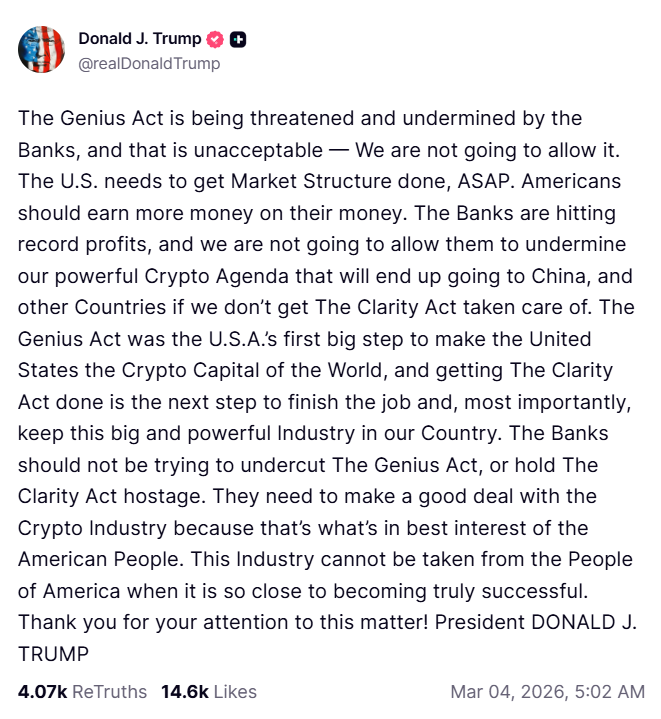
Trump’s comments called on Congress to advance market structure legislation governing cryptocurrencies, writing that “The U.S. needs to get Market Structure done, ASAP.” The president described the stablecoin law as “the U.S.A.’s first big step to make the U.S. the crypto capital of the world,” while urging lawmakers to finalize additional regulatory measures intended to clarify oversight of digital asset markets. Debate over the regulatory framework has intensified among lawmakers, regulators, banks, and crypto industry representatives as negotiations continue on Capitol Hill.
Central to the dispute is the issue of yield-bearing stablecoins, which allow holders to earn rewards or interest-like returns through lending or other platform incentives. Banking groups have argued that such products could pull deposits away from traditional banks, prompting lobbying efforts aimed at limiting or banning yield programs tied to stablecoins. Crypto industry representatives and some policymakers counter that the financial products differ structurally from bank deposits and operate under different reserve requirements.
The GENIUS Act itself prohibits stablecoin issuers from paying interest directly on tokens but does not fully settle whether external platforms can distribute rewards linked to stablecoin holdings. Negotiations between crypto industry advocates and banking lobbyists had been expected to produce a compromise in early March, but discussions remain unresolved as lawmakers continue reviewing the regulatory framework. Disagreements over yield rules have become one of the primary obstacles preventing progress on broader digital-asset legislation.
Lawmakers are simultaneously working on the CLARITY Act, a bill intended to establish which digital assets fall under the jurisdiction of the Securities and Exchange Commission or the Commodity Futures Trading Commission. The legislation remains stalled in the Senate Banking Committee while policymakers debate how stablecoin rules should be implemented alongside broader market-structure reforms governing the digital asset industry.
Banking industry criticism of stablecoin yield intensified after JPMorgan Chase chief executive Jamie Dimon addressed the issue during a CNBC interview, arguing that firms offering interest-like rewards on digital tokens should comply with banking regulations. Dimon said, “If you want to be a bank, become a bank,” while warning that allowing crypto companies to provide interest-style returns without bank-level oversight could create regulatory imbalances in financial markets.
White House officials responded by pushing back against Dimon’s characterization of stablecoins. Patrick Witt, executive director of the President’s Council of Advisors for Digital Assets, said stablecoin issuers operate under a structure different from traditional banks because the GENIUS Act requires reserves to remain fully backed and prohibits issuers from lending out those reserves. Witt said those requirements distinguish stablecoin operators from institutions that rely on fractional-reserve banking practices.
The GENIUS Act, formally known as the Guiding and Establishing National Innovation for U.S. Stablecoins Act, was signed into law by Trump on July 18, 2025 after receiving bipartisan approval in Congress. The legislation requires stablecoins to be fully backed on a one-to-one basis by liquid assets such as U.S. dollars or Treasury bills and mandates public disclosures of reserve holdings on a monthly basis as part of federal oversight of dollar-pegged digital assets.
Market reaction followed the political debate as crypto-related equities rallied alongside a rebound in digital asset prices. Coinbase Global shares climbed 14.44% during trading on March 4, 2026 to roughly $208.70. The move followed several sessions of volatility in the digital-asset market amid broader macroeconomic uncertainty and institutional fund flows.
Crypto prices also moved higher during the same trading session. Bitcoin approached $73,219 after gaining 9% following earlier losses that pushed the asset toward $63,000 earlier in the week. Ethereum rose more than 7% to about $2,143, while XRP traded near $1.44 and Cardano changed hands at roughly $0.2787.
The rally extended beyond cryptocurrency prices and into digital-asset-linked equities, with Strategy shares rising about 9% and Circle advancing nearly 6% during the session. Comments from Coinbase chief executive Brian Armstrong coincided with the market rebound. Armstrong said the “foundations for crypto have never been stronger,” referring to expanding institutional participation and continued development of blockchain-based financial infrastructure.
Federal policymakers, banking executives, and digital-asset industry representatives continue negotiations over stablecoin regulations and broader cryptocurrency oversight as Congress reviews legislation intended to define the regulatory structure governing digital assets in the United States.
This article has been refined and enhanced by ChatGPT.


