




 USD
USD
Uniswap’s 100M UNI Burn Reshapes DeFi Economics, Governance Power, and Token Scarcity

Historic Supply Shock Marks a New Era for UNI Holders
TL;DR
- Uniswap executed a 100 million UNI burn on Dec. 28, following a near-unanimous governance vote.
- The move redirected protocol fees toward sustained burns, tightening supply and reshaping UNI’s economic model.
- Market reaction showed renewed attention to UNI’s role in DeFi amid shifting crypto price dynamics and a rising crypto price index.
We’ve just launched the all-new COIN360 Perp DEX, built for traders who move fast!
Trade 130+ assets with up to 100× leverage, enjoy instant order placement and low-slippage swaps, and earn USDC passive yield while climbing the leaderboard. Your trades deserve more than speed — they deserve mastery.
Uniswap’s leadership and community delivered one of DeFi’s most consequential economic restructurings this year after permanently removing 100 million UNI tokens from circulation on December 28, 2025, a transaction valued at roughly $596 million at the time and visible on-chain shortly after 4:30 a.m. UTC. The burn followed the overwhelming passage of the “UNIfication” governance proposal, a measure that secured around 125 million votes in support against just 742 opposing ballots, resulting in a near-perfect approval rate and marking one of the clearest demonstrations of community alignment in recent governance history. The vote’s success triggered an automated burn from the Uniswap treasury, cutting outstanding supply from roughly 629 million UNI to about 529 million and sending an unmistakable signal about how the protocol intends to handle token scarcity and value capture moving forward.
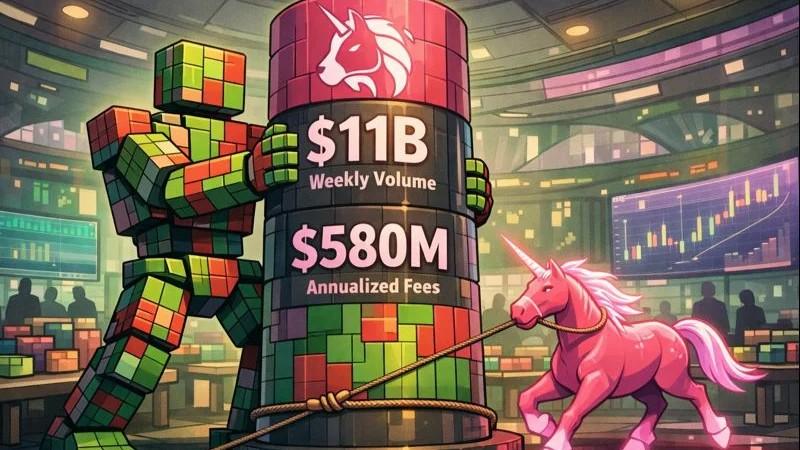
The UNIfication initiative extended far beyond the one-time burn. Core components restructured the protocol’s economic flow by turning on the long-debated fee switch for Uniswap v2 and selected v3 pools, redirecting a share of protocol revenue toward ongoing token reductions rather than exclusively liquidity provider rewards. Governance documents described the 100 million burn as a symbolic representation of what might have been retired if the fee switch had been active since Uniswap’s early years. The proposal also reset interface and frontend fees to zero to streamline value accrual directly to UNI holders, while future mechanisms such as Protocol Fee Discount Auctions were outlined to maintain competitive incentives for liquidity providers without undermining token economics. These changes arrived at a time when Uniswap was processing about $11 billion in weekly trading volume and generating an estimated $580 million in annualized protocol fees, reinforcing its position among the most systemically important platforms in DeFi.
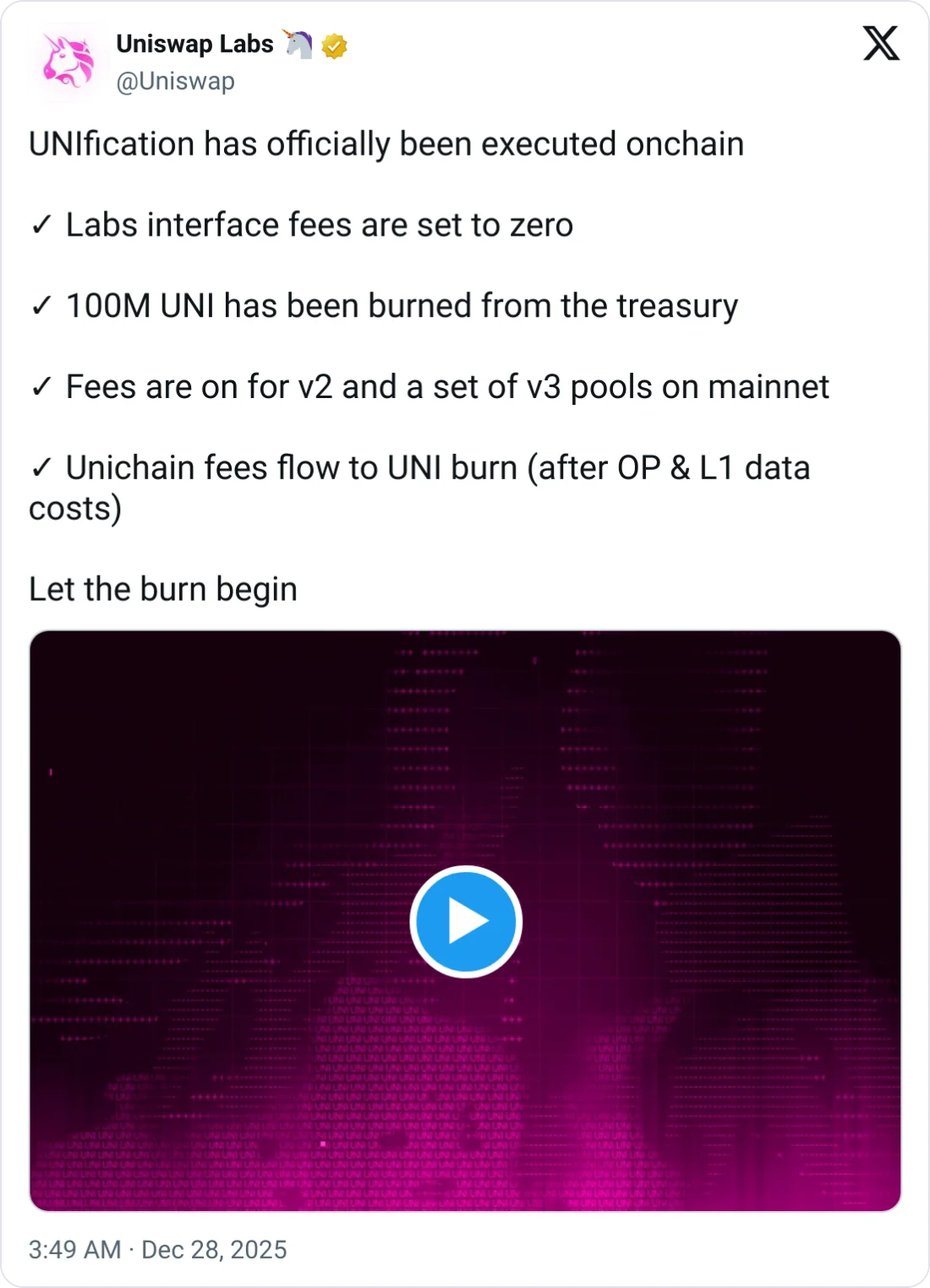
UNI’s trading performance reflected the market’s expectation of a shift in underlying fundamentals. The token climbed roughly 11% around the time burn execution was publicly confirmed, moving from about $5.88 to $6.52 before normal volatility produced temporary retracement. Other market windows captured a 4.53% gain across a 24-hour period after the burn as traders recalibrated assumptions about future supply dynamics relative to the broader crypto price index and coin market cap rankings. Earlier rallies of 15–25% ahead of the vote had already signaled that the market was positioning around a deflationary pivot, even as UNI diverged from typical crypto price correlations during governance-driven repricing. Uniswap Labs later confirmed the execution with the statement, “UNIfication has officially been executed onchain… 100M UNI has been burned from the treasury,” underscoring the finality of the supply reduction and the beginning of a more active fee-to-burn model.
The implications extend well beyond Uniswap’s own ecosystem. The burn established a precedent for how a mature DeFi protocol can integrate revenue, governance, and token scarcity into a sustainable framework without relying on short-term incentives or inflationary emissions. Analysts described the move as a structural evolution that could influence how other protocols design long-term value capture, particularly as DeFi seeks to differentiate itself in a market dominated by shifting regulatory standards, increasingly complex token models, and rapid capital migration across chains. Uniswap’s new framework ties UNI’s economic trajectory more tightly to real protocol activity, marking a rare instance in which decentralized governance produced both a high-participation mandate and a tangible transformation in token mechanics.
This article has been refined and enhanced by ChatGPT.


