




 USD
USD
U.S. Targets A7 Network Over Iran Sanctions Evasion

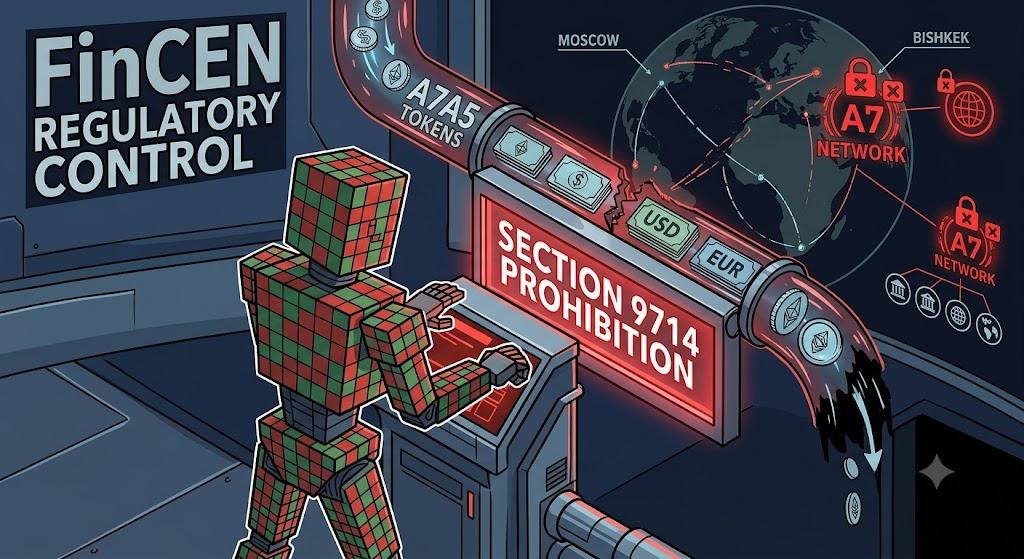
FinCEN proposal would cut A7-linked intermediaries from U.S. finance, including crypto transfers
TL;DR
- OFAC designated the Russia-linked A7 Network a significant transnational criminal organization on October 1, 2026, while FinCEN proposed blocking transfers involving its Sub-Agents.
- FinCEN said more than 180 entities processed at least $179.1 billion in the ruble-backed A7A5 token between February 2025 and June 2026.
- Treasury tied the network to Iranian sanctions evasion, the Islamic Revolutionary Guard Corps, Nobitex, weapons procurement and North Korean crypto hack proceeds.
Trade smarter on Jupiter, Solana’s leading DEX built for fast execution and deep liquidity.
Swap tokens at competitive rates, route across multiple liquidity sources automatically, and access perpetuals, DCA, and advanced trading tools — all in one place!
The U.S. Treasury moved against the Russia-linked A7 Network on October 1, 2026, accusing the shadow banking operation of helping Iran evade sanctions through a mix of conventional finance and cryptocurrency. OFAC designated A7 a significant transnational criminal organization, while FinCEN proposed barring U.S. financial institutions from processing transfers involving A7’s network of Sub-Agents.
FinCEN also issued an alert to help financial institutions detect and report suspicious activity tied to A7 and its affiliates. The measures are part of Operation Economic Outcast, which Treasury said was launched at U.S. President Donald Trump’s direction in late August 2026 as “an economic onslaught against Iran’s financial connections around the globe.”
Treasury Secretary Scott Bessent said: “Today’s action targeting A7 … sends a clear message that if you facilitate illicit finance for America’s adversaries, you will lose access to the U.S. financial system.”
FinCEN is acting under Section 9714 of the Combating Russian Money Laundering Act. The agency selected the sixth of six available special measures, allowing it to prohibit transmittals of funds rather than relying only on restrictions covering correspondent accounts.
TRM Labs said that distinction matters because A7A5 transfers can move outside correspondent banking. The proposed measure extends to fiat and convertible virtual currency and could apply to roughly 348,000 institutions, including cryptocurrency exchanges.
A7A5 Moved $179.1 Billion Through a Crypto-Fiat Settlement Network
A7A5 is a ruble-backed token issued by Kyrgyzstan-registered Old Vector on Tron and Ethereum, with backing held in Russian ruble deposits at Promsvyazbank, or PSB. FinCEN described a mirror settlement system in which tokens move between addresses inside Russia while A7 Sub-Agents execute corresponding overseas transfers in dollars, yuan, dirhams and euros.
FinCEN said more than 180 entities processed at least $179.1 billion in A7A5 between February 2025 and June 2026. Historically, almost all of that activity passed through sanctioned exchanges Garantex and Grinex. A7A5 was commonly used as a bridge into USDT and then fiat.
Following a reported Grinex exploit in April 2026, A7A5 supply became increasingly concentrated in unhosted wallets, which FinCEN viewed as a possible shift away from sanctioned trading venues.
A7 also built a large conventional-finance network. Hundreds of Sub-Agents held accounts at about 435 financial institutions across at least 83 countries and processed more than $17 billion between January 2025 and June 2026. Staff managed some accounts from Moscow through customized VPNs designed to make activity appear to originate in Dubai, Hong Kong or Bishkek.
A separate investigation found that A7 moved nearly $7 billion through the international banking system using forged documents and front companies, including entities in the United Arab Emirates, Hong Kong, Indonesia and Kyrgyzstan. Treasury said those Sub-Agents “form a core layer of the A7 Network’s operational architecture.”
Treasury Links A7 to Iranian and Other Illicit Finance
Treasury said one A7 Sub-Agent dealt directly with entities tied to Iran’s shadow fleet of tankers. That Sub-Agent and a sister company received close to $140 million from firms involved in Iranian sanctions evasion, while another Sub-Agent transferred about $1.6 million to a company linked to weapons procurement.
Treasury also connected A7 to the Islamic Revolutionary Guard Corps, Iranian proxies including Hamas, the designated Iranian digital asset exchange Nobitex and the laundering of proceeds from North Korean cryptocurrency exchange hacks.
A7 was launched in September 2024 by fugitive Moldovan oligarch Ilan Shor and Promsvyazbank. A7 is majority-owned by Shor and co-owned by state-controlled PSB. By January 2025, the network claimed to process more than 2,000 transactions per day.
Shor later said A7 processed 7.5 trillion rubles over 10 months, valued at about $90 billion under one conversion and roughly $91.5 billion under another. Treasury said that volume equaled about 13% of Russia’s 2025 foreign trade transactions.
The European Union had already sanctioned parts of the A7 network, while the UK National Crime Agency issued an alert in August 2026.
FinCEN’s transaction prohibition remains a proposed rule. Its public comment period closes 30 days after publication in the Federal Register.
This article has been refined and enhanced by ChatGPT.


