




 USD
USD
U.S. Soldier Charged Over Polymarket Bets

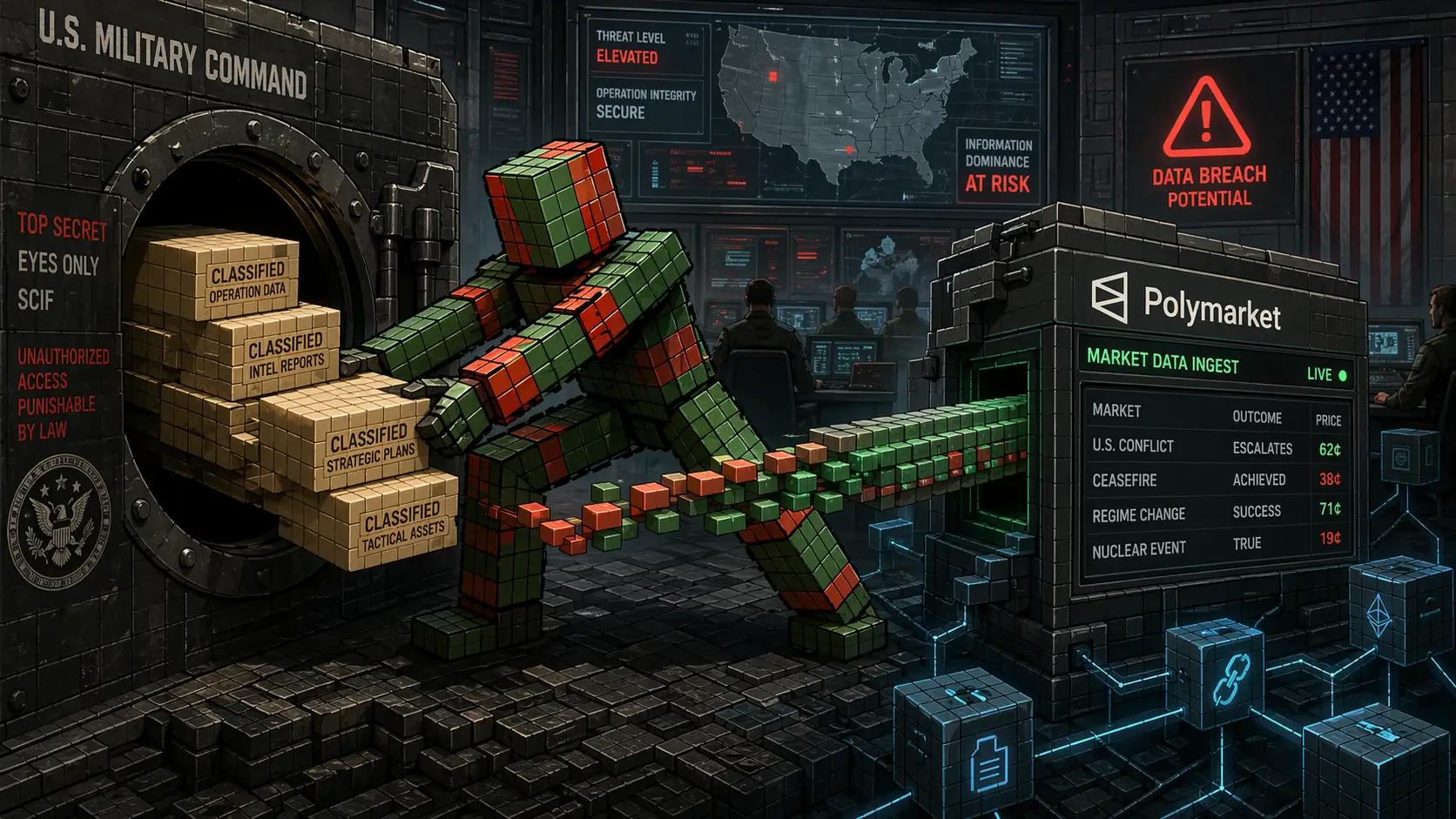
DOJ and CFTC allege classified information fueled Maduro market profits
TL;DR
- U.S. prosecutors charged Gannon Ken Van Dyke over alleged Polymarket bets tied to a U.S. operation against Nicolas Maduro.
- The CFTC said the case is its first insider trading action involving event contracts.
- A separate French weather market probe widened scrutiny of prediction market integrity.
We’ve launched the all-new COIN360 Perp DEX, built for traders who move fast!
Trade 130+ assets with up to 100× leverage, enjoy instant order placement and low-slippage swaps, and earn USDC passive yield while climbing the leaderboard. Your trades deserve more than speed — they deserve mastery.
U.S. prosecutors charged Gannon Ken Van Dyke, a 38 year old active duty U.S. Army soldier from Fayetteville, North Carolina, with allegedly using classified and nonpublic government information to profit from Polymarket bets tied to a U.S. operation against Nicolas Maduro, according to charges unsealed on April 23, 2026.
Van Dyke served as a U.S. Army Special Forces master sergeant stationed at Fort Bragg, North Carolina. He was described as a communications specialist supporting the Joint Special Operations Command, which oversees Delta Force and SEAL Team Six. Prosecutors allege he participated in the planning and execution of Operation Absolute Resolve, the U.S. military operation to capture Maduro.
Van Dyke’s access allegedly began around December 8, 2025, and continued through at least January 6, 2026. Prosecutors said he had signed nondisclosure agreements promising to “never divulge, publish, or reveal by writing, words, conduct, or otherwise … any classified or sensitive information” related to military operations.
Prosecutors Say Bets Followed Classified Access
Polymarket, operated by Blockratize, Inc., had begun offering binary event contracts in 2025 tied to Venezuela and Maduro outcomes. Those markets included whether U.S. forces would enter Venezuela, whether Maduro would be removed from power, whether the U.S. would invade Venezuela, and whether President Donald Trump would invoke War Powers against Venezuela.
The Justice Department said Van Dyke allegedly created a Polymarket account on or about December 26, 2025, funded it, used a VPN, and placed approximately 13 YES bets from December 27, 2025, through the evening of January 2, 2026. The Justice Department put the total alleged wager amount at approximately $33,034.
The CFTC complaint focused on more than 436,000 Yes shares in the “Maduro Out by January 31, 2026?” contract, bought between December 30, 2025, and January 2, 2026. The CFTC said Van Dyke used the Polymarket handle “Burdensome-Mix” and made more than $404,000 in profits from that contract. The Justice Department said he allegedly profited approximately $409,881 across the broader Maduro and Venezuela wagers.
U.S. special forces apprehended Maduro and his wife, Cilia Flores, at a residence in Caracas, Venezuela, during the predawn hours of January 3, 2026. Hours later, Trump publicly announced the successful operation, and Polymarket resolved several relevant contracts to YES.
The CFTC complaint said the Maduro contract stayed below $0.13 from 10:00 a.m. ET on December 29 through 1:15 a.m. ET on January 3, except for a brief spike to about $0.22 around 10:42 p.m. ET on January 2. The contract then jumped from $0.375 at 4:21 a.m. ET to $0.955 at 4:25 a.m. ET after Trump’s public announcement.
Prosecutors said Van Dyke withdrew most of the allegedly unlawful proceeds from his Polymarket account on the same day as the operation. He allegedly sent most of the proceeds to a foreign cryptocurrency vault, deposited funds into a newly created online brokerage account, and later tried to conceal his identity after unusual trading activity surfaced.
On or about January 6, 2026, Van Dyke allegedly asked Polymarket to delete his account while falsely claiming he had lost access to the email address tied to it. That same day, he allegedly changed the email linked to his cryptocurrency exchange account to an address not subscribed in his name and created on or about December 14, 2025.
Officials Frame Case As Insider Trading
Van Dyke faces three Commodity Exchange Act counts carrying maximum sentences of 10 years each, one wire fraud count carrying a maximum sentence of 20 years, and one unlawful monetary transaction count carrying a maximum sentence of 10 years. The Justice Department said any sentence would be determined by a judge.
U.S. Attorney Jay Clayton said, “Prediction markets are not a haven for using misappropriated confidential or classified information for personal gain.” Clayton said Van Dyke allegedly used classified information “to place bets on the timing and outcome of that very operation, all to turn a profit,” which he called “clear insider trading” and “illegal under federal law.”
Acting Attorney General Todd Blanche said, “Widespread access to prediction markets is a relatively new phenomenon, but federal laws protecting national security information fully apply.” FBI Director Kash Patel said, “Any clearance holders thinking of cashing in their access and knowledge for personal gain will be held accountable.” FBI Assistant Director in Charge James C. Barnacle Jr. said Van Dyke allegedly “betrayed his fellow soldiers.”
The CFTC filed a parallel civil complaint in the U.S. District Court for the Southern District of New York on April 23, 2026. The agency is seeking restitution, disgorgement, civil monetary penalties, trading and registration bans, and a permanent injunction against further violations of the Commodity Exchange Act and CFTC regulations.
CFTC Chairman Michael S. Selig said, “I have been crystal clear that anyone who engages in fraud, manipulation, or insider trading in any of our markets will face the full force of the law.” Selig said the alleged conduct “endangered U.S. national security and put the lives of American service members in harm’s way.”
CFTC Director of Enforcement David I. Miller said the case marks “the first time the CFTC has charged insider trading involving event contracts” and “the first time the CFTC has used the so called ‘Eddie Murphy Rule’ to bring charges based on the misuse of government information.”
Polymarket said it identified a user trading on classified government information, referred the matter to the Justice Department, and cooperated with investigators. The platform later said, “Insider trading has no place on Polymarket. Today’s arrest is proof the system works.”
Trump, asked about the case at an Oval Office event, said, “That’s like Pete Rose betting on his own team.” He added, “The whole world, unfortunately, has become somewhat of a casino,” and said he was “not happy” with prediction markets and “was never much in favor of it.” The White House denied staff wrongdoing, and no cited source tied any Trump adviser or official to the trades.
Weather Market Probe Adds Pressure
French authorities are separately investigating suspected physical manipulation of real world infrastructure tied to prediction market payouts. Meteo France filed a police complaint over suspicious temperature spikes at Paris Charles de Gaulle airport that coincided with profitable Polymarket wagers. The broader controversy widened on April 24, 2026, at 6:00 PM, as scrutiny extended from the U.S. military case to market integrity concerns involving Polymarket and Kalshi.
On April 6 and April 15, temperature readings at Paris Charles de Gaulle airport spiked within minutes to 22 C despite ambient conditions suggesting 18 C. The readings triggered payouts to traders who had bet on those exact outcomes. One wallet reportedly made $13,990 from a stake of less than $30 after betting Paris temperatures would hit 21 C at a 0.2 percent implied probability.
Another wallet turned $119 into more than $21,000 by betting temperatures would exceed 18 C at a 0.5 percent implied probability. Trading volume in Polymarket’s Paris temperature market exceeded $500,000 on both anomalous days, more than double typical daily volume.
Meteo France said, “In light of physical findings on one of our instruments and the analysis of sensor data, Meteo France has indeed been led to file a complaint for interference with the operation of an automated data processing system with the Air Transport Gendarmerie Brigade in Roissy.” The agency declined further comment.
Sebastien Brana, who runs Infoclimat, said users first flagged the April 6 anomaly but initially assumed sensor glitches. “We thought it was an issue with the sensors... You can have sudden temperature changes at sundown when there is a storm as well. But the weather situation didn’t explain what was happening,” Brana said. “It became clear there was something else going on when it happened again on April 15.”
Weather enthusiast forums discussed whether a battery powered hairdryer may have been used to manipulate the sensor. Polymarket has since switched the Paris temperature market’s resolution metric from Charles de Gaulle airport to Paris Le Bourget airport, without canceling resolved contracts or refunding bets.
Other integrity incidents cited in the broader scrutiny include Israeli authorities indicting two reservists in February for allegedly using classified information to bet on military operations. A CNN investigation found one trader made nearly $1 million over two years from bets on U.S. and Israeli military actions against Iran. Another cited case involved a $553,000 profit from a bet placed moments before an Israeli airstrike killed Iran’s Supreme Leader.
Earlier suspicious prediction market activity included clusters of wallets that reportedly made over $1 million betting on military strikes involving Iran, with positions opened shortly before the events. No direct link has been established between those accounts and Van Dyke’s case. Kalshi also drew scrutiny after sanctioning three U.S. politicians who bet on outcomes in their own congressional election races.
Regulatory questions are still developing in the United States, where the CFTC and state regulators are evaluating whether prediction markets fall under derivatives law, gambling frameworks, or a new category. The U.K. Gambling Commission considers Polymarket and Kalshi unlicensed betting operators.
The CFTC had already moved toward this enforcement framework in March 2026, when staff described event contracts as derivatives that can fall within swap or futures like definitions depending on structure. The CFTC staff also reminded designated contract markets to monitor trading and prevent manipulation, and said misappropriation of confidential information in breach of trust can fall under antifraud rules commonly described as insider trading.
Polymarket does not require most accounts on its international site to provide identification documents. Polymarket is reportedly in fundraising talks at a valuation of up to $15 billion, while Goldman Sachs and other institutional traders are already using Polymarket data to inform their own positions.
FAQ
Who is Gannon Ken Van Dyke?
A 38 year old active duty U.S. Army Special Forces master sergeant.
What did prosecutors allege?
They alleged he used classified information to profit from Polymarket bets.
What did the CFTC say was historic?
It called the case its first insider trading charge involving event contracts.
What happened in France?
Meteo France filed a complaint over suspicious temperature spikes tied to Polymarket wagers.
This article has been refined and enhanced by ChatGPT.


