




 USD
USD
Vanguard Opens Trading Access to Bitcoin, Ethereum, XRP, and Solana ETFs for 50M Clients


Shift Marks Major Break from Vanguard’s Longstanding Anti-Crypto Stance
TL;DR
- Vanguard now allows its 50M clients to trade SEC-regulated crypto ETFs holding BTC, ETH, XRP, and SOL.
- The shift applies to third-party funds only, with no plans for Vanguard-issued crypto products.
- Even modest allocations could translate into billions in new inflows due to Vanguard’s ~$11T AUM footprint.
Vanguard’s latest policy change lands as one of the firm’s most consequential reversals in years, opening its brokerage platform to third-party ETFs containing Bitcoin, Ethereum, XRP, and Solana after consistently resisting digital-asset exposure. The decision, confirmed on December 2, 2025, grants more than 50 million clients the ability to buy and sell SEC-approved crypto-linked ETFs, while maintaining the company’s conservative posture by refusing to launch its own crypto funds or support high-volatility products tied to speculative tokens.
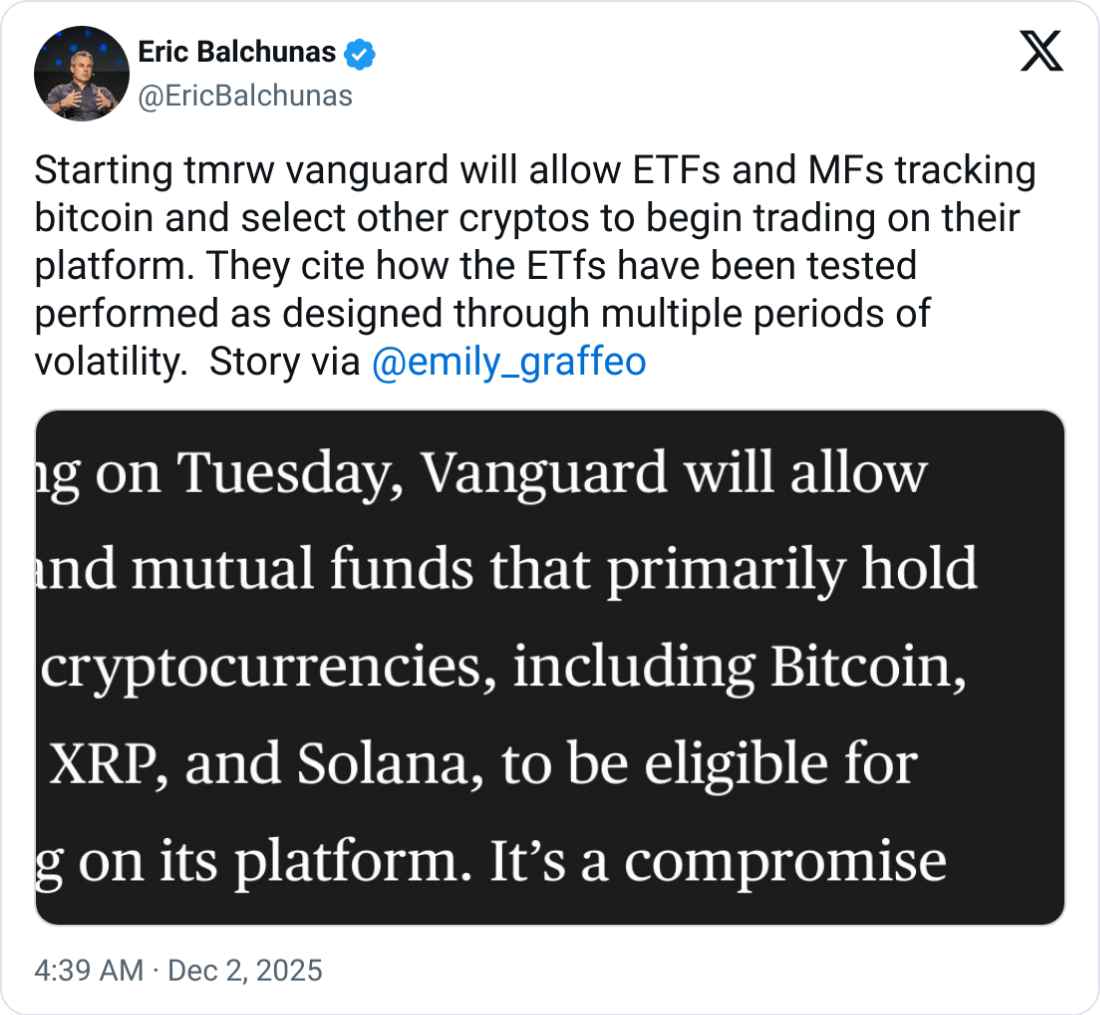
The firm framed the shift as a response to maturing market structure, improved regulatory clarity, and a noticeable evolution in investor preference. A spokesperson underscored the change by noting that cryptocurrency ETFs and mutual funds had “been tested through periods of market volatility, performing as designed while maintaining liquidity,” signaling that operational reliability and compliance infrastructure now meet Vanguard’s internal thresholds. The move follows months of internal evaluation that began around September 2025 under updated leadership, contrasting sharply with the explicit rejection of crypto ETFs by prior executives who argued digital assets lacked long-term investment merit.
Allowing Bitcoin, Ethereum, XRP, and Solana ETFs onto the platform opens a channel with potentially significant market implications—given Vanguard’s roughly $11 trillion in assets under management, even minimal client participation could funnel billions of dollars into regulated crypto markets. Analysts note that this access shift is likely to normalize crypto exposure inside traditional portfolios, moving it from a fringe, speculative segment into a more standardized allocation category among long-term retail investors.
While the policy change increases investor access, Vanguard made clear that it is not embracing the broader digital-asset ecosystem. The firm will not handle direct crypto custody, will stay away from meme-coin-linked financial products, and has no intention of developing proprietary crypto ETF offerings. The brokerage addition signals a strictly defined pathway: investors may access blue-chip crypto assets only through vetted, regulated ETFs that meet Vanguard’s risk and compliance criteria. Industry observers view that boundary-setting as a blueprint for how other conservative institutions may integrate crypto exposure without engaging in the higher-risk, decentralized segments of the market.
This development marks a milestone for mainstream visibility of crypto within traditional finance, reflecting both competitive pressure across the asset-management landscape and the broadening acceptance of regulated digital-asset vehicles among retail investors. Vanguard’s measured, compliance-first entry reinforces the ETF model as the gateway through which most conservative investors will encounter crypto—an approach signaling that digital assets have reached a level of market and regulatory stability significant enough for inclusion on one of the most risk-averse retail platforms in the world.
This article has been refined and enhanced by ChatGPT.


