




 USD
USD
Visa Expands Stablecoin Settlement Pilot to Nine Blockchains

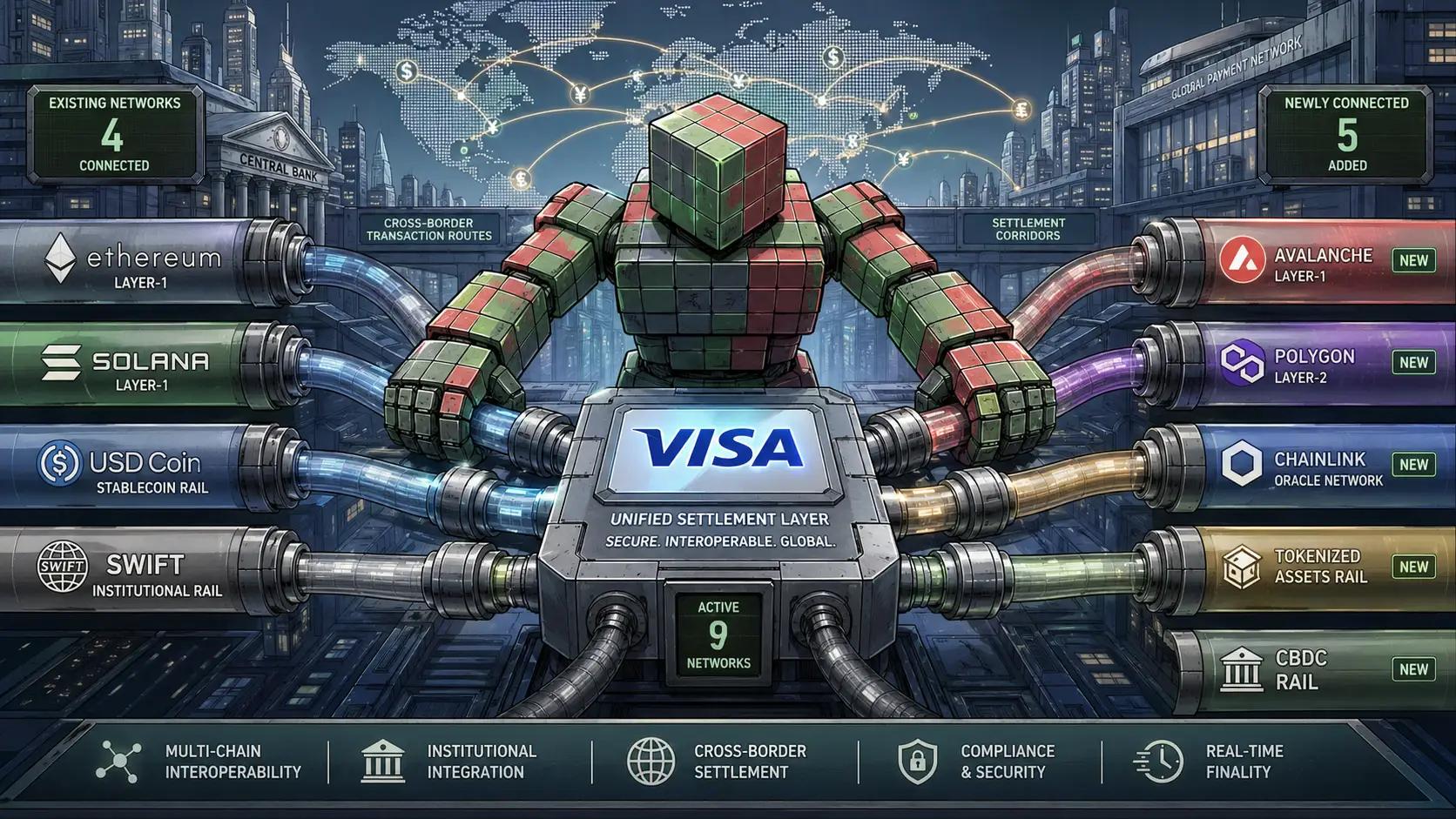
New networks join as annualized settlement run rate reaches $7 billion
TL;DR
- Visa added Arc, Base, Canton, Polygon, and Tempo to its stablecoin settlement pilot.
- The program now supports nine blockchains after starting with Avalanche, Ethereum, Solana, and Stellar.
- Visa said the pilot reached a $7 billion annualized settlement run rate.
We’ve launched the all-new COIN360 Perp DEX, built for traders who move fast!
Trade 130+ assets with up to 100× leverage, enjoy instant order placement and low-slippage swaps, and earn USDC passive yield while climbing the leaderboard. Your trades deserve more than speed — they deserve mastery.
Visa expanded its global stablecoin settlement pilot on April 29, 2026, adding Arc, Base, Canton, Polygon, and Tempo as the program’s annualized settlement run rate reached $7 billion, according to Visa. The move brings the pilot to nine supported blockchains and gives issuers and acquirers more network options for testing blockchain-based settlement.
Visa said the $7 billion annualized run rate was up 50% from the previous quarter, marking record quarter-over-quarter growth for the program. The expansion adds five networks to the existing blockchain roster of Avalanche, Ethereum, Solana, and Stellar, creating a broader multi-chain settlement structure for partners testing stablecoin payments.
Visa Broadens Stablecoin Settlement Options
Rubail Birwadker, Global Head of Growth Products and Strategic Partnerships, Visa, said the expansion reflects how payment partners are operating across several blockchain ecosystems. “Our partners are building in a multi-chain world, and they expect their options to reflect that reality,” Birwadker said, adding that the expansion lets partners choose networks that fit their needs while relying on Visa to provide “a common settlement layer across all of them.”
Visa described Arc as an open Layer-1 blockchain created by Circle and built to connect programmable money and onchain innovation with real-world economic activity. Base was described as a high-performance blockchain powered by Coinbase that enables fast, low-cost settlement for stablecoins, onchain assets, and agentic commerce. Canton was positioned as a blockchain built with configurable privacy for regulated capital markets and compliant institutional settlement.
Visa described Polygon as a blockchain payments solution for fast, low-cost transactions, with high-throughput infrastructure designed for global payments and digital commerce. Tempo was described as a network focused on faster, private, and more efficient movement of stablecoin liquidity and settlement flows.
Nikhil Chandhok, Chief Product and Technology Officer, Circle, said, “Arc is designed to provide the performance, predictability, and reliable access to liquidity needed to support real-time settlement at a global scale,” adding that the work with Visa reflects demand for USDC and blockchain infrastructure that can settle payment flows instantly.
Jesse Pollak, Founder of Base, said, “Our goal with Base has always been to make onchain the new standard,” calling Visa’s expansion “a pivotal step” toward making stablecoin payments a daily reality for billions of people. Eric Saraniecki, Head of Network Strategy at Digital Asset, co-founder of the Canton Network, said Canton was designed for regulated institutions and that Visa’s platform gives them a bridge to explore onchain settlement while staying aligned with compliance requirements.
Marc Boiron, CEO, Polygon Labs, said, “Visa adding Polygon signals that stablecoins are moving into real world payments at scale,” adding that Visa’s reach and Polygon’s infrastructure make stablecoin settlement more practical, reliable, and accessible for partners. Ani Narayan, GTM, Tempo, said Tempo is focused on real-time stablecoin settlement and that Visa’s role as both a validator and settlement partner helps bring always-on, programmable payments closer to the mainstream.
Pilot Growth Builds on Earlier Rollouts
Visa said the expansion follows years of live pilots and regional rollouts across LAC, Europe, AP, and CEMEA. The company also pointed to its recent expansion of USDC settlement to U.S. banks and more than 130 stablecoin-linked card programs in over 50 countries.
The pilot launched in 2023 and allows Visa partners to settle transactions using stablecoins instead of traditional banking rails. Its stated goal is to evaluate faster settlement, round-the-clock availability, and cross-border payment efficiencies.
Visa framed stablecoin settlement over blockchain infrastructure as a viable complement to traditional settlement rails, not a wholesale replacement for every existing payment rail. The company said supporting multiple blockchains gives partners more flexibility in accessing liquidity across ecosystems while Visa handles part of the underlying complexity through a trusted global network.
Arc, Tempo, and Canton were newer blockchain entrants that already had Visa support before this settlement expansion. Visa acted as a design partner for Arc and later became a validator for both Tempo and Canton.
Stablecoins in circulation have surpassed $320 billion, rising nearly 150% since early 2024, according to DeFiLlama data. The broader stablecoin payments race also includes Mastercard activity, U.S. stablecoin-linked card spending through wallet integrations such as MetaMask, and Modern Treasury’s integration with Polygon after acquiring Beam in October.
U.S. stablecoin momentum has also been shaped by the GENIUS Act, which established clearer regulatory standards for payment stablecoins. Broader policy questions, including whether stablecoins can offer yield, remain under debate in a stalled U.S. market structure bill.
FAQ
How many blockchains does Visa’s pilot support now?
Visa’s stablecoin settlement pilot now supports nine blockchains.
Which blockchains did Visa add?
Visa added Arc, Base, Canton, Polygon, and Tempo.
What run rate did the pilot reach?
The pilot reached a $7 billion annualized settlement run rate.
When did the pilot launch?
Visa’s stablecoin settlement pilot launched in 2023.
This article has been refined and enhanced by ChatGPT.


