




 USD
USD
Vitalik Buterin Says Ethereum’s ZK Speed Race Is Won, Security Takes Priority


ZKsync’s Airbender Prime benchmark shifts the zkEVM debate from proving speed to formal guarantees
TL;DR
- Vitalik Buterin says the zkEVM “battle for speed” is over and security should now become the top priority.
- ZKsync says Airbender Prime proved 99% of 7,200 consecutive Ethereum mainnet blocks in under 10 seconds on a single graphics card.
- Buterin wants formal verification around Ethereum-spec equivalence, prover costs and the proof system itself.
Trade smarter on Jupiter, Solana’s leading DEX built for fast execution and deep liquidity.
Swap tokens at competitive rates, route across multiple liquidity sources automatically, and access perpetuals, DCA, and advanced trading tools — all in one place!
Ethereum co-founder Vitalik Buterin said on October 15, 2026, that the race to make zero-knowledge proofs fast enough for Ethereum has been “definitively won,” shifting his focus toward zkEVM security. His comments followed ZKsync’s claim that its Airbender Prime prover generated proofs for 99% of 7,200 consecutive Ethereum mainnet blocks in under 10 seconds using a single graphics card. The performance figures came from ZKsync’s own evaluation.
Ethereum validators currently re-run transactions to verify blocks. Zero-knowledge proofs instead allow them to check a shorter proof showing that the computation was performed correctly.
Ethereum produces a block every 12 seconds, and ZKsync said none of the blocks in its sample took that long to prove. ZKsync also said the public ETHproofs prover leaderboard ranks Airbender Prime first by average proving time and argued that its lower hardware requirements could make proving accessible to more institutions and independent operators.
Buterin Wants Ethereum zkEVMs to Prove Their Security
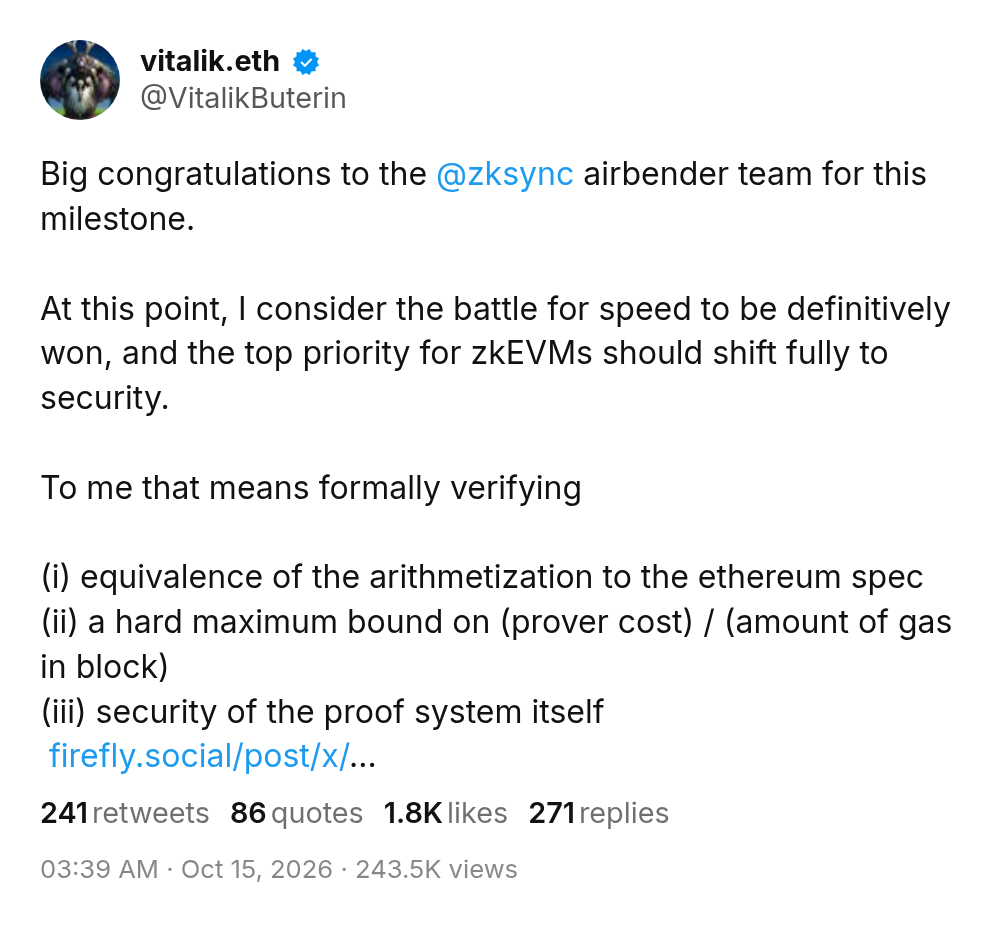
Buterin congratulated ZKsync’s Airbender team before laying out what he sees as the next priorities for zkEVM developers:
“Big congratulations to the @zksync airbender team for this milestone.
At this point, I consider the battle for speed to be definitively won, and the top priority for zkEVMs should shift fully to security.
To me that means formally verifying
(i) equivalence of the arithmetization to the ethereum spec
(ii) a hard maximum bound on (prover cost) / (amount of gas in block)
(iii) security of the proof system itself”
The first requirement concerns proving that the mathematics used by a zkEVM matches Ethereum’s specification. The second would place a firm limit on how expensive proving can become relative to the gas contained in a block. The third focuses on the underlying proof system. Buterin wants those properties formally verified, meaning mathematically proven rather than relying only on testing.
Prover costs also carry decentralization implications. A system that becomes too expensive when processing heavier blocks could push smaller operators out, according to the material accompanying Buterin’s comments. His priority is therefore no longer simply producing proofs faster, but closing security and cost-related gaps before zkEVM technology takes on a larger role.
Airbender Prime Does Not Directly Change ETH Economics
Airbender Prime is a ZKsync prover rather than an Ethereum protocol change. It does not alter Ethereum’s supply, fees or staking rewards. Any connection between the proving milestone and the ETH price would therefore be indirect rather than a mechanical change to the asset’s economics.
ZKsync has also pitched the proving technology to banks, arguing that even a compromised server could not produce a verified ledger update that broke the system’s rules. That puts the emphasis on whether fast proofs are also dependable: the performance milestone addresses proving speed, while Buterin’s stated priority now centers on formally demonstrating that zkEVM systems behave securely and within defined cost limits.
This article has been refined and enhanced by ChatGPT.


