


 USD

Walmart, Eli Lilly Join 38 Companies Opposing OKXICE Tokenized Stocks

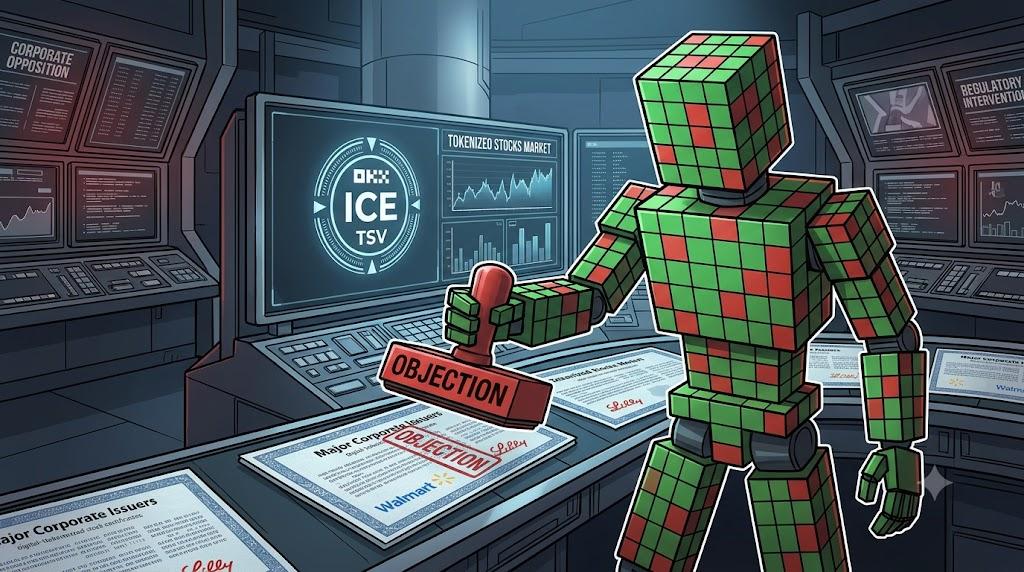
SEC exemption lets issuers block third-party tokenized share listings
TL;DR
- Walmart, Eli Lilly, Cigna Group, Carnival and Arcos Dorados joined the companies objecting to OKXICE TSV.
- The latest opposition extends beyond technology and finance into retail, health care and travel.
- Under the SEC exemption, a timely written objection blocks an unaffiliated third-party tokenized listing on that venue.
Trade smarter on Jupiter, Solana’s leading DEX built for fast execution and deep liquidity.
Swap tokens at competitive rates, route across multiple liquidity sources automatically, and access perpetuals, DCA, and advanced trading tools — all in one place!
Walmart, Eli Lilly, Cigna Group, Carnival and Arcos Dorados have objected to having tokenized versions of their shares offered on OKXICE TSV, according to an updated notice dated October 28. The five additions bring the number of objecting companies to 38 as corporate resistance spreads across more industries. Walmart is the world’s largest retailer by revenue, while Cigna and Carnival add health insurance and travel companies to the growing group.
The total represents roughly 60% of the 63 companies initially identified for tokenization. Together, the objecting companies represent more than $19.4 billion in combined market cap. Eli Lilly is one of the world’s most valuable pharmaceutical companies and a major participant in the weight-loss drug market. Arcos Dorados has been described as the largest independent McDonald’s franchisee globally and the largest McDonald’s franchisee in Latin America, joining McDonald’s itself among companies opposing listings.
Objections have climbed quickly since mid-October
The objection tally has risen sharply since OKXICE TSV published its first list. A prior update added Coca-Cola, JPMorgan Chase, Dell Technologies, AMD, Applied Materials, Adobe and Sandisk. Other earlier objectors include Microsoft, Google parent Alphabet, Intel, Oracle, IBM, Goldman Sachs, Wells Fargo, McDonald’s, Verizon, UnitedHealth Group and Moderna.
SEC rules give companies a formal objection mechanism
The objections have direct consequences under the U.S. Securities and Exchange Commission’s innovation exemption, which the agency introduced in September after the Clarity Act stalled in the Senate. The temporary regulatory relief allows qualifying platforms to facilitate tokenized stock trading without complying with certain traditional exchange requirements. A venue seeking to offer shares tokenized by an unaffiliated third party must first notify the underlying public company.
A company that submits a written objection within 30 days prevents the venue from making that third-party tokenized version of its stock available under the exemption. The objection applies only to the specific venue. The public notices identify which companies have objected but do not provide their individual reasons. Former New York Gov. Andrew Cuomo, who serves on OKX’s board and co-chairs OKXICE, played down the objections during an October 20 press conference, characterizing the regulatory initiative as an experiment and suggesting companies could adopt tokenization at different stages.
OKXICE plans round-the-clock tokenized U.S. stock trading
OKXICE TSV is a 50-50 joint venture between Intercontinental Exchange, the parent of the New York Stock Exchange, and OKX’s U.S. holding company. The planned venue would allow approved users to trade tokenized U.S. stocks 24/7. The tokens would be backed by actual shares held through registered broker-dealers, while trades would run through permissioned Uniswap v4 pools on OKX’s XLayer blockchain and use stablecoins such as USDC. OKX and ICE first teamed up on tokenized securities earlier this year before announcing the venue this month.
The SEC exemption caps the venue at 75 of the largest and most liquid stocks, with trading limited to 0.25% of each stock’s average daily volume, plus as many as 250 other stocks with a 2.5% limit. OKXICE has also said it can list shares tokenized by issuers themselves, giving those companies direct control over how their stock appears onchain. Nvidia, Tesla, Apple and Amazon are among heavily traded companies that had not objected, leaving room for the list to grow during the remaining objection windows.
This article has been refined and enhanced by ChatGPT.


