




 USD
USD
Western Union Launches USDPT Stablecoin on Solana, Taps Anchorage and Crossmint for Global Remittance Network


Legacy Remittance Giant Introduces Digital Asset Network Linking Stablecoins to 360,000 Cash Payout Locations
TL;DR
- Western Union confirmed the launch of its U.S. dollar–pegged stablecoin USDPT on the Solana blockchain, with issuance handled by Anchorage Digital Bank and infrastructure support from Crossmint.
- The company is building a Digital Asset Network connecting stablecoins, wallets, and fintech apps with Western Union’s 360,000 retail payout locations across more than 200 countries and territories.
- The initiative targets the $600 billion–$700 billion global remittance market, where cross-border transfers currently average 6.5% in fees, while blockchain settlement could reduce costs by as much as 50%.
We’ve launched the all-new COIN360 Perp DEX, built for traders who move fast!
Trade 130+ assets with up to 100× leverage, enjoy instant order placement and low-slippage swaps, and earn USDC passive yield while climbing the leaderboard. Your trades deserve more than speed — they deserve mastery.
Western Union confirmed plans to launch a U.S. dollar-pegged stablecoin called USDPT on the Solana blockchain as part of a broader effort to integrate blockchain payments with its global remittance infrastructure. The announcement, reported on March 5, 2026, introduces a digital dollar token designed for cross-border transfers and payment settlement through the company’s network. USDPT will be issued by Anchorage Digital Bank, a federally chartered crypto bank in the United States, while blockchain infrastructure provider Crossmint will supply wallet systems and payment APIs. The rollout follows an earlier announcement made in October 2025 describing plans to introduce the stablecoin during the first half of the year.
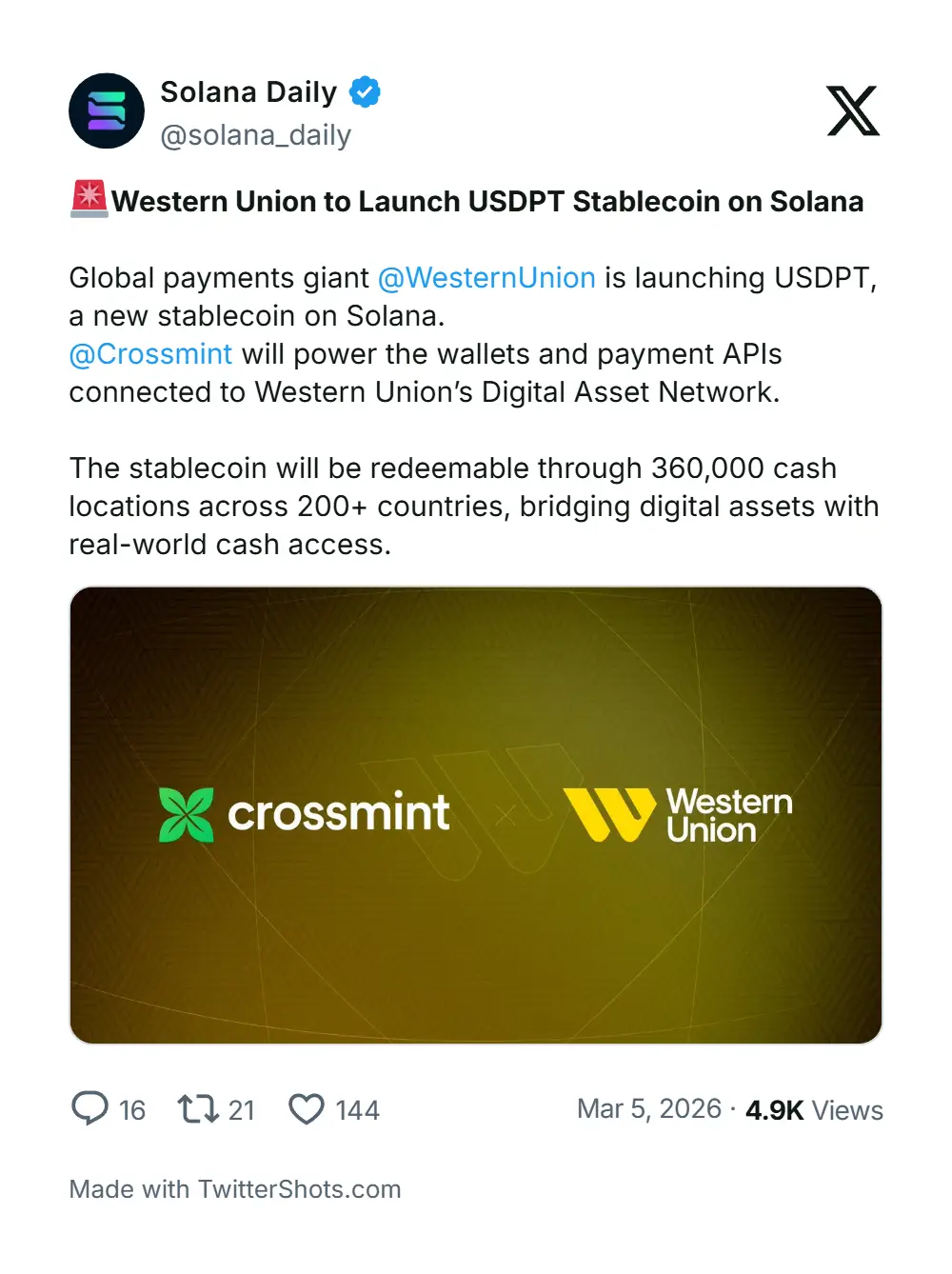
Western Union paired the stablecoin rollout with the creation of a new Digital Asset Network designed to connect stablecoins, wallets, exchanges, and fintech applications to its existing payout infrastructure. The system will allow users to send, receive, hold, and spend USDPT while converting digital assets into cash through Western Union’s retail footprint. The company operates more than 360,000 payout locations worldwide and maintains payment corridors spanning over 200 countries and territories with support for more than 130 currencies, providing access points for users who rely on physical cash transfers.
Chief Executive Officer Devin McGranahan described the initiative as part of a broader technology transition underway inside the payments company. “We are committed to leveraging emerging technologies to empower our customers and communities,” McGranahan said. He added that the stablecoin strategy would allow the firm to capture value within the digital asset economy, stating, “Western Union’s USDPT will allow us to own the economics linked to stablecoins.”
Western Union selected Solana as the underlying blockchain network because of its transaction speed and low operational costs. Transfers on the network settle within seconds and typically incur fees of about 0.000005 SOL per transaction, a fraction of a cent. Stablecoin activity on the network has increased sharply, with market observers noting that transaction volume reached approximately $650 billion during February 2026 as usage expanded across decentralized finance and payment applications.
Company executives positioned the stablecoin initiative within the context of the global remittance industry, a sector valued at roughly $600 billion to $700 billion annually. International transfers in that market typically carry an average cost of about 6.5%, according to widely cited World Bank estimates. Blockchain-based remittance systems using stablecoins can reduce the cost of sending money across borders by as much as 50% even after accounting for compliance and conversion processes. Western Union itself processes between $103 billion and $150 billion in remittance transactions each year through its existing transfer network.
Crossmint’s technology will provide the software layer connecting wallets and financial applications to the stablecoin infrastructure. The company supplies blockchain payment tools and programmable wallet systems that allow developers to integrate digital asset transfers into financial platforms. Crossmint reports that its services are used by more than 40,000 clients worldwide. Rodrigo Fernández Touza, a co-founder of the firm, described the role of stablecoins in financial infrastructure, saying, “Stablecoins are quickly becoming a foundation for global treasury money movement.”
Western Union’s Digital Asset Network is designed to integrate blockchain transactions with traditional financial access points. Malcolm Clarke, the company’s vice president of digital assets, said the infrastructure aims to connect digital tokens with the company’s cash distribution network. “Western Union’s Digital Asset Network is designed to link digital value with our global cash and payout ecosystem,” Clarke said.
Stablecoins have emerged as a rapidly expanding sector within digital finance, led by large tokens used for trading and settlement across crypto markets. Circle’s USDC stablecoin has about $73.7 billion in circulation and accounts for roughly 24% of the sector’s market share. PayPal’s PYUSD stablecoin has also expanded to the Solana network, recording supply growth of 16.66% over a recent 30-day period. Western Union’s USDPT enters a competitive landscape that includes payment-focused digital dollars and projects targeting institutional settlement and cross-border transfers.
Blockchain-based remittance services have already begun appearing across the financial sector as traditional money transfer companies experiment with digital assets. MoneyGram previously introduced transfers using the USDC stablecoin on the Stellar network to enable blockchain settlement for international payments. Western Union’s stablecoin initiative arrives as financial institutions increasingly explore tokenized payment rails for faster settlement and lower transaction costs.
Western Union traces its origins to 1861, when the company helped build the first transcontinental telegraph network in the United States before evolving into a global money transfer provider. The firm now serves more than 100 million customers worldwide through a combination of digital services and physical agent locations. McGranahan referenced the company’s history while discussing its technology transition, stating, “We are a long way from the telegraph, but the idea of connecting people and using technology to do it is deeply in our roots for 175 years.”
This article has been refined and enhanced by ChatGPT.


