




 USD
USD
Zcash Governance Crisis Triggers Developer Exodus, Wallet Spin-Out, and Sharp ZEC Price Volatility in Early 2026

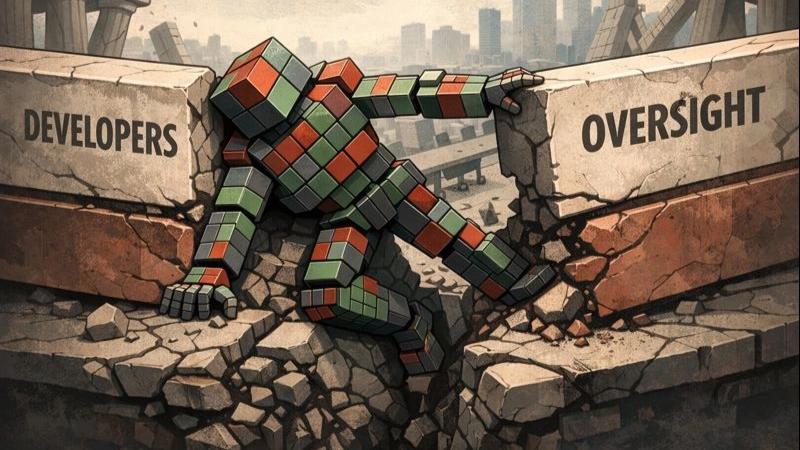
Developers Quit, Markets React, and the Foundation Pushes Back as Zcash Enters a Defining Moment
TL;DR
- Zcash’s entire core development team resigned in early January 2026 following a governance dispute, triggering a double-digit drop in ZEC and a surge in trading volume.
- Departing developers announced plans to continue Zcash development independently and to launch a new wallet, cashZ, built from the Zashi codebase.
- The Zcash Foundation insists the network remains fully operational and decentralized despite record selling pressure and declining development activity.
We’ve just launched the all-new COIN360 Perp DEX, built for traders who move fast!
Trade 130+ assets with up to 100× leverage, enjoy instant order placement and low-slippage swaps, and earn USDC passive yield while climbing the leaderboard. Your trades deserve more than speed — they deserve mastery.
Zcash entered 2026 facing one of the most consequential internal upheavals in its history, as governance tensions boiled over into the resignation of its entire core development team and sent shockwaves through markets tracking the crypto price index. On January 7, 2026, Electric Coin Company CEO Josh Swihart confirmed that roughly 25 ECC staff members, including senior engineers and Chief Scientist Chelsea Komlo, had stepped down simultaneously, describing the situation as a case of “constructive discharge.” Swihart said changes imposed by a majority of board members at Bootstrap, the governance body overseeing ECC, fundamentally altered working conditions and created what he characterized as an untenable environment for continuing Zcash’s original mission. He specifically named Zaki Manian, Christina Garman, Alan Fairless, and Michelle Lai as board members whose direction he said no longer aligned with the project’s founding principles.
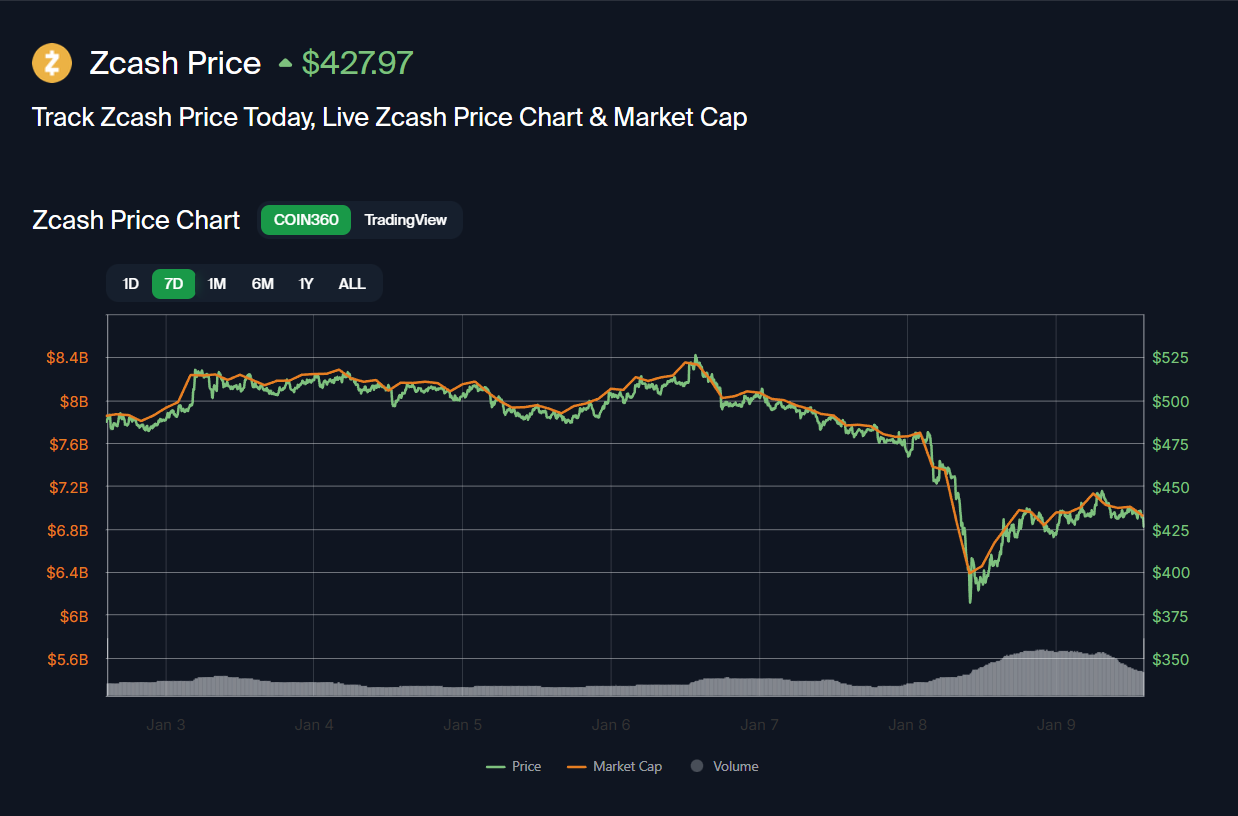
News of the resignations rippled quickly across trading desks and social channels, translating governance uncertainty into immediate market stress. ZEC recorded a steep sell-off, falling as much as 17.6% at its intraday low to roughly $382 before recovering part of the losses to trade near $401 by the time initial reports circulated. Daily trading volume surged to around $780 million, roughly 12% higher than the prior session, signaling heightened speculative activity and forced repositioning. Technical indicators cited by market analysts pointed to growing bearish momentum, with short-term averages rolling over and sentiment gauges reflecting caution as ZEC’s crypto price struggled to stabilize amid the headlines. However, subsequent price action showed a partial rebound, with ZEC later recovering above the $428 level, indicating that some buyers stepped back in after the initial wave of panic selling.
Despite the severity of the market reaction, multiple observers stressed that the turmoil was organizational rather than technical. Zcash’s blockchain continued producing blocks normally, with consensus, privacy features, and cryptographic guarantees intact. Still, the optics of a mass departure from a long-standing privacy-focused project weighed heavily on sentiment, especially as on-chain analytics showed development activity dropping to its lowest levels since 2021. That decline, attributed largely to the sudden exit of the core engineering team, raised concerns about the pace of future upgrades, including work related to advanced zero-knowledge proof systems such as Halo-based implementations, even as the protocol itself remained live.
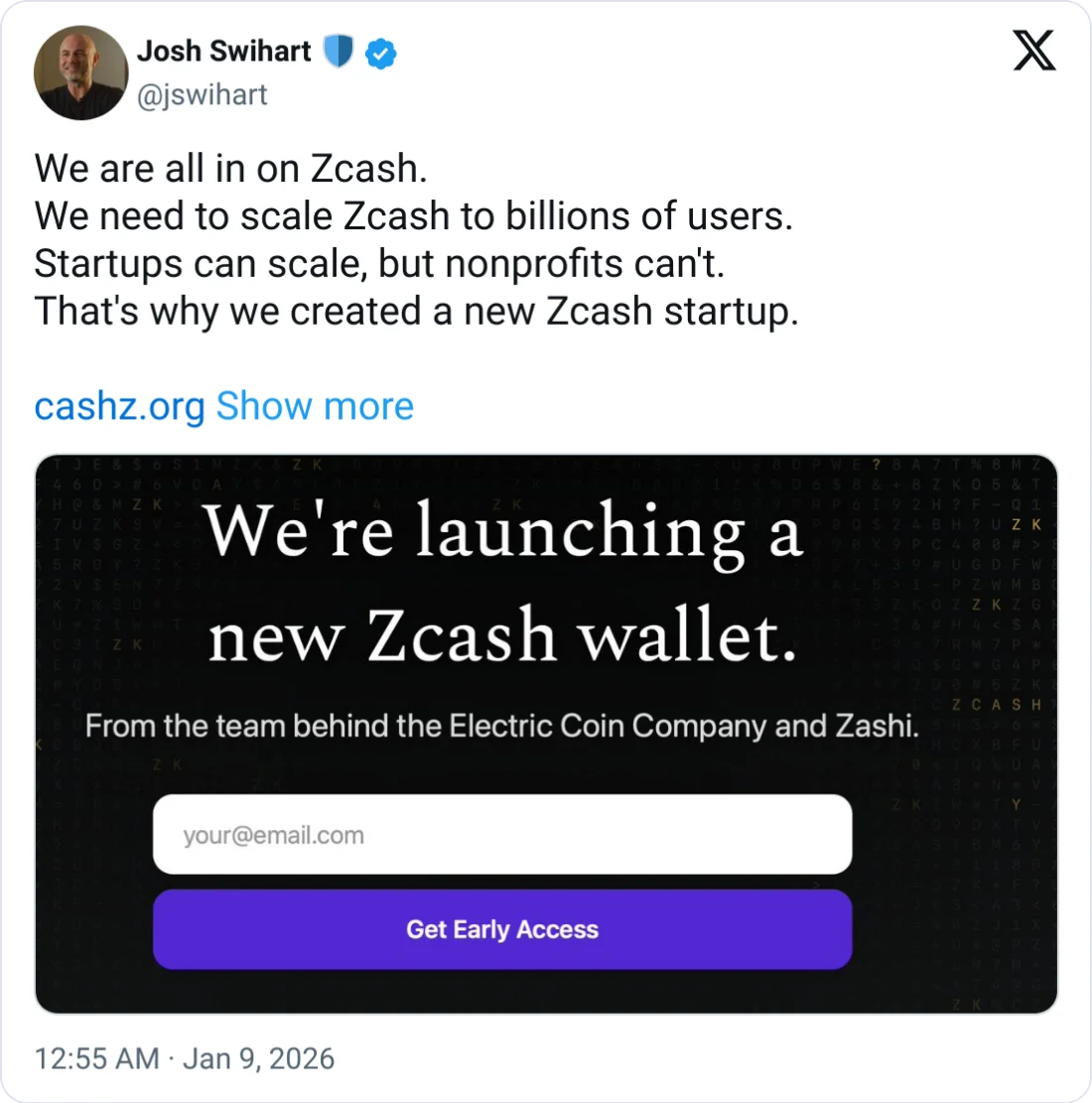
Developers who resigned moved quickly to clarify their next steps, aiming to reassure users and contributors unsettled by the split. Swihart and former ECC engineers announced plans to form a new independent company dedicated to continuing Zcash development outside the existing governance structure. As an early signal of execution, the group revealed a forthcoming wallet called cashZ, built on the existing Zashi codebase. The wallet is positioned as a continuity product rather than a fork, with no new token planned and a migration path for current users through a waitlist system. The announcement framed cashZ as a way to accelerate user adoption and maintain momentum while broader governance questions play out, though its launch also underscored the fragmentation now visible within the Zcash ecosystem.
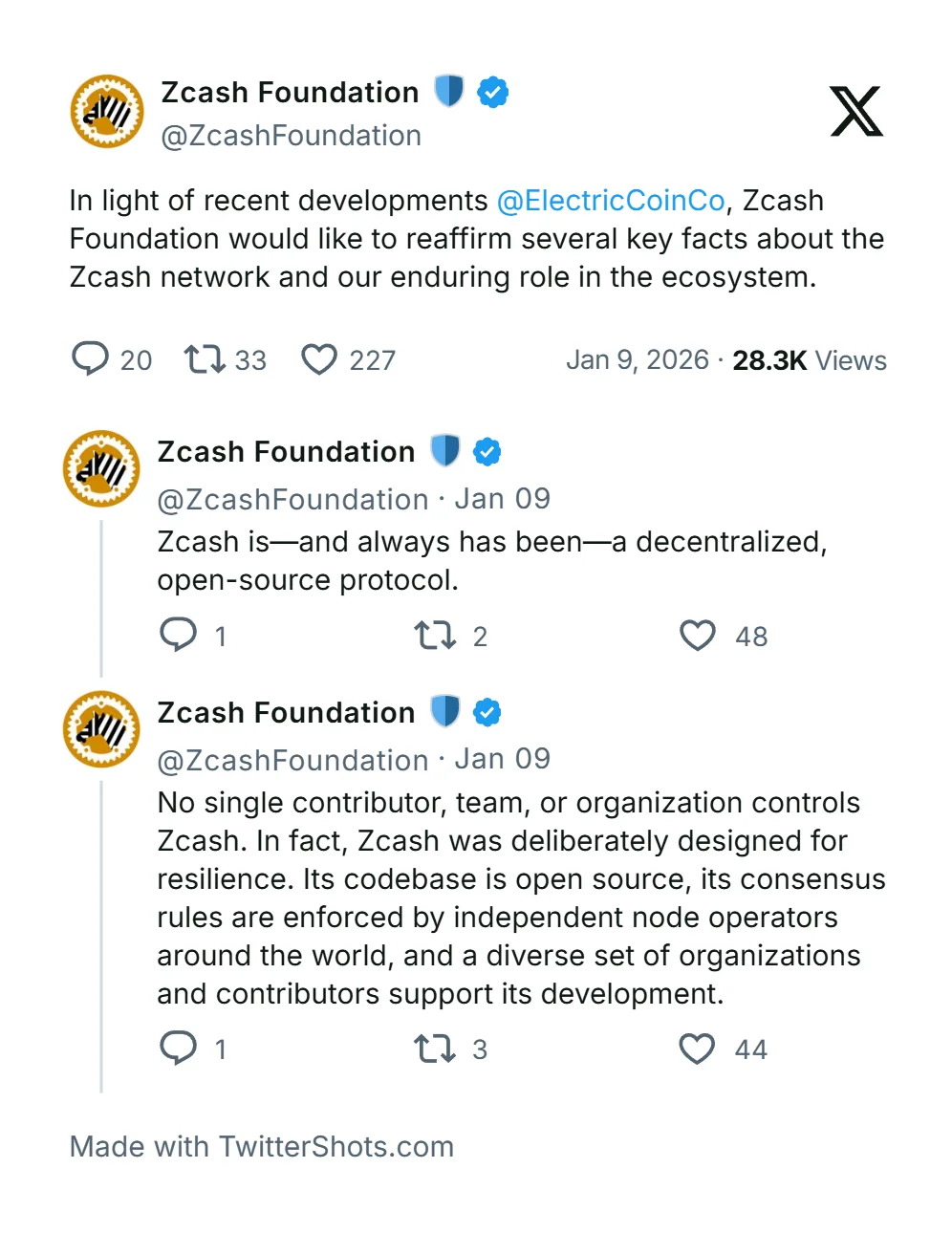
Pressure intensified further as the Zcash Foundation stepped in publicly on January 9, 2026, seeking to draw a clear line between organizational conflict and network health. Foundation representatives emphasized that Zcash was designed so that no single team or institution controls its operation, arguing that decentralization is precisely what allows the protocol to endure moments like this. Statements highlighted that the network remained secure and functional, even as high selling pressure pushed ZEC lower on price charts and affected its standing within the broader coin market cap rankings. The Foundation acknowledged the drop in visible development activity but urged observers to avoid conflating governance disputes with systemic failure, framing the episode as a stress test rather than an existential threat.
Community reaction has been divided, reflecting deeper questions about how decentralized projects balance nonprofit oversight, corporate development teams, and long-term stewardship. Critics argue that leadership vacuums and public disputes risk delaying upgrades, complicating audits, and weakening external confidence, regardless of whether the chain itself keeps running. Others counter that the developers’ decision to regroup independently could ultimately streamline decision-making and reduce political friction, potentially benefiting innovation over the long term. For now, those debates remain largely theoretical, while markets focus on immediate signals, price levels, and liquidity conditions.
What remains clear is that Zcash’s early-2026 crisis has fused governance, development, and market dynamics into a single narrative. A governance clash escalated into a mass resignation, that resignation fed into sharp ZEC price swings tracked across the crypto price index, and the resulting volatility forced both developers and the Foundation to publicly articulate their visions for the project’s future. As traders watch the crypto price stabilize or slide further and analysts reassess ZEC’s place within the evolving coin market cap landscape, Zcash finds itself at a crossroads where organizational decisions may prove as influential as code in shaping its next chapter.
This article has been refined and enhanced by ChatGPT.


