


 USD

Zcash Grant Funding Dispute Widens as Policy Group Presses SEC on Privacy

Bowe seeks to redirect ZCG subsidies while Swihart wants the full development fund retired
TL;DR
- Sean Bowe proposed ending Zcash Community Grants’ automatic funding and redirecting its 8% block subsidy allocation to the Network Sustainability Mechanism.
- Josh Swihart opposed shutting down only ZCG, arguing that both the ZCG and coinholder funding streams should be retired.
- Pretty Good Policy for Zcash separately asked the SEC to allow targeted proof of fundraising claims without exposing unrelated wallet histories.
Trade smarter on Jupiter, Solana’s leading DEX built for fast execution and deep liquidity.
Swap tokens at competitive rates, route across multiple liquidity sources automatically, and access perpetuals, DCA, and advanced trading tools — all in one place!
Zcash co-founder Sean Bowe has proposed ending automatic funding for Zcash Community Grants and redirecting its block subsidy allocation to the Network Sustainability Mechanism, prompting Zcash Open Development Lab founder Josh Swihart to argue that the entire development fund should instead be retired.
Separately, Pretty Good Policy for Zcash is pressing the U.S. Securities and Exchange Commission to structure proposed crypto disclosure rules so issuers can verify material claims without exposing unrelated financial activity.
Bowe Wants ZCG’s Automatic Funding Stream Shut Off
Bowe submitted a draft Zcash Improvement Proposal seeking to stop the ZCG funding stream and move its remaining subsidy allocation to the Network Sustainability Mechanism, or NSM. ZCG traces back to Zcash Open Major Grants, introduced in 2020. Builders can seek funding through open or invite-only grants, with approvals handled by a five-person committee elected by the Zcash community. The program has now operated for nearly six years.
“It’s time to turn off the ZCG funding stream,” Bowe wrote on X. “ZCG has over $125M in funding, and will receive millions more before the spigot is turned off. The program was never designed to handle this amount of funding.”
The proposal argues that ZCG has accumulated enough resources to continue supporting projects without further automatic allocations. Its principal funding figures are:
Under Bowe’s plan, redirected funds would be credited to the NSM and withheld from immediate circulation, subject to the mechanism’s existing rules for possible future issuance. The change would preserve Zcash’s maximum supply, existing transaction formats and miners’ proportional share of block subsidies. ZCG would keep control of its accumulated treasury, continue approving grants and meet commitments already outstanding.
The proposal remains a draft. It has not been approved or scheduled for activation, has no assigned activation height and is not part of the currently specified Network Upgrade 7. A later network upgrade would be required before the existing funding stream expires, and no reference implementation or activation date has been established.
COIN360 data placed the Zcash (ZEC) price at around $1,248 on Tuesday, up 2% over the previous 24 hours.
Swihart Wants Both Development Fund Streams Retired
Swihart pushed back on Bowe’s proposal because it targets ZCG while leaving the coinholder-controlled stream intact. He argued that removing only one part of the development fund would amount to a partial solution and could create additional community division and market uncertainty.
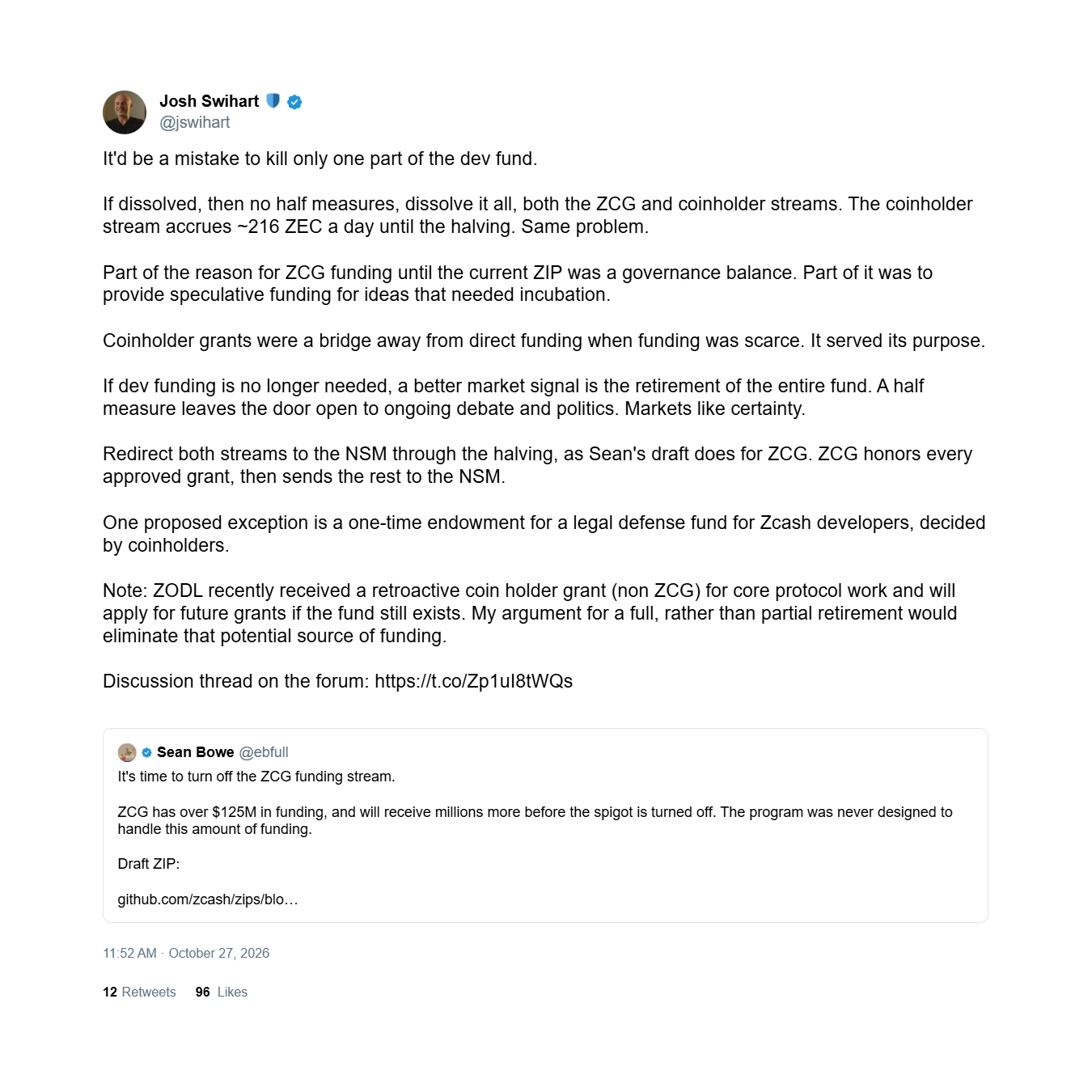
“It’d be a mistake to kill only one part of the dev fund,” Swihart said. “If dissolved, then no half measures, dissolve it all, both the ZCG and coinholder streams. The coinholder stream accrues ~216 ZEC a day until the halving. Same problem.”
Swihart said both funding streams should instead be redirected to the NSM through the upcoming halving while previously approved ZCG grants are honored. He argued that ZCG was designed to balance governance and incubate speculative ideas, while coinholder grants served as a temporary bridge when funding was scarce. Swihart said “markets like certainty” when arguing for a broader retirement of the funding structure.
His proposal would include one exception: a one-time endowment approved by coinholder vote to fund legal defense for Zcash developers. Swihart also acknowledged that ZODL would lose access to a major funding source under his approach. The organization recently received a retroactive coinholder grant for core protocol work.
PGPZ Presses SEC to Protect Unrelated Wallet Activity
A separate Zcash policy effort is focused on how much financial history crypto issuers could be required to expose under proposed SEC disclosure rules. Pretty Good Policy for Zcash, or PGPZ, asked the agency to let issuers substantiate fundraising claims with evidence tailored to the claim being verified rather than exposing unrelated wallet activity.
PGPZ made the request in an Oct. 20 submission. The group argues that proving a blockchain transaction followed a network’s rules does not by itself show how an issuer used investor funds. Depending on the assertion being tested, accounting records or other financial evidence could still be necessary.
SEC Chairman Paul Atkins had addressed the underlying privacy issue in remarks on Dec. 15, describing zero-knowledge proofs, selective disclosure and wallet designs as possible tools for demonstrating compliance without surrendering an entire financial history. Atkins expressly said those views were his own and did not necessarily represent the SEC or other commissioners.
PGPZ wants material holdings and conflicts to remain publicly disclosed while supporting evidence is structured to avoid revealing unrelated financial activity. By Oct. 26, the SEC docket continued to classify Regulation Crypto Assets as a proposed rule after the comment deadline had passed, meaning the protections requested by PGPZ had not become an adopted compliance framework.
SEC Proposal Sets Disclosure Rules for Crypto Fundraising
The SEC proposal was issued Aug. 18 and would establish two exemption tracks for eligible issuers.
Eligible issuers using those exemptions would receive a tailored route around securities registration requirements while remaining subject to disclosure obligations and federal antifraud and antimanipulation provisions.
Rule 103 would establish narrative disclosure requirements. Paragraph 103(b)(7) covers material token economics and allocations, including supply, pricing, lockups, distribution methods, holdings by related persons and release schedules. It also covers mechanisms for creating or destroying tokens and methods used to verify transaction history.
Other provisions cover intended use of offering proceeds, management, transactions involving related persons, conflicts and transfer or resale restrictions applying to those persons. Rule 103(a) would allow disclosures to be tailored to an issuer’s circumstances when a requirement is inapplicable or responsive information is unknown or not reasonably available.
PGPZ is asking the SEC to make clear that issuers may use accounting records, cryptographic proofs and selective disclosure of relevant records, while explaining what each method verifies and where its limits lie. The group says evidence of valid blockchain activity should not be treated as proof of a separate accounting claim about how investor funds were spent.
PGPZ also wants regulators to distinguish information investors need in public disclosures from supporting records that an auditor or regulator may need to inspect. Its request expressly preserves applicable audit standards.
The group warns that granting access to a key can reveal extensive financial activity even when the key cannot spend funds. PGPZ therefore wants narrower forms of evidence rather than key access as a default and seeks clarification against requiring full public histories or viewing and spending keys. Rule 103(b)(7) itself contains no express requirement to deliver a viewing key.
PGPZ Seeks Consistent Privacy Treatment Across SEC Disclosures
Form 1-CRYPTO Item 15 would permit redaction of required exhibits when publication would constitute a clearly unwarranted invasion of personal privacy, with crypto wallet addresses expressly listed among the examples. PGPZ wants that treatment applied consistently to Rule 103 disclosures, related forms and websites.
Item 15 also provides a route for redacting specific terms in paragraph 6 or 7 exhibits when an issuer customarily and actually treats that information as private or confidential and the omitted information is immaterial. An issuer would have to identify an omission and mark the removed material with brackets. SEC staff could request an unredacted copy and supporting analysis and require material to be restored if the redaction lacked adequate support.
That mechanism would limit public exposure without keeping the underlying records outside regulatory review. It would not create a broader right to remove material narrative disclosures from other parts of the framework.
PGPZ accepts the use of aggregate amounts and narrative descriptions when they sufficiently explain holdings, relationships and transactions, provided they do not conceal material concentrations, preferential terms or conflicts. The group says a person’s identity should still be disclosed when material or expressly required, while unnecessary financial identifiers can be omitted.
PGPZ maintains that Zcash is not a security and does not assume that a Zcash ecosystem organization would need to rely on the proposed exemptions or safe harbor. Its SEC request instead focuses on whether issuers covered by the proposed regime can provide credible evidence about holdings, conflicts and use of funds without making unrelated wallet activity public.
This article has been refined and enhanced by ChatGPT.


