




 USD
USD

/ 10

Summary
MindStudio combines 200+ AI models, flexible deployment, and enterprise controls, but opaque Business pricing and past platform changes make careful evaluation essential.
Pros
Cons
MindStudio Review Scores
MindStudio Review: The No-Code AI Agent Builder That Actually Has Enterprise Ambitions
MindStudio is a no-code platform for building, deploying, and running AI agents. It sits in a crowded category — automation tools claiming to make AI accessible without code — but it's one of the few that can credibly serve both a solo marketing manager and a government agency on the same product. Whether that breadth is a strength or a warning sign depends on what you're actually trying to do.
This review covers what MindStudio is, how it works in practice, where it looks genuinely useful, and where the gaps are worth flagging before you commit.
What Is MindStudio?
MindStudio is a multi-agent platform built around a visual drag-and-drop workflow editor. You use it to design AI-powered automations — agents — that can pull data from the web, call AI models, write to CRMs, post to social platforms, send emails, generate documents, and execute decision logic, all without writing code. Or with code, if you need it.
The submitted category for this review was "AI agent builder," which is accurate but slightly underspecifies the product. MindStudio is better understood as a multi-agent platform: a builder environment where you assemble and orchestrate multi-step workflows, then deploy them in multiple ways. It's not a pre-built agent you configure. It's the environment in which agents get created.
The core problem it solves is the gap between what AI models can theoretically do and what non-technical teams can actually get them to do in production. Building a functional multi-step agent using raw APIs is genuinely hard for most business users. MindStudio collapses that distance with a visual builder, 200+ pre-connected AI models, and 189+ pre-built capability blocks covering data sources, integrations, AI generation, content output, and communication channels.
That's the pitch. It's a real pitch, backed by real infrastructure. The question is whether it survives contact with actual workflow complexity.
How Does MindStudio Work?
The workflow starts in the MindStudio IDE — a visual canvas where you assemble capability blocks into a sequence. Each block does a specific job: call an LLM, scrape a URL, write to a Google Sheet, post to LinkedIn, send an email, route execution based on conditions, ask a human to review before proceeding. You chain these blocks together into an agent.
Inputs can come from many places: a user filling out a form, a file upload, a forwarded email, a scheduled timer, a webhook from Zapier or Make, or a manual trigger. Outputs can be text, structured data, documents, images, videos, or direct writes to external systems.
The execution model leans autonomous. Once an agent is built and deployed, it runs without human involvement unless you've explicitly built in a checkpoint. Human-in-the-loop steps are configurable — you can require approval before the agent proceeds, collect clarification from a user mid-run, or let the whole thing run dark and send a Slack notification when done.
What distinguishes MindStudio from most workflow automation tools is the model layer. It routes AI model calls through its Service Router, which connects to 200+ text, image, video, speech, and music generation models across OpenAI, Anthropic, Google, Amazon, Meta, Stability AI, and others — without you managing separate API accounts or keys. You pay exactly what the model provider charges, no markup. That's not a given in this space.
Deployment is more flexible than most competitors offer. A finished agent can run as a web app with a custom UI, a scheduled autonomous automation, an email-triggered workflow, a browser extension button, an API endpoint, or an MCP server that other AI systems can call. That last one is a recent addition and increasingly relevant as agentic architectures mature.
Key Features
- Visual builder with 189+ capability blocks. The drag-and-drop editor is what most users engage with first. Blocks cover everything from AI model calls to web scraping, CRM writes, social media interactions, document generation, vector database queries, and custom JS or Python functions. The breadth is genuine — this isn't a thin wrapper around a few integrations. What stands out is the testability built into the builder: a live debugger, model-comparison side-by-side, and automated diagnostics mean you're not guessing why an agent broke.
- Model-agnostic routing with no billing markup. Access to 200+ models from a single platform, billed at provider rates with no surcharge, is a real commercial advantage for teams running agents at any meaningful volume. The ability to swap models mid-workflow — use a fast, cheap model for data extraction, a more capable model for synthesis — is how production AI systems should work. Most no-code tools either limit model choice or take a cut on usage. MindStudio doesn't.
- Multiple deployment contexts. Web apps, email triggers, scheduled automations, API endpoints, browser extensions, MCP servers — the deployment flexibility is unusually broad. For teams building internal tools, this means one platform can serve a research agent that runs on a schedule, a sales enablement app deployed to a team, and a browser extension for on-page data extraction. That's not a feature list padded for marketing. It changes what kinds of workflows are actually worth building.
- Enterprise governance. SOC 2 Type II, GDPR compliance, SAML SSO, SCIM provisioning, role-based access controls, audit logs, spend budgets, custom SLAs, self-hosting, and custom domains all exist — but are gated to the Business plan, whose pricing isn't public. Still, the infrastructure exists and is documented, which matters for teams evaluating regulated-environment deployability.
- Human-in-the-loop checkpoints. Configurable approval and review steps let teams deploy agents that pause before consequential actions. This is underrated. It's the feature that makes AI automation feel less like a gamble and more like a supervised assistant.
Setup and Onboarding
The free tier gets you started with one agent and 1,000 runs a month, no API keys required, and access to the full model library. That's a legitimate on-ramp — you can build and test a real agent before spending anything.
Getting your first agent working takes under an hour for most workflows. The Agent Architect feature (MindStudio's name for its vibe-coding interface) lets you describe what you want in plain language and generates a workflow scaffold. Useful for orientation, though production agents typically need manual refinement.
Where the ramp gets steeper is the second and third agent. The platform's breadth — 189+ capability blocks across 17 categories — means there's a lot to navigate. Users consistently report an initial feeling of overwhelm despite the no-code promise. That's not a knock on the builder design, it's an honest consequence of genuine capability depth. The documentation and training resources are substantial: MindStudio University offers an on-demand library, live weekly workshops are included in the Individual plan, and bootcamp certification programs exist for deeper commitment. The CEO reportedly runs live training calls. That's an unusual support posture and it clearly builds loyalty.
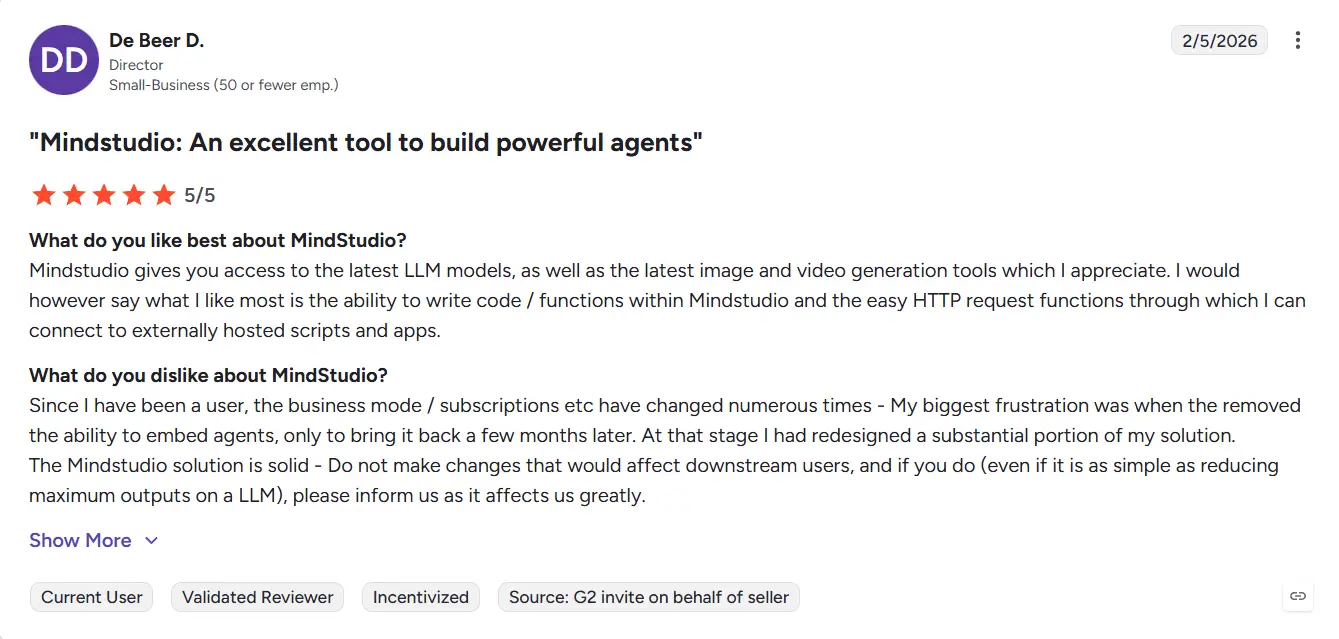
What's harder to shake is the platform stability question. One verified G2 reviewer, an auditor, documents that MindStudio removed the agent embed capability mid-production and then reinstated it months later — requiring significant rework on existing deployments. That's a meaningful risk for teams building agents into client-facing products or internal systems. It suggests a platform still in active development and not yet treating backward compatibility as a hard constraint. Worth knowing before you build something mission-critical on it.
Real-World Use Cases
The strongest fit for MindStudio in practice is recurring operational workflows where a human currently does the same steps, repeatedly, using a mix of AI tools and manual data-wrangling.
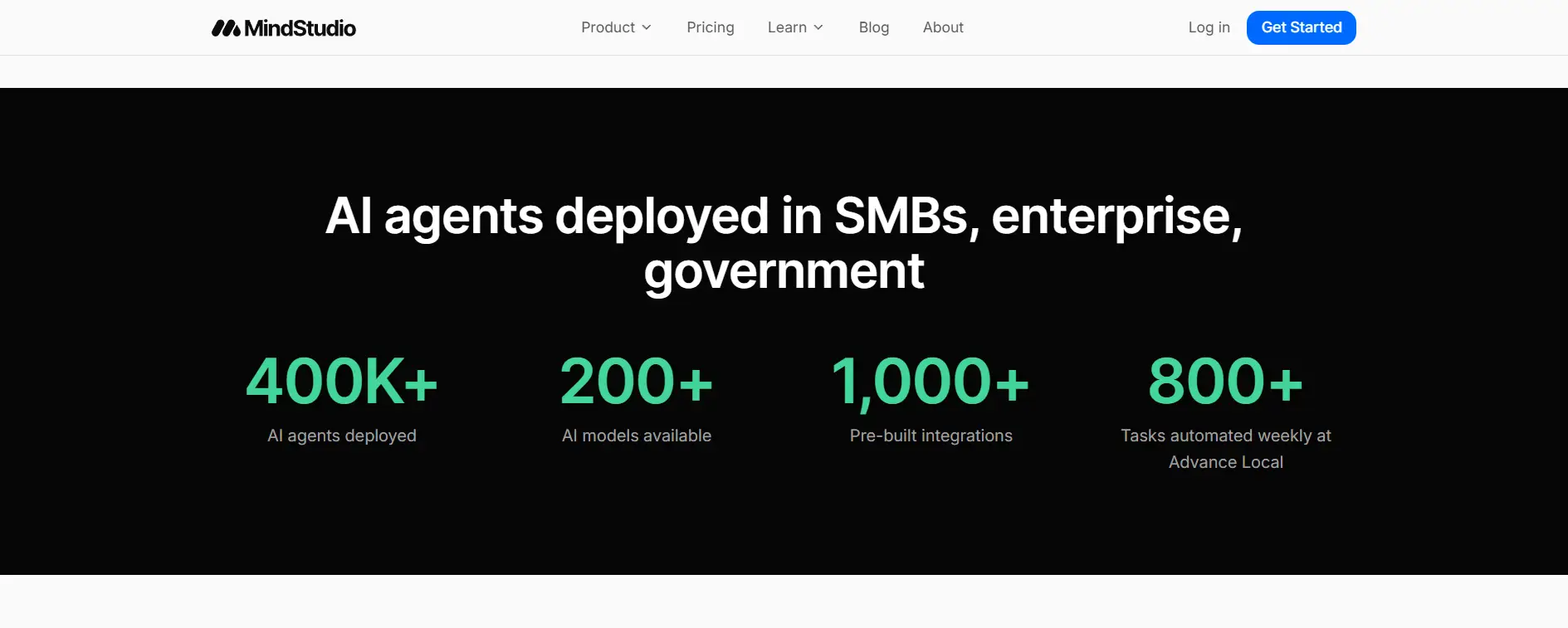
Content and social media operations are well-documented examples — agents that monitor competitor websites, pull articles, summarize them, and draft LinkedIn posts for human review before publishing. Advance Local, a large media company, runs 800+ weekly tasks through MindStudio agents, with documented time savings across newsroom operations. That's as close to a real-world production proof point as this category gets.
Sales and marketing enablement is another strong fit. Agents that enrich leads via Apollo or Hunter.io, write personalized outreach per industry and role, and push records to HubSpot or Salesforce reduce the coordination overhead between AI tools and CRM systems that currently eats significant team time.
Research automation — web scraping, YouTube transcript extraction, news monitoring, structured synthesis — fits well because MindStudio's data source integrations are broad and the built-in RAG (vector database) capability lets agents pull from private knowledge bases too.
Where the fit gets murkier is highly custom back-end automation requiring precise conditional logic, error handling, and debugging at scale. Not because MindStudio can't do it — the JS/Python function blocks and debugger exist precisely for this — but because users who need that level of control usually have the technical background to consider more developer-native alternatives with better observability.
Who Is MindStudio Best For?
- Non-technical operators at mid-market companies who need to automate real workflows and can't wait for an engineering sprint. Marketing managers, ops leads, sales team leads, content producers — anyone doing repetitive AI-assisted work who currently stitches together ChatGPT, Zapier, spreadsheets, and Slack by hand.
- AI-automation consultants and agencies building agent products for clients. The model-agnostic architecture, deployment flexibility, and ability to embed agents on client websites or white-label via custom domains make MindStudio well-suited to the build-and-hand-off model.
- Enterprises with governance requirements who need SOC 2 compliance, SSO, audit logs, and self-hosting without building the stack themselves. The infrastructure exists; it just costs what Business plan costs — which nobody knows until they call sales.
- Teams at organizations already using diverse AI models who don't want to manage separate API accounts and billing relationships with every provider. The Service Router eliminates that overhead at zero markup.
Who Should Avoid MindStudio?
- Solo users who mainly need a chatbot or simple AI assistant. The platform is overkill for occasional AI use. A direct interface with Claude or GPT-4o serves that need at a fraction of the operational overhead.
- Developer teams building custom agent infrastructure. If you need precise observability, custom execution environments, and full control over how agents reason and branch, platforms built around LangChain, custom APIs, or open-source agent frameworks will give you more leverage. MindStudio's power-user escape hatches are real but the platform isn't designed around them.
- Budget-sensitive users planning to run premium models at high frequency. The $20/month Individual plan looks affordable, but model usage costs stack on top and are billed per token at provider rates. An agent running Claude Opus or GPT-4o at meaningful volume could add meaningfully to the monthly bill. MindStudio provides per-agent spend controls, but you have to set them up proactively. This isn't hidden, but it's easy to overlook when evaluating entry price.
- Organizations that need enterprise pricing clarity before starting conversations. If your procurement process requires a public price range before engaging a vendor, MindStudio's opaque Business plan is a process blocker.
Strengths
- The model layer is a genuine advantage. Access to 200+ models from one visual interface, billed at-cost, with no API key management per provider — this is meaningfully better than piecing together separate accounts and billing relationships. It makes multi-model workflows practical rather than painful.
- Deployment flexibility is unusually broad. Most no-code agent builders are chat-first or form-based. MindStudio's six deployment modes — web apps, email triggers, scheduled automations, webhooks, browser extensions, MCP servers — mean the same builder handles fundamentally different types of agent architectures. That's rare.
- Enterprise adoption at verifiable scale. Named customers across media, government, pharma, and enterprise technology, with identifiable roles and specific outcome claims. The Advance Local case (800+ tasks/week, documented newsroom time savings) is the kind of real-world signal that actually means something in a category full of vague testimonials.
- The testing and debugging infrastructure. A built-in debugger, side-by-side model comparison, automated diagnostics, and version history reduce the invisible overhead of building production-grade agents. Most no-code tools don't have this; they make you guess.
- The free tier is real. One agent and 1,000 runs per month is enough to build and test something meaningful. It's not a crippled demo — it's a functional evaluation environment.
Weaknesses
- Business plan pricing is a black box. Any team that needs collaboration features — which means any team — has to contact sales. There's no public range, no ballpark, no indication of whether "custom" means $200/month or $2,000/month. For evaluation-stage buyers this is friction that costs deals.
- Model usage costs can surprise you. The $20/month platform fee is the entry price, not the actual price. Token costs stack on top, and for agents running expensive models at volume, the real monthly spend isn't visible until it arrives. Budget controls exist but are opt-in — not defaulted to any protective limit.
- Platform changes have broken existing deployments. The documented removal and reinstatement of the agent embed capability is a real trust issue for teams building agents into production systems. A platform that changes behavior affecting downstream users without proactive, advanced warning is a platform that requires defensive architecture — versioning, fallbacks, monitoring. That's extra work most no-code buyers didn't sign up for.
- The "no code" promise has fine print. Getting a first agent running is genuinely fast. Building something production-grade that handles edge cases, branching logic, data validation, and multi-step orchestration reliably is harder — and it requires meaningful platform learning, not just drag-and-drop instinct. The training resources are good, but the learning investment is real.
- G2 review volume is thin. Twenty-six reviews with a 4.9 average. The testimonial wall on the homepage is impressive, but it skews toward bootcamp participants and platform advocates. Independent critical analysis from neutral buyers is limited. That doesn't mean the product is bad. It means the signal is directional, not conclusive.
- Remy is alpha. The full-stack app-building product agent is prominently featured on the homepage but is explicitly in early development. It's interesting. It's not a reason to choose the platform today.
Pricing and Plans
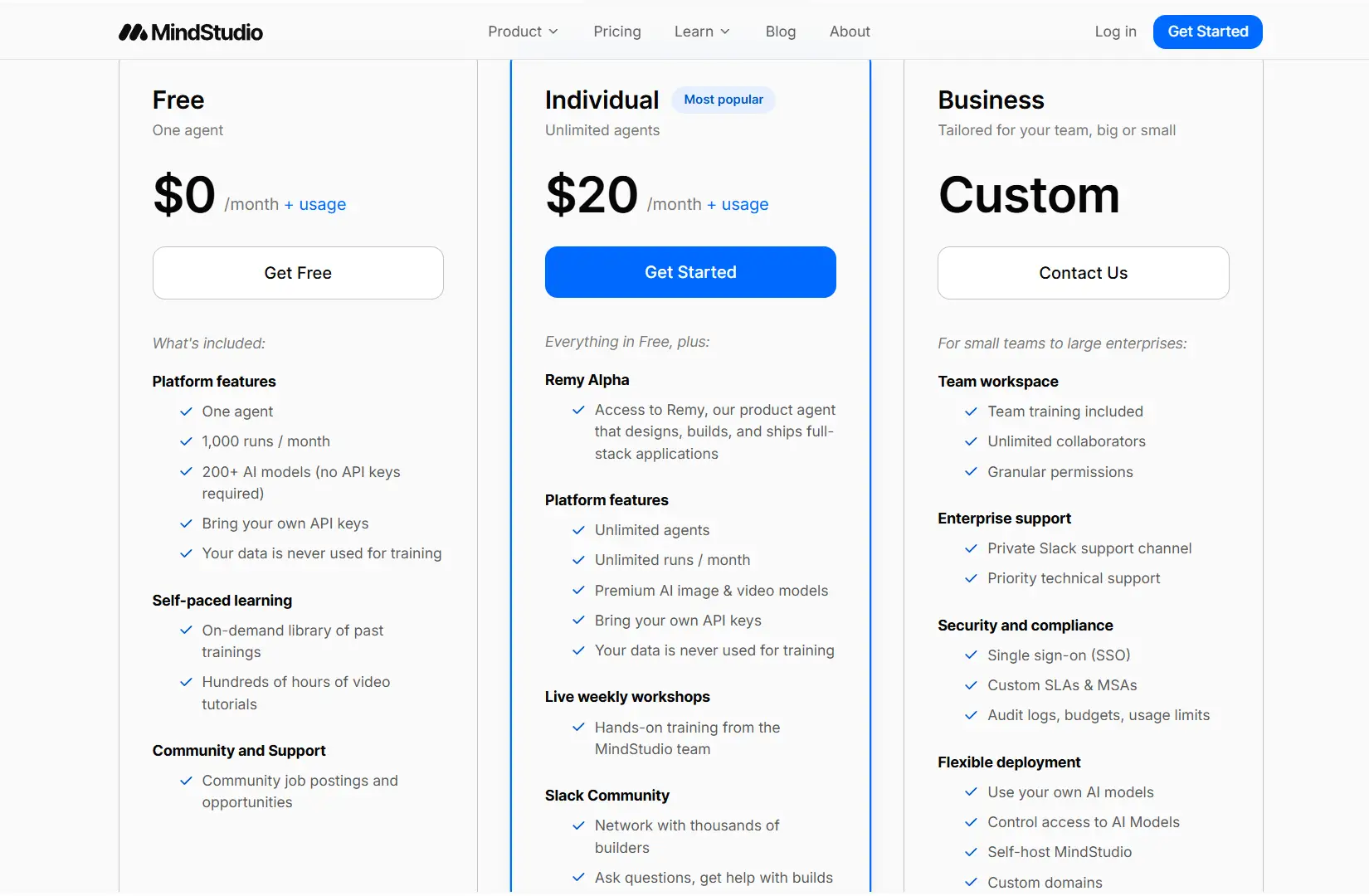
Three tiers. One is public, one is public, one is not.
- The Free plan is permanent, not a trial. One agent, 1,000 runs per month, access to 200+ AI models without API keys, and data never used for training. That's a generous enough entry point to evaluate the platform properly.
- The Individual plan runs $20/month on monthly billing, $16/month billed annually. That buys unlimited agents and unlimited runs — a meaningful jump from the free tier. The individual pricing looks competitive against n8n's $24/month plan (which caps at 2,500 runs and requires technical setup). But note: the Individual plan is solo-use only. No team workspaces, no collaborator permissions, no shared agent management.
- The Business plan is custom pricing, contact sales. This is where team features, SSO, audit logs, self-hosting, custom SLAs, and enterprise support live. What it costs is unknown without a conversation. For teams that need any of those features — which is most organizations of meaningful size — the evaluation process runs through a sales call.
The pricing logic is clear at the individual level and opaque at the team level. That's a deliberate sales funnel, not an oversight. It works fine for vendors; it creates friction for buyers trying to build internal business cases without a vendor conversation.
One more thing worth stating clearly: the platform fee is not the total cost. Every AI model call is billed separately at provider rates. MindStudio passes these through at-cost with no markup, which is good. But those costs are real, they scale with usage, and they depend heavily on which models your agents use. A well-designed agent running Claude Haiku costs very differently from one using GPT-4o or Claude Opus. Build accordingly.
How MindStudio Compares With Alternatives
- vs. n8n: n8n is the competitor MindStudio positions against most directly. n8n is open-source, self-hostable for free, and offers deep technical flexibility. It's built for users who want full control over workflow logic and are comfortable with developer-level setup. MindStudio is easier, ships a built-in AI model layer, and handles model billing natively. The right choice depends almost entirely on whether your team has a developer to own the n8n instance. If not, MindStudio looks more practical. If yes, n8n's flexibility and self-hosting free tier are hard to dismiss.
- vs. Make: Make dominates traditional trigger-action automation with broad app-to-app integration coverage. It handles data manipulation well and scales reliably for high-volume zaps. What it doesn't do natively is orchestrate AI reasoning workflows — multi-step agents that branch based on LLM output, build context, and execute decisions. MindStudio is more purpose-built for that job. Make may still win for teams with primarily non-AI workflow automation needs.
- vs. Relevance AI: Relevance AI targets similar buyers — non-technical business users who want to build AI agents without code — with a heavier focus on structured tool-calling and multi-agent team architectures. MindStudio's edge appears to be deployment flexibility and model breadth. Relevance AI's edge is in more opinionated agent-team design for complex enterprise orchestration. Both operate with opaque enterprise pricing at the team level.
- vs. Botpress: Botpress is purpose-built for conversational AI — chatbots, voice interfaces, dialogue flows. If the job is a customer-facing chat agent, Botpress is more specialized and likely better tuned for that specific deployment. MindStudio can build conversational agents but is more compelling for workflow-execution agents that do work rather than just respond.
Final Verdict
MindStudio is a genuinely capable no-code agent platform. The model-agnostic architecture, the deployment flexibility, the enterprise governance layer, and the at-cost model billing are real differentiators — not marketing fluff. The platform has verifiable adoption at enterprise scale, documented production use cases, and the kind of testimonial depth that comes from users who actually built something rather than evaluated a demo.
The strongest fit is non-technical operators at mid-market and enterprise organizations who need to automate repeatable AI workflows without waiting on engineering resources. It's also a strong fit for AI consultants and agencies building and managing agent products for clients. For those users, the $20/month Individual plan is a credible starting point, and the Business plan infrastructure — however opaquely priced — is real.
The weaknesses are real too. Business plan pricing opacity will slow evaluation for any team of meaningful size. The separate usage-based billing requires active cost management. Platform changes have historically affected production deployments without adequate warning. And the "no code" framing sets an expectation the platform doesn't fully meet — you can get started fast, but building agents that run reliably in production requires real platform investment.
The main tradeoff: MindStudio asks you to commit to its platform in exchange for infrastructure you'd otherwise have to build yourself. That tradeoff is worth it for teams with clear, recurring AI workflow needs and the capacity to learn the builder. It's less worth it for solo users with occasional AI tasks, teams needing enterprise pricing transparency before conversations start, or developers who want full infrastructure control.
Worth testing on the free tier? Yes, clearly. Worth shortlisting for serious operational AI automation? Yes, with eyes open on the pricing and stability questions. Worth skipping entirely? Only if your needs are simpler than MindStudio's scope is designed for.
Verdict at a Glance
- Best for: Non-technical operators, operations teams, and AI consultants building repeatable multi-step AI workflows at SMB or enterprise scale
- Not ideal for: Solo users needing a simple AI chat tool, developer teams requiring full infrastructure control, or organizations that can't evaluate without public enterprise pricing
- Core strength: Model-agnostic architecture with 200+ AI models, no markup billing, and six deployment modes in a genuinely accessible no-code builder
- Main tradeoff: Business plan pricing is opaque, model usage costs stack on top of the subscription, and the platform has a history of mid-production changes that require defensive architecture from builders
- Bottom line: MindStudio is the most capable no-code AI agent builder for non-technical teams with serious operational workflow needs — but it asks for more platform commitment than the easy onboarding implies, and the pricing picture gets murky the moment your team grows beyond one.
FAQ
What is MindStudio used for?
MindStudio is used to design and deploy AI agents — automated multi-step workflows powered by AI models. Common uses include content research and publishing pipelines, lead enrichment and CRM updates, competitor monitoring, data extraction, internal business apps, and recurring operational automations. It's purpose-built for teams that want AI-powered automation without writing code.
How does MindStudio work?
Users build agents in a visual drag-and-drop IDE using pre-built capability blocks — covering AI model calls, web scraping, CRM integrations, messaging, document generation, and more. Finished agents can be deployed as scheduled automations, email-triggered workflows, API endpoints, embedded web apps, browser extensions, or MCP servers for agent-to-agent use.
Does MindStudio offer a free plan?
Yes. The permanent free tier includes one agent, 1,000 runs per month, and access to 200+ AI models without requiring separate API keys. It's enough to build and test a real agent before committing to a paid plan.
How much does MindStudio cost?
The Individual plan is $20/month (or $16/month billed annually) and covers unlimited agents and unlimited runs for solo users. Business plan pricing for teams and enterprises is not publicly listed — it requires a conversation with sales. AI model usage is billed separately at provider cost with no markup, so total costs depend on which models your agents use and at what volume.
What are the main alternatives to MindStudio?
The most realistic alternatives depend on your needs. n8n offers more developer flexibility with a self-hostable free tier but requires technical ownership. Make covers traditional trigger-action automation better but is weaker for AI-reasoning workflows. Relevance AI targets similar buyers with a stronger focus on structured tool-calling and multi-agent teams. Botpress is better suited for conversational and chatbot-centric deployments.
Is MindStudio suitable for enterprise use?
Yes, with caveats. MindStudio is SOC 2 Type II and GDPR compliant, with SSO, SCIM, RBAC, audit logs, self-hosting, and custom SLAs available on the Business plan. Documented enterprise users include organizations in media, pharma, government, and professional services. Business plan pricing requires a sales conversation and is not publicly disclosed.
Disclosure: This article may contain affiliate links. If you sign up through them, Coin360 may earn a commission at no extra cost to you. That does not affect our editorial standards, and reviews are written to prioritize accuracy, usefulness, and reader value.


