




 USD
USD
Perpetual DEXs vs TradFi: Why Onchain Derivatives Are Challenging Banks


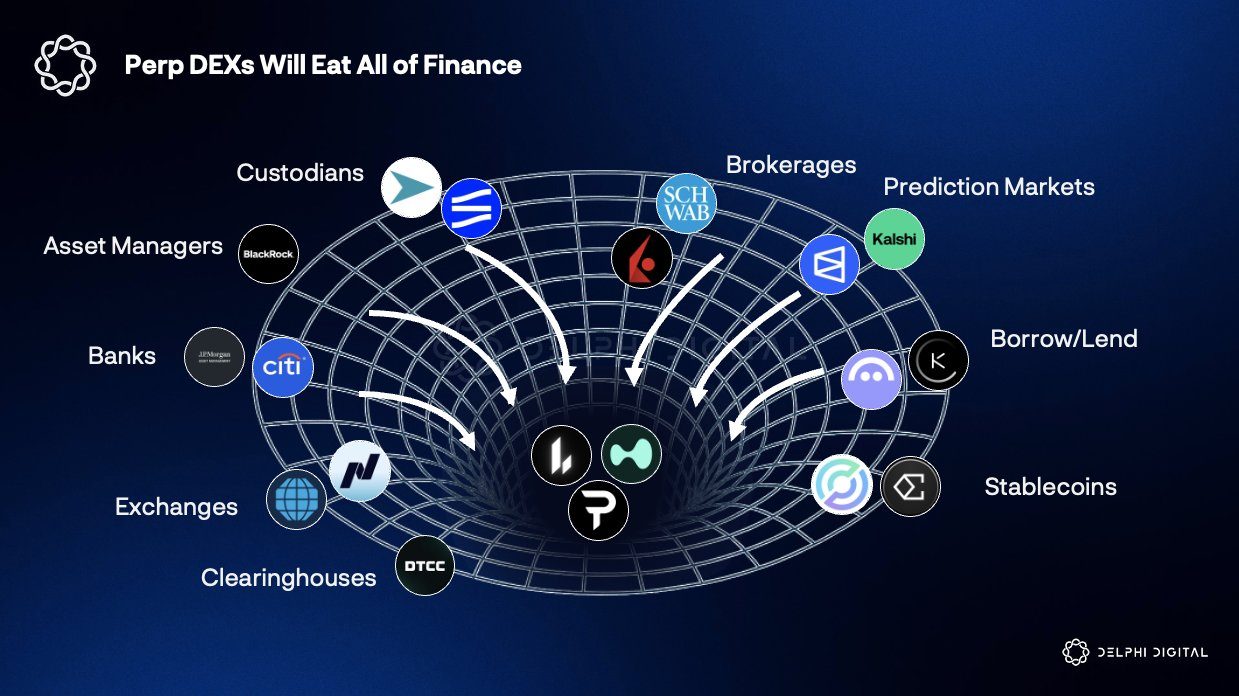
Perpetual DEXs vs TradFi isn’t a marketing slogan. It’s a shift in financial architecture. Traditional finance runs through layers — broker, exchange, clearinghouse, custodian, bank — each adding cost, delay, and dependency. Perp DEXs collapse that stack into one onchain system.
A perp DEX lets you trade leveraged perpetual futures with no expiry, settled directly by smart contracts.
Research from Delphi Digital notes that these platforms are increasingly bundling trading, custody, and lending into a single framework.
This isn’t hype. It’s structural compression. And compressed systems tend to win.
We’ve launched the all-new COIN360 Perp DEX, built for traders who move fast!
Trade 130+ assets with up to 100× leverage, enjoy instant order placement and low-slippage swaps, and earn USDC passive yield while climbing the leaderboard. Your trades deserve more than speed — they deserve mastery.
The Structural Case: Why Perpetual DEXs vs TradFi Is a Real Shift
Let’s zoom out.
Traditional finance isn’t slow because people are lazy. It’s slow because it’s layered. Brokerage hands off to exchange. Exchange hands off to clearing. Clearing hands off to custody. Every handoff adds cost, time, and operational risk. As experts put it, legacy finance is fragmented and expensive to operate.
Decentralized infrastructure flips that model. It bundles execution, margin, settlement, and custody into one programmable layer. Code replaces coordination. Smart contracts replace middlemen.
And traders are responding.
Perp DEX market share climbed from 2.1% in January 2023 to 11.7% in November 2025. That’s not a blip. That’s measurable displacement.
When you compress five institutions into one protocol, overhead drops and latency shrinks. Fewer intermediaries. Fewer fees. Faster settlement.
The perpetual DEXs vs TradFi debate is now backed by market share, not ideology.
Perp DEX Replacing Banks: Function-by-Function Breakdown
When people say perp DEX replacing banks, it sounds dramatic. It’s not. It’s functional.
Let’s break it down.
- Brokerage -> wallet-native access
You don’t open an account. You connect a wallet. No gatekeeper holding your assets. - Exchange -> onchain matching engine
Orders execute directly on protocol infrastructure. No backroom routing. - Clearing -> smart contract settlement
Trades settle automatically through code. No separate clearinghouse. - Custody -> self-custody transparency
You hold the keys. The system is auditable. - Margin lending -> protocol-native leverage
Liquidity pools replace bank balance sheets.
This is what an onchain derivatives trading platform really means. You get leverage without intermediaries. Instead of contract expiry, funding rates keep positions balanced. Instead of human risk desks, the risk engine lives inside the protocol logic.
Delphi pointed to Hyperliquid building native lending as a clear sign of convergence. Competitors like Aster and Lighter are racing to integrate similar features.
A perp DEX replacing banks is not narrative — it’s architectural consolidation.
Adoption Acceleration: The Volume Explosion
Now let’s talk activity. Not opinions. Not narratives. Flow.
Cumulative perp DEX volume reached $12.09 trillion in 2025. Even more telling, $7.9 trillion of that was generated in 2025 alone, according to DefiLlama. That’s not steady growth. That’s acceleration.
When most of your lifetime volume comes from one year, you’re not climbing a hill — you’re hitting escape velocity. Traders aren’t experimenting anymore. They’re migrating size.
What does that signal? Derivatives demand is moving onchain. Capital is choosing programmable margin systems over traditional rails.
Now zoom out. The global OTC derivatives market sits around $846 trillion notional as of mid-2025. So yes, perp DEXs are still small in absolute terms.
But markets don’t flip overnight. They compound. And when growth curves steepen like this, the trajectory matters more than today’s market share.
Where TradFi Still Holds Ground
Let’s be honest. TradFi isn’t obsolete.
Banks still win on regulatory clarity. They operate inside established legal frameworks. Institutions know the rules. That matters when you’re managing billions.
They also control fiat rails. Moving dollars in and out at scale is still smoother through traditional channels.
Then there’s uncollateralized lending. Banks extend credit based on balance sheets and reputation. Onchain systems mostly require overcollateralization.
And don’t forget consumer protection and institutional compliance frameworks. Dispute resolution, insurance structures, reporting standards — these aren’t trivial.
In the perpetual DEXs vs TradFi shift, the moat isn’t efficiency. It’s regulation and trust architecture.
For full convergence to happen, compliance layers and user experience need to mature. Infrastructure is evolving fast. Governance just moves slower.
What Defines the Best Perpetual DEX for Leveraged Trading
So what separates noise from signal?
The best perpetual DEX for leveraged trading isn’t the one with the loudest token hype. It’s the one that handles real size without breaking.
Here’s what actually matters:
- Deep liquidity so you can move capital without wrecking price
- Transparent funding mechanics so costs aren’t a mystery
- Stable matching engine that doesn’t freeze during volatility
- Minimal slippage when markets get fast
- High throughput to handle bursts of activity
- Integrated analytics for informed positioning
- Risk management safeguards baked into the protocol
Plenty of perp DEXs nailed execution. Fewer built decision infrastructure.
If you want a structured comparison of leading platforms, review our updated Top Perpetual DEXs list to see how the major players stack up side by side.
The best perpetual DEX for leveraged trading must integrate execution with intelligence.
That’s the gap. And that’s where the conversation shifts toward platforms like COIN360.
Why the COIN360 DEX Perpetual Trading Platform Stands Out
Now let’s get practical.
The COIN360 DEX perpetual trading platform isn’t built as a flashy dashboard. It’s built as a data-native trading environment. Execution and analytics don’t live in separate tabs. They live in the same workflow.
You get real-time market data embedded directly into the execution layer. That means reduced decision latency. You see the move, you act on the move. No bouncing between tools. No second-guessing delayed charts.
This platform is designed for active traders. Up to 100× leverage. Instant perp order placement. Competitive fees at 0.06% taker and 0.03% maker. Deep asset coverage across 130+ markets, including RWAs like gold, silver, and tokenized stocks. Multi-network access for seamless capital movement. Even idle USDC can generate passive yield instead of sitting cold.
That’s infrastructure thinking.
Execution plus intelligence converge here. That aligns with the broader “all-in-one stack” direction analysts have highlighted across the perp DEX space.
The COIN360 DEX perpetual trading platform embodies the evolution of the onchain derivatives trading platform.
No hype. Just integrated rails built for speed, precision, and scale.
Strategic Outlook: Infrastructure Migration in Motion
Capital doesn’t move because of narratives. It moves toward efficiency.
Derivatives dominate global finance, and the rails that support them shape where liquidity lives. When execution, margin, settlement, and analytics compress into one integrated system, friction drops. And friction always loses over time.
Perpetual DEXs vs TradFi is ultimately a battle of architecture.
The platforms that win won’t shout the loudest. They’ll simply run leaner, faster, and more integrated than the systems they replace.
Conclusion: What This Means for Traders
Here’s the bottom line: the infrastructure you trade on directly impacts your capital efficiency. Fees, latency, slippage, margin logic — they compound over time, whether you notice or not.
This shift isn’t theoretical. It’s measurable in behavior, adoption, and structural redesign.
Early adoption of superior rails tends to reward disciplined traders.
Platforms like COIN360 DEX position you inside that next phase of onchain financial evolution — where execution and intelligence operate as one system.


