




 USD
USD
Aave Launches "DeFi United" Fund as Lido, EtherFi, and Kulechov Pledge ETH to Cover Kelp Shortfall

A coordinated industry bailout takes shape after the year's largest DeFi exploit left a six-figure ETH hole across lending markets
TL;DR
- Aave announced "DeFi United" on April 23, 2026, a multi-party recovery fund targeting the rsETH deficit left by the $292 million KelpDAO exploit.
- DeFi protocols have joined forces to pledge over 43,500 ETH for the recovery of rsETH.
- The total rsETH deficit exceeds 100,000 ETH; Aave's impaired collateral exposure stands at approximately $359 million, with bad debt estimated between $177 million and $290 million.
We’ve launched the all-new COIN360 Perp DEX, built for traders who move fast!
Trade 130+ assets with up to 100× leverage, enjoy instant order placement and low-slippage swaps, and earn USDC passive yield while climbing the leaderboard. Your trades deserve more than speed — they deserve mastery.
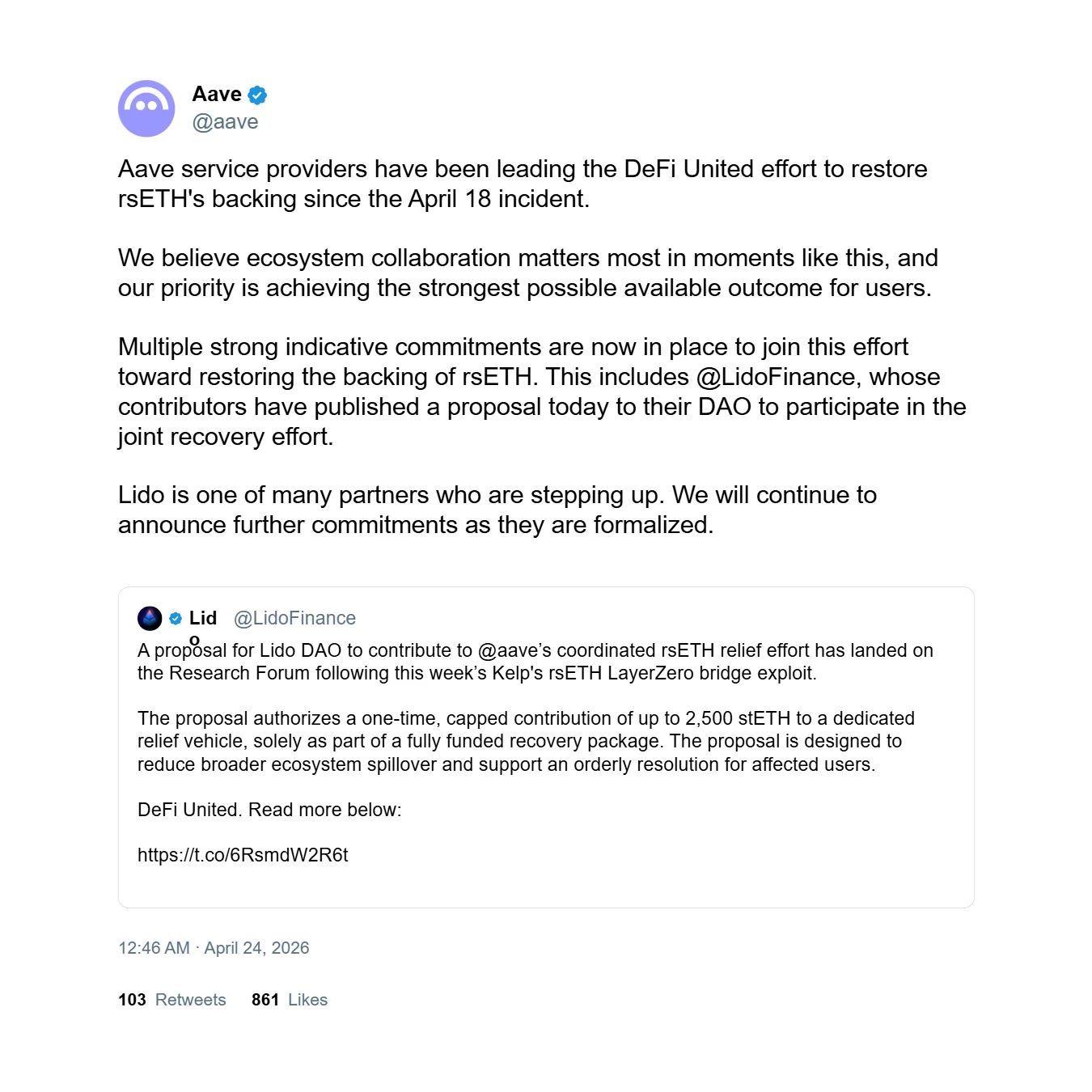
Aave and a growing coalition of DeFi protocols are coordinating a recovery effort they are calling "DeFi United," aimed at restoring the backing of rsETH — a yield-bearing liquid restaking token — after the $292 million KelpDAO bridge exploit left the sector's largest lending protocol exposed to hundreds of millions in bad debt. Aave announced on X on April 23, 2026, that "multiple strong indicative commitments are now in place," with Lido Finance named as the first confirmed public participant and further pledges expected to be formalized in the coming days.
The initiative emerged after an attacker exploited KelpDAO's LayerZero-powered cross-chain bridge on April 19, 2026, minting 116,500 unbacked rsETH tokens worth approximately $292 million and depositing them into Aave V3 as collateral to borrow 106,467 ETH. Because the rsETH was fraudulently minted against zero underlying collateral, the related Aave positions became effectively unliquidatable, leaving Aave with bad debt estimated between $177 million and $290 million on total rsETH collateral exposure of approximately $359 million. Aave's own incident report put the total impaired hole at more than 112,000 rsETH.
The Kelp DAO exploiter has completely divested from Ethereum, converting 75,701 ETH, valued at approximately $175 million, into BTC. The transactions were processed via THORChain and other cross-chain methods, representing a significant change in the management of the misappropriated funds.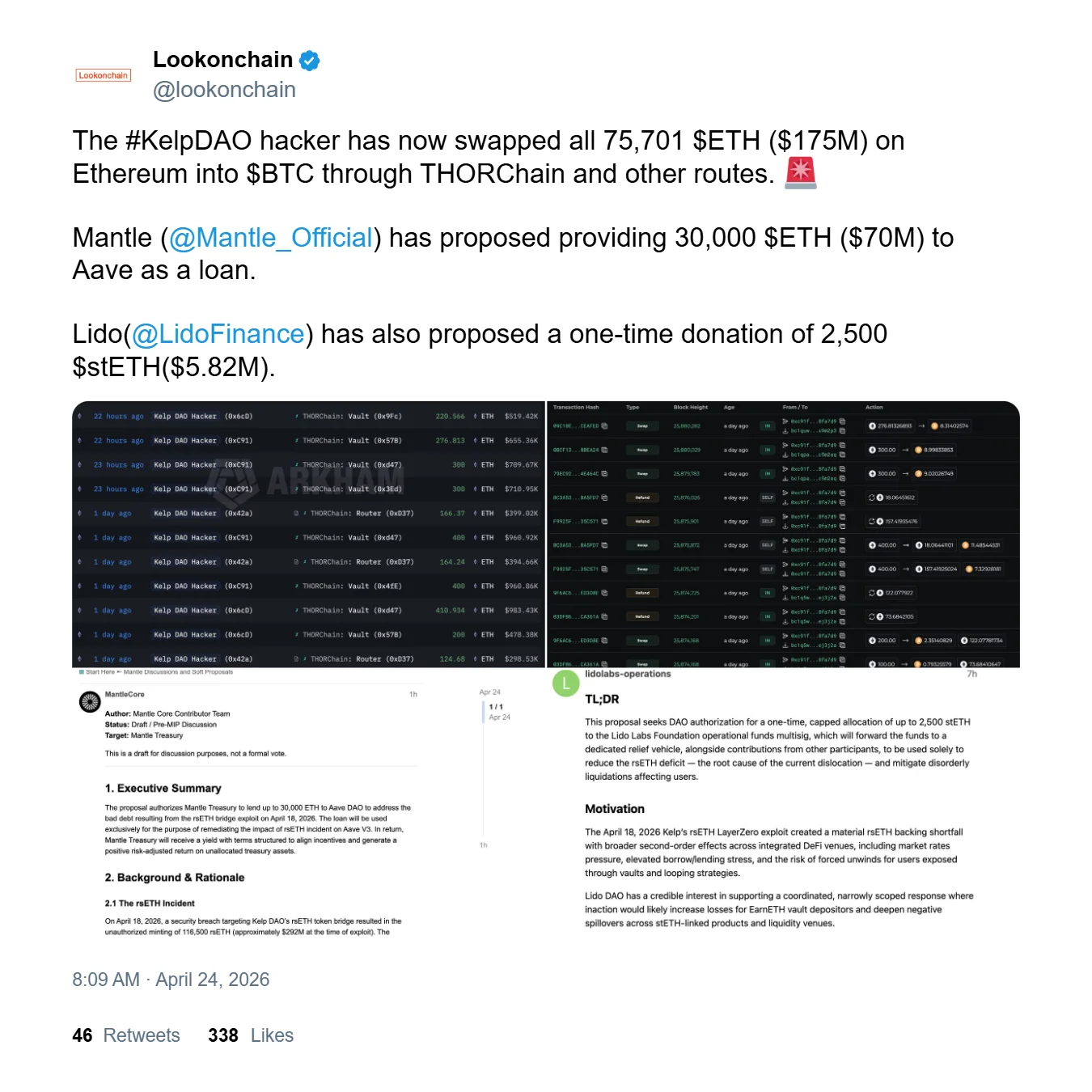
The DeFi United fund is designed to close that shortfall through multi-party contributions rather than through on-chain recovery of stolen funds, the bulk of which remain unrecovered. Arbitrum's Security Council had already frozen 30,766 ETH — worth approximately $71 million — in an emergency nine-of-twelve governance vote earlier in the week, but the remainder of the stolen assets had been bridged and swapped into Bitcoin via THORChain, making further direct recovery uncertain.
Who Has Committed and on What Terms
Lido Labs Foundation, an ecosystem contributor to Lido Finance, submitted a governance proposal on Thursday, April 23, 2026, requesting Lido DAO permission to allocate up to 2,500 stETH — roughly $5.8 million at current prices — to the dedicated relief vehicle. The proposal specified the funds would be "used solely to reduce the rsETH deficit" and attached a firm conditionality clause: the contribution "may be made available only as part of a fully funded recovery package intended to close the rsETH deficit in full," meaning Lido's participation depends on other contributors stepping up to cover the gap in full.
"Kelp's rsETH LayerZero exploit created a material rsETH backing shortfall with broader second-order effects across integrated DeFi venues," Lido said in the proposal, describing the fallout as including "market rates pressure, elevated borrow/lending stress, and the risk of forced unwinds for users exposed through vaults and looping strategies." Lido warned that without a fully funded recovery, EarnETH vault depositors could face losses of up to approximately 9,000 ETH.
Lido Labs framed its participation as protecting its own ecosystem rather than acting as a general-purpose backstop. "Lido DAO has a credible interest in supporting a coordinated, narrowly scoped response where inaction would likely increase losses for EarnETH vault depositors and deepen negative spillovers across stETH-linked products and liquidity venues," the proposal said. It also noted that the total deficit exceeds 100,000 ETH, with Lido expecting to participate "as one of several stakeholders rather than as the sole backstop provider."
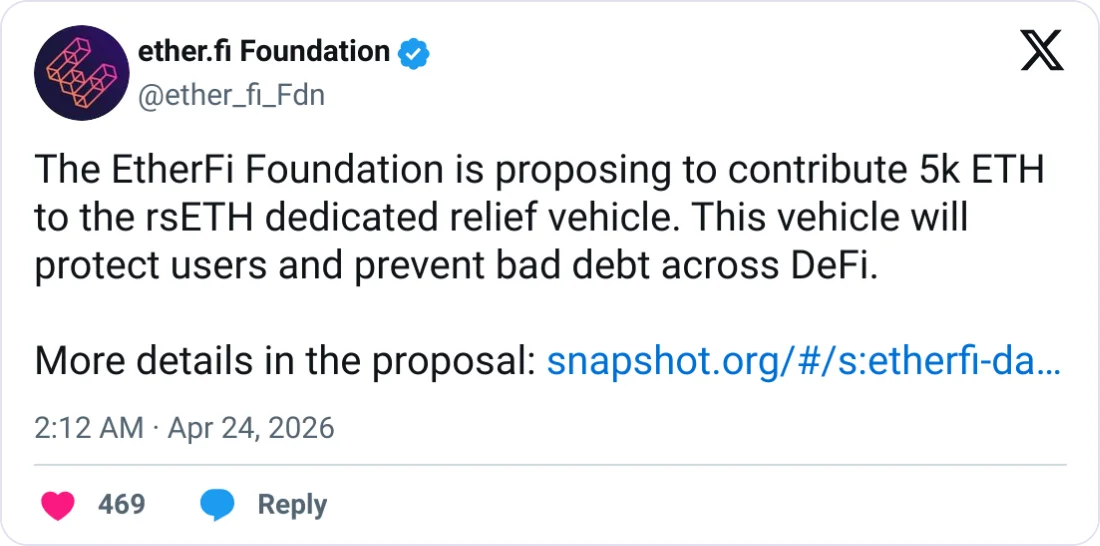
Shortly after the Lido DAO post appeared, the EtherFi Foundation proposed contributing 5,000 ETH to the relief effort to protect users and prevent bad debt across DeFi.
Aave founder Stani Kulechov separately pledged a personal contribution of 5,000 ETH. "Aave is my life's work and we're working nonstop to find the best possible outcome for users," Kulechov said in an X post. "I'm working to see this resolved and market conditions normalized as soon as possible."
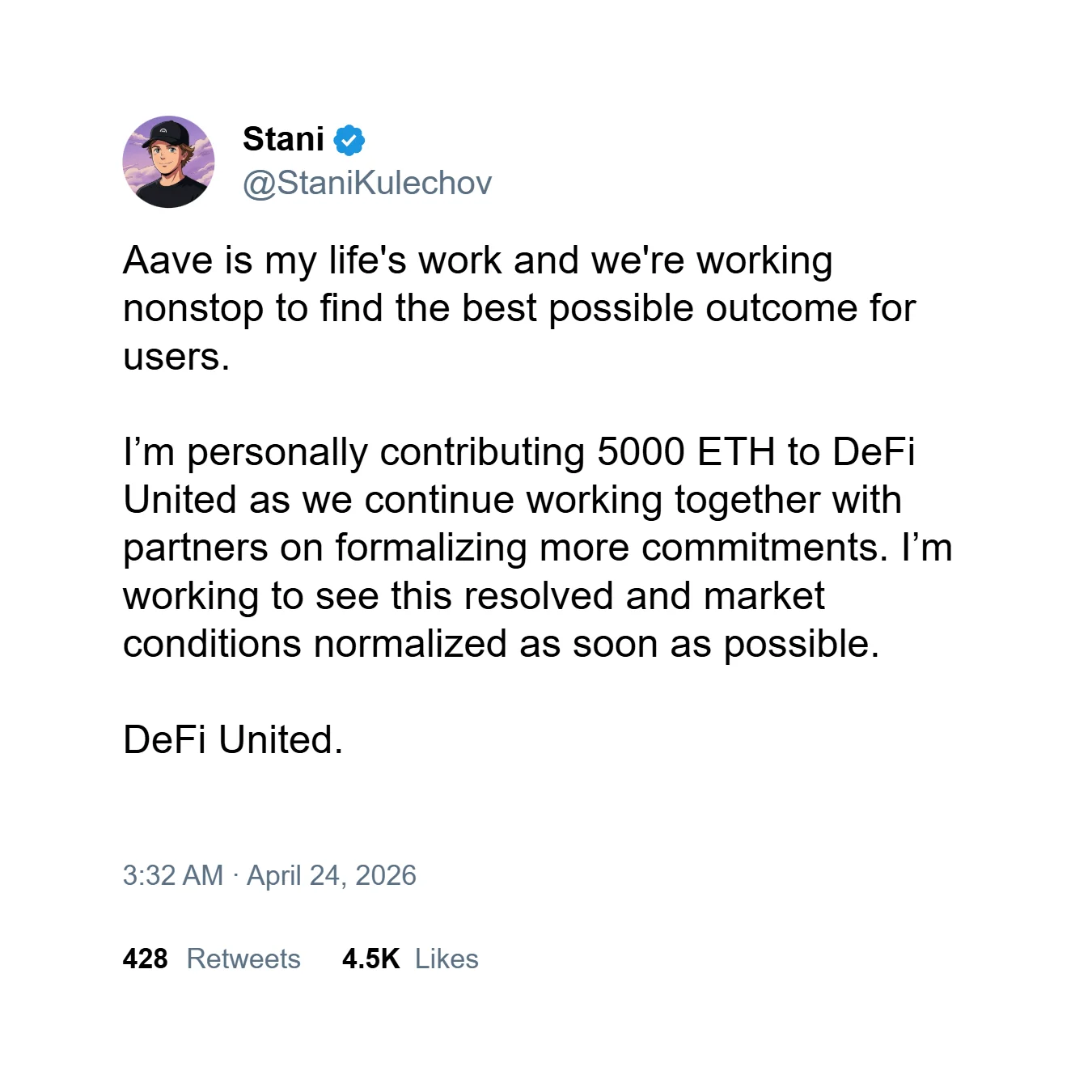
The three confirmed commitments at time of publication — 2,500 stETH from Lido, 5,000 ETH from EtherFi, and 5,000 ETH from Kulechov — represent a combined initial pledge of approximately $28 million to $30 million against a deficit that exceeds 100,000 ETH.
The broader DeFi ecosystem has rapidly mobilized around Aave’s recovery effort, signaling a coordinated industry response to contain systemic risk after the exploit. Multiple protocols have pledged capital to restore rsETH backing, with total commitments surpassing 43,500 ETH, worth over $100 million at current prices.
Ethereum layer-2 network Mantle has put forward a proposal to lend as much as 30,000 ETH to the Aave DAO to help manage its bad debt in exchange for yield. Additionally, the EtherFi Foundation has suggested contributing 5,000 ETH, while both the Golem Foundation and Golem Factory are collectively proposing to contribute 1,000 ETH to the initiative.
Various other DeFi protocols, such as the cross-chain communication protocol LayerZero, the layer-2 blockchain Ink Foundation, and the lending and borrowing platforms Tyrdo and Frax Finance, have also committed unspecified amounts of Ether to support the initiative.
Market Impact and the Capital Flight That Prompted the Fund
The scale of the capital exit following the exploit explains the urgency behind the DeFi United effort. Aave's total value locked dropped from $26.39 billion on April 18 to approximately $17.51 billion in under 48 hours — a decline of nearly 30% over seven days. The broader DeFi ecosystem lost $13.2 billion in TVL within less than two days, with DefiLlama data showing the sector falling from $99.497 billion to $86.286 billion, its lowest reading in twelve months.
Lookonchain reported that whales began selling AAVE shortly after the exploit became public, with Binance inflows rising above 236,000 AAVE tokens compared with a normal average of 31,000, and total exchange inflows crossing 355,000 AAVE worth approximately $32 million. CryptoQuant data showed exchange reserves climb past 180,000 tokens.
According to COIN360 crypto price data, AAVE fell more than 20% in the first 24 hours, hitting a low of approximately $80 on April 20, before recovering to approximately $93.59 as sentiment stabilized following the Arbitrum freeze. Santiment reported that Aave sentiment stopped dropping to new lows after news of the Arbitrum Security Council's ETH confiscation reached the market. LayerZero's ZRO token fell more than 22% to approximately $1.52, down from above $2 two days earlier, then recovered to approximately $1.63 — up 5.57% — as of April 21.
SparkLend saw more than $1 billion in deposits since the Kelp exploit, as users migrated capital away from Aave amid uncertainty about protocol exposure, illustrating that capital rotated within DeFi rather than exiting it entirely.
Two Recovery Scenarios, One Unresolved Question
@0xngmi, the anonymous founder of DefiLlama, published an analysis outlining two scenarios for how Arbitrum's handling of the frozen 30,766 ETH would affect Aave's final bad debt position — a key variable the DeFi United fund is designed to reduce regardless of which path governance chooses.
In the first scenario, where every rsETH holder is treated equally regardless of whether they hold on Layer 1 or Layer 2, all holders would automatically be down approximately 18.5% on their holdings — the share of rsETH supply stolen before the Arbitrum ETH recovery — with Aave on the hook for approximately $216 million, requiring it to deplete its treasury and Umbrella fund and potentially liquidate tokens.
In the second scenario, where losses are localized to rsETH holders on Layer 2 networks since that is where the exploit occurred, Aave bad debt on Arbitrum would fall from approximately $88 million to $17 million — an 80% reduction — but total Aave bad debt under that path would reach approximately $341 million on its $359 million exposure.
@0xngmi stated that the $71 million recovery from Arbitrum "gives Aave a lot of breathing room on the very difficult decisions that it faces," but added that Aave's Umbrella fund does not cover all Layer 2 networks, meaning Aave would have discretion to choose which markets to save and which to allow to fail — a path he noted could lead to dissatisfaction and potential litigation. He also noted: "If they return to Kelp and Kelp adds it to the pool to cover losses the bad debt on Arbitrum will be higher as well, as this recovered money will need to be split among all L2s."
Industry Response: Optimism Alongside Structural Criticism
Haseeb Qureshi, managing partner at Dragonfly, said on April 20, 2026, that Aave and affected protocols were in "completely recoverable" positions. "AAVE might take on some bad debt, but it has the equity to pay it," Qureshi said, adding: "DeFi learns through failures. The important thing is that these failures are not fatal. The heart of DeFi is risk-averse and robust." @0xngmi added his own assessment: "DeFi is gonna take a hit, but it will not die."
Michael Egorov, founder of Curve Finance and Yield Basis, used the incident to call for formal, coordinated industry safety standards. "All issues like this should be prevented before they happen. We should probably come together and develop safety standards for DeFi," Egorov said on April 21, 2026, arguing that critical dependencies should be distributed wherever possible and that, where centralization cannot be eliminated, trust should be split across multiple parties. He called on major ecosystem players including the Ethereum and Solana Foundations to lead that effort.
JPMorgan analysts noted that repeated DeFi hacks and flat TVL growth are dampening institutional interest, with each exploit pushing investors toward keeping funds in stablecoins rather than deploying into DeFi protocols.
Keone Hon, CEO and co-founder of Monad, argued on April 19, 2026, that pooled lending protocols should adopt "smart caps" on collateral supply growth. "Feels like pooled lending protocols would benefit from a rate limit on the supply of an asset being deposited for collateral. Like, if the current supply is 100m and the supply cap is 300m, the supply should only be allowed to go to 110m in the next 10 minutes," Hon said, adding that such a control would have saved rsETH depositors $200 million in this case.
Ethena contributor Guy Young said Ethena had already implemented a solution that caps cross-chain transfers at $10 million per hour for every DVN. "We built a solution on top of the standard OFT to throttle cross chain transfers at $10m per hour for every DVN, in addition to the $10m per block rate limit on the mint contract," Young wrote. "The former would have prevented Kelp, the latter Resolv."
Terence Kwok, founder of Humanity, said: "What's striking is how often the damage still comes down to the same weak points around access control and single points of failure. That tells you the industry still has some basic security discipline issues it has not solved."
FAQ
What is DeFi United and what is it trying to do?
It is a multi-party Aave-led recovery fund to restore rsETH's backing and prevent further bad debt.
Is Lido's 2,500 stETH contribution approved?
No — it is a governance proposal; approval by Lido DAO is still required.
Will the three pledges confirmed so far cover the full shortfall?
No — confirmed pledges total roughly $28–$30 million against a deficit exceeding 100,000 ETH.
Have any stolen funds been returned to the recovery pool?
Only 30,766 ETH frozen by Arbitrum; the majority of stolen funds remain unrecovered.
This article has been refined and enhanced by ChatGPT.


