




 USD
USD
Blast to Shut Down Ethereum Layer 2 as Costs Exceed Revenue

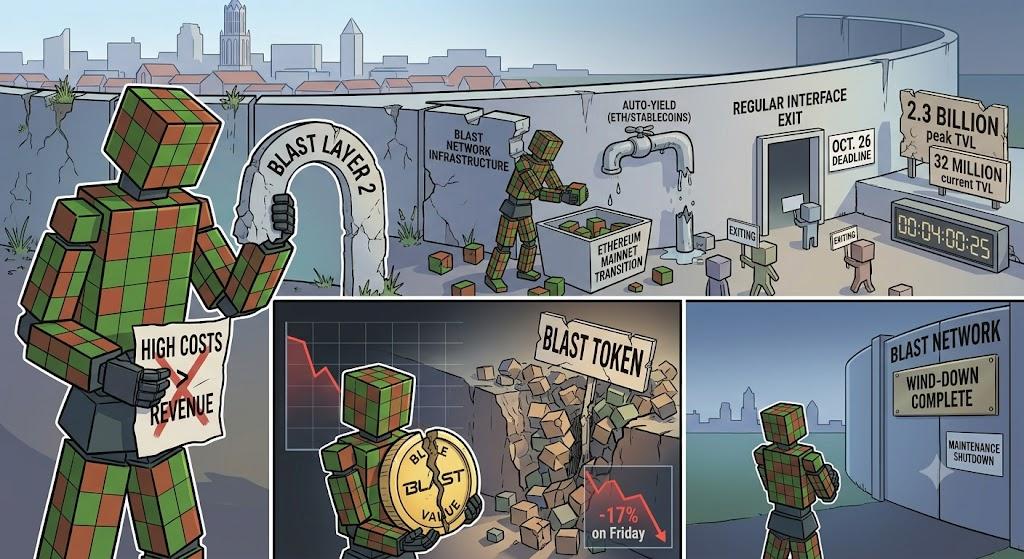
Users Have Until Oct. 26 to Exit Through the Regular Interface
TL;DR
- Blast will wind down its Ethereum Layer 2 because operating costs exceed revenue and the project sees no credible path to economic sustainability.
- Users can withdraw through Blast’s regular interface until Oct. 26 before direct interaction with its Ethereum bridge contracts is required.
- Blast’s TVL has fallen to a little over $32 million after the network once held more than $2.3 billion.
Trade smarter on Jupiter, Solana’s leading DEX built for fast execution and deep liquidity.
Swap tokens at competitive rates, route across multiple liquidity sources automatically, and access perpetuals, DCA, and advanced trading tools — all in one place!
Blast said on October 2, 2026, that it will wind down its Ethereum Layer 2 after the cost of maintaining the network rose above the revenue it generates. The project said it no longer sees a credible route to making the chain economically sustainable and is asking users to move their assets back to Ethereum mainnet.
“We launched Blast with the goal of building a self-sustaining chain for users and developers. Unfortunately, the economics of operating the chain no longer make sense,” Blast wrote on X. “The ongoing costs of maintaining Blast exceed the revenue generated by the L2, and we do not see a credible path to making the chain economically sustainable.”
“As a result, we've made the difficult decision to wind Blast down,” the team added.
Blast will first withdraw the network’s assets from Lido, a process expected to take about a week. Withdrawals will be temporarily unavailable during that process. Once completed, Blast said withdrawals will resume with a 24-hour delay. The withdrawal request also covers assets held through Blast’s PWA, or progressive web app.
Users can continue withdrawing through Blast’s regular interface until Oct. 26. After that cutoff, assets will remain withdrawable, but users will need to interact directly with Blast’s bridge contracts on Ethereum. Blast said it plans to publish instructions before the interface deadline.
Blast Falls From More Than $2.3 Billion to $32 Million in TVL
Blast currently has a little over $32 million in total value locked, according to DeFiLlama. The network had exceeded $2 billion in TVL from nearly 200,000 early-access users before its mainnet launch, while more than $2.3 billion was locked in its bridge by the February 2024 launch.
The network went live in November 2023 after a $20 million funding round led by Paradigm and Standard Crypto. Built by the team behind NFT marketplace Blur, Blast promoted automatic yield on ETH and stablecoin balances. Returns were generated through ETH staking and real-world asset protocols and distributed automatically to users. Paradigm publicly criticized the project’s launch messaging at the time.
Users had deposited more than $1.1 billion before the network went live. Blast later briefly stopped producing blocks following Ethereum’s Dencun upgrade in March 2024. Its June 2024 airdrop allocated $354 million worth of BLAST tokens to users. By that point, TVL had already fallen about 30% from its $2.3 billion peak.
The BLAST token fell 17% on Friday as the shutdown was announced, reducing its market capitalization to around $23 million.
Other Ethereum Layer 2 Networks Have Also Wound Down
Blast joins other Ethereum Layer 2 projects that have closed or begun winding down. Wallet maker Zerion said in May that it would shut Zero Network, its gasless Ethereum Layer 2, after about 18 months of operation and gave users until July 31 to bridge their assets out.
Silicon Network, an Ethereum Layer 2 associated with South Korean exchange Korbit, stopped accepting deposits on Sept. 2. Users were given until Dec. 31 to withdraw, while about $9.75 million remained on the network, according to L2Beat data.
Shutdowns have also affected crypto exchanges. Hong Kong-founded CoinEx said last month that it will close on Dec. 22, joining BitMEX and BitMart among exchanges shutting down this year.
This article has been refined and enhanced by ChatGPT.


