




 USD
USD
CLARITY Act Stalls as Senate Deadline Narrows


Industry and regulators prepare for competing paths on U.S. crypto rules
TL;DR
- The CLARITY Act faces a shrinking Senate window as lawmakers remain divided over ethics, stablecoin yield, DeFi and enforcement.
- Brian Armstrong urged Congress to finish the bill, while Paul Atkins said the SEC could act under its existing authority.
- JPMorgan warned that continued delay could push tokenization toward incumbent financial infrastructure instead of public blockchain networks.
Trade smarter on Jupiter, Solana’s leading DEX built for fast execution and deep liquidity.
Swap tokens at competitive rates, route across multiple liquidity sources automatically, and access perpetuals, DCA, and advanced trading tools — all in one place!
The Digital Asset Market Clarity Act is nearing a critical Senate deadline without enough confirmed support to advance, leaving lawmakers divided over ethics restrictions, stablecoin yield, decentralized finance, anti-money laundering rules and regulatory authority. Supporters are pressing for action before the August recess, while SEC Chair Paul Atkins has said the agency is prepared to establish crypto rules on its own if Congress does not pass the legislation.
Coinbase CEO and co-founder Brian Armstrong intensified the pressure on July 29, 2026, saying the bill had reached the “one-yard line” after a bipartisan effort. “It’s time to get CLARITY done,” Armstrong wrote, thanking lawmakers and industry participants involved in the negotiations and adding that “clear rules are almost here.”
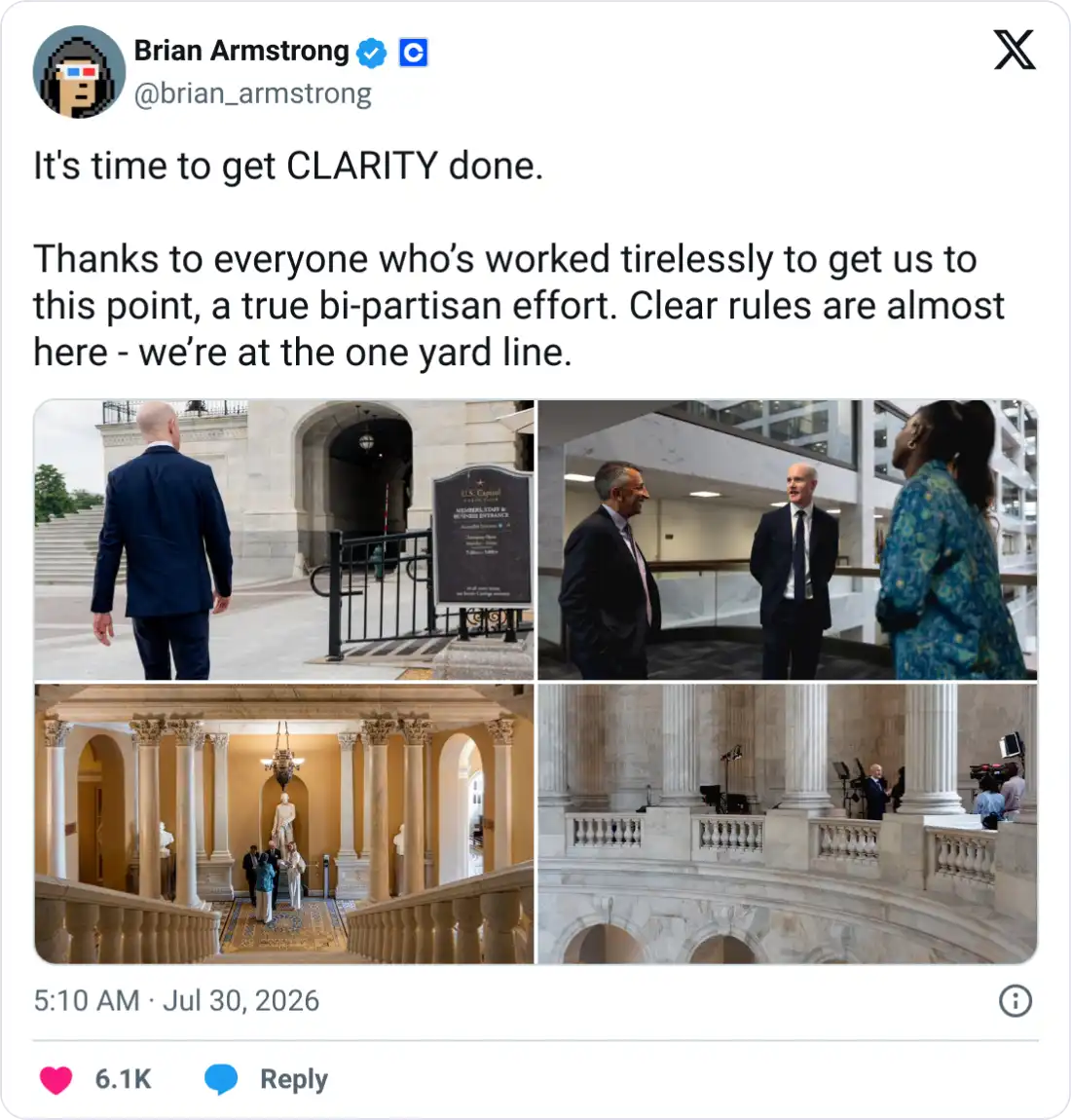
Supporters were described as having approximately seven days to move the legislation before the recess. The bill still needed 60 Senate votes to overcome a potential filibuster, and the chamber would have to begin a multi-day cloture process before holding a final floor vote. Each day without that procedural step further reduced the possibility of completing the legislation before senators left Washington.
Senate Majority Leader John Thune said the chamber would probably vote on the measure but placed responsibility for beginning debate on Democratic support. “We’ll see if the Democrats give us the votes to get on the bill,” Thune said. He also acknowledged that the Senate almost certainly lacked enough time to complete the legislation before lawmakers departed.
Thune separately told reporters that the measure would not pass before September, creating a more difficult political timetable as members of Congress shifted attention toward the election cycle. One assessment said a change in control of either congressional chamber following the November elections could end the current proposal and prevent comparable legislation from advancing before 2029. That outlook was presented as an assessment of the legislative environment rather than a confirmed schedule.
Another assessment said passage during a lame-duck session would be unlikely if the Senate failed to act in September. A Democratic victory in the House could also require lawmakers to reopen negotiations and substantially rewrite the measure.
Sen. Cynthia Lummis warned that failure to reach an agreement by August 7 could effectively delay the legislation until 2027. She also expressed frustration over the negotiations, writing: “After nearly 11 months of giving almost everything asked of us, I genuinely don’t know what else my Democrat colleagues need before we act.”
Bill Would Divide Oversight Between SEC and CFTC
The House has already approved the CLARITY Act, while the Senate Banking Committee has advanced its version. The legislative votes and related market estimates were reported as follows:
The bill would establish a federal digital-asset market-structure framework by defining the respective jurisdictions of the Securities and Exchange Commission and Commodity Futures Trading Commission. It would create rules for token issuers, exchanges, brokers, custodians, decentralized projects and other intermediaries while replacing conflicting state and federal interpretations with a national system.
Supporters say the legislation would clarify when a digital asset should be treated as a security and when it should fall under commodities regulation. It would also distinguish between a securities transaction used to raise capital and the blockchain token involved in that transaction.
Trevor Overko, co-founder of Sapien, said that distinction better reflects how decentralized networks develop because a fundraising transaction may involve securities law without permanently making the underlying token a security. He said companies currently may not know whether they fall under the SEC, the CFTC or both until regulators begin an enforcement action.
“That is not a serious regulatory system,” Overko said, arguing that the current arrangement pushes responsible businesses offshore while failing to prevent fraud.
The reported framework would create three connected classifications: digital commodities, network tokens and ancillary assets. A digital commodity would generally be a fungible blockchain-based asset capable of exclusive possession and peer-to-peer transfer.
A network token would be a digital commodity intrinsically connected to a distributed-ledger system and deriving, or reasonably expected to derive, value from use within that system. An ancillary asset would be a network token whose value depends on the managerial or entrepreneurial efforts of an originator or related party.
Primary sales of network tokens that are not ancillary assets generally would not be treated as securities transactions unless the assets carry disqualifying financial rights. Transactions involving ancillary assets could still qualify as investment-contract transactions and would need to comply with an ancillary-asset disclosure regime or another registration exemption.
A proposed Regulation Crypto pathway would provide a specialized registration exemption subject to offering limits, disclosures and other conditions. The framework reportedly includes initial and semiannual disclosures, restrictions on insider resales, intermediary registration, customer-asset protections and divided responsibilities between the two federal market regulators.
Critics have argued that the classifications could create overlapping categories whose practical application remains subjective. Different interpretations by the SEC and CFTC could shift uncertainty from court cases into agency rulemaking rather than eliminate it.
Developers could avoid the ancillary-asset framework only by giving up coordinated control, performing no more than nominal managerial work and no longer serving as a principal source of a token’s value. That endpoint may be impractical for teams that continue actively developing their networks.
Projects retaining meaningful control would instead face extensive disclosures under Regulation Crypto. Critics said those requirements could recreate much of the compliance burden that made Regulation A unattractive to crypto issuers.
The framework may also leave existing tax incentives unchanged. Regulation Crypto was described as limited to originators organized in the United States and as providing no specialized federal tax treatment for token sales, potentially reducing its appeal for projects structured through jurisdictions such as the Cayman Islands.
Overko nevertheless supported passage with conditions on implementation. He said the objective should not merely be to simplify compliance for crypto businesses but to make legitimate projects easier to recognize and fraud or regulatory arbitrage more difficult.
Clearer classifications and mandatory disclosures could help investors understand what they are buying, which regulator has jurisdiction, what information a project must provide and what legal protections apply if the project fails or misconduct occurs, Overko said.
He said the current system often gives investors disadvantages associated with both regulated and unregulated markets. Projects may lack disclosures comparable with those of public companies, while decentralized networks also lack a workable framework designed for their structure. Legitimate businesses can spend years and millions of dollars debating whether their tokens are securities, commodities or another type of asset.
The legislation would not eliminate investment risk. Tokens could still fail, markets could remain volatile and investors could continue making poor decisions, Overko said, but clearer disclosures and classifications could make those risks more visible, comparable and easier to price.
Overko said revisions would almost certainly be needed after implementation because staking, decentralized finance, tokenized securities, governance models and emerging custody structures evolve faster than Congress can legislate. He identified the distinction between genuinely decentralized networks and projects decentralized mainly in name as a likely area of pressure.
He also said ancillary-asset definitions would require close monitoring. Definitions drawn too broadly could allow weak projects to avoid securities protections, while definitions that are too narrow could recreate the uncertainty the bill is intended to address. Overko supported a structure combining durable statutory principles, adaptable agency rules and a formal review after the market had operated under the framework.
Ethics and Stablecoin Yield Divide Negotiators
Ethics restrictions for federal officials remain among the most politically contentious parts of the negotiations. Democratic lawmakers have sought language barring certain officeholders, including the president, from issuing cryptocurrency tokens while serving in government.
The provision creates a direct political conflict because President Donald Trump would need to sign the legislation and has previously issued or supported cryptocurrency tokens. Democrats have treated restrictions on political officials’ crypto activities as a central requirement for backing the broader framework.
Sen. Ruben Gallego rejected an earlier Republican proposal in unusually blunt terms. “Whatever piece of s**t they sent back to us, that was not a serious effort,” Gallego said.
Gallego and Sen. Thom Tillis later finalized a new ethics compromise. Its language had not been made public as of July 30, and it still required approval from the White House and enough Democratic support to help the wider bill clear the Senate threshold.
Stablecoin yield has become another major point of conflict. White House crypto adviser Patrick Witt said banking groups had spent months demanding a prohibition on stablecoin interest payments because yield-bearing tokens could draw deposits away from community banks.
Witt said the bill included the restriction banks had requested, yet banking groups then opposed the legislation on the ground that it could weaken community-bank lending. “Make it make sense,” Witt wrote.
American Bankers Association president Rob Nichols said the banking industry supported cryptocurrency regulation but believed the current draft contained a loophole. Stablecoin issuers could be prohibited from paying yield directly while affiliates, exchanges or other intermediaries remained able to route equivalent payments to users.
Nichols said the structure could circumvent the restriction Congress intended to impose. He argued that lawmakers could resolve the issue with approximately two paragraphs of changes to a bill spanning roughly 600 pages.
We’ve launched the all-new COIN360 Perp DEX, built for traders who move fast!
Trade 130+ assets with up to 100× leverage, enjoy instant order placement and low-slippage swaps, and earn USDC passive yield while climbing the leaderboard. Your trades deserve more than speed — they deserve mastery.
JPMorgan Warns Delay Could Favor Incumbent Finance
JPMorgan said on July 29 that declining odds of passage represented a setback for crypto markets and institutional adoption because the legislation had been viewed as one of the sector’s most important regulatory catalysts.
Analysts led by Nikolaos Panigirtzoglou identified ethics provisions, enforcement policy, decentralized finance, stablecoin yield and anti-money laundering requirements as the principal areas of deadlock.
“The longer the approval of the Clarity Act is postponed, the greater the threat to crypto markets from the growth of tokenization and blockchain-based applications eventually being absorbed by incumbent market infrastructure rather than accruing to public crypto networks,” the analysts wrote.
JPMorgan’s concern was that tokenization could continue expanding without comprehensive crypto legislation while established financial institutions captured the economic value through private systems, permissioned networks or conventional market infrastructure instead of open public blockchains.
Clear federal rules could give banks, brokers, exchanges and asset managers more confidence to invest, introduce products and build digital-asset infrastructure, JPMorgan said. Passage could also increase activity on regulated U.S. platforms and lower barriers facing banks, exchanges, custodians and market makers operating under fragmented requirements.
JPMorgan cited Citadel Securities’ $400 million investment in Crypto.com and the CFTC’s approval of the first U.S.-regulated perpetual cryptocurrency futures contracts as evidence that institutional participation and regulated market development were already moving forward despite the legislative delay.
The bank also identified possible weaknesses in the draft. Provisions allowing some tokenized securities or derivatives activity outside direct SEC or CFTC oversight could discourage traditional institutions rather than attract them.
JPMorgan questioned whether crypto businesses could face lighter anti-money laundering obligations than traditional financial institutions. Such a difference could create competitive concerns and make regulated banks more hesitant to enter the market.
Jefferies had warned in June that the bill still faced significant obstacles despite clearing the Senate Banking Committee, underscoring that committee approval did not guarantee sufficient support on the Senate floor.
Crypto Groups Press Senate for a Vote
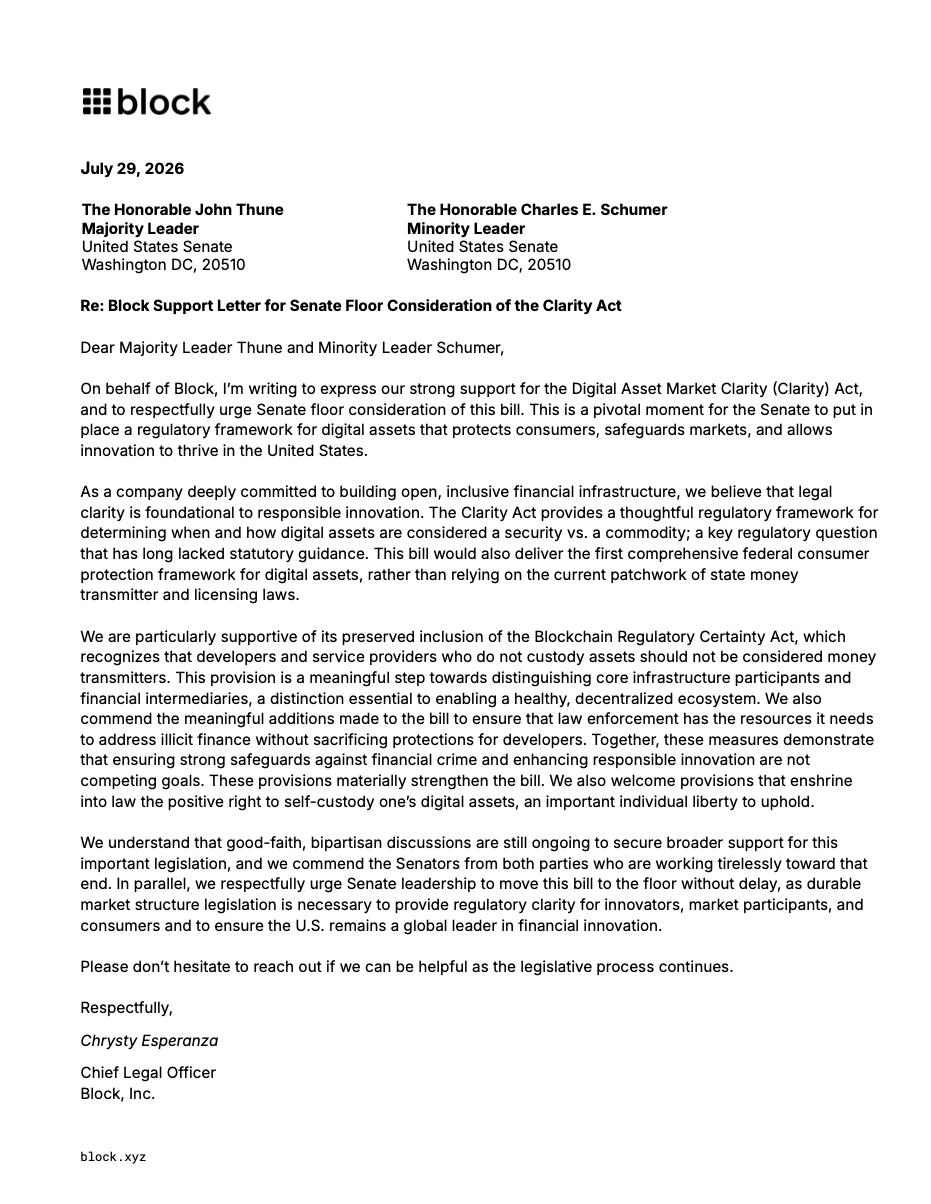
Block Inc. sent a letter to Thune and Senate Minority Leader Chuck Schumer asking them to bring the legislation to the floor before the recess.
Chief Legal Officer Chrysty Esperanza signed the letter, which said durable market-structure legislation was necessary to give innovators, market participants and consumers greater certainty while helping the United States remain a global leader in financial innovation.
Block said a national framework could replace fragmented state requirements, establish consistent consumer protections and define when digital assets fall under securities or commodities regulation.
The Solana Policy Institute sent a separate letter on July 28 requesting floor consideration before lawmakers departed. Miller Whitehouse-Levine, founder and CEO of the Solana Policy Institute, and Kristin Smith, president of the Solana Policy Institute, signed the letter.
“The Clarity Act delivers what the American crypto ecosystem needs,” the institute said, arguing that the bipartisan legislation was ready for final consideration after nearly a decade of policy work.
The institute said the United States led global blockchain-developer growth in 2024 and that the Solana ecosystem recorded an 84% year-over-year increase in developers. It cited those figures while arguing that legal certainty was needed to retain innovation and technical talent.
Existing financial rules were designed around custodians, brokers and centralized exchanges, the institute said, while blockchain networks can operate through decentralized infrastructure and direct user participation. The group argued that regulation should account for those structural differences.
SEC Says It Can Move Without Congress
Atkins said the SEC was “ready, willing and able” to develop cryptocurrency rules under its existing authority if Congress failed to pass the CLARITY Act.
He nevertheless said legislation would provide stronger and more durable certainty than agency rulemaking. “We need the certainty of a statute that will help future-proof so that we have clear direction to go forward,” Atkins said.
Agency rules can be revised when presidential administrations, SEC leadership or regulatory priorities change. A statute would provide a more permanent framework than rules adopted through the commission’s existing authority.
The SEC’s alternative initiative has been informally called Regulation Crypto and would mark a move away from an enforcement-led approach toward published rules governing token issuers, intermediaries and trading platforms.
The agenda could include registration exemptions for token launches, safe-harbor provisions for projects moving toward decentralization, custody standards for broker-dealers and market-structure requirements for cryptocurrency trading platforms.
Draft cryptocurrency rules could begin emerging later this year if Congress misses the legislative window. SEC action could address part of the existing uncertainty but would not settle questions requiring statutory coordination between the SEC and CFTC.
The dispute therefore concerns both the timing and structure of U.S. crypto regulation. Congress is considering a law that would divide authority across federal regulators, while the SEC is preparing a narrower framework based on powers already available under securities statutes.
FAQ
What does the CLARITY Act do?
It divides digital-asset oversight between the SEC and CFTC and establishes federal market-structure rules.
Why is the bill stalled?
Lawmakers remain divided over ethics, stablecoin yield, DeFi, anti-money laundering rules and enforcement authority.
What happens if Congress does not pass it?
The SEC could pursue token, custody and trading-platform rules under its existing authority.
Why is JPMorgan concerned?
JPMorgan said delay could shift tokenization activity toward incumbent infrastructure instead of public blockchain networks.
This article has been refined and enhanced by ChatGPT.


