




 USD
USD
Crypto Exchanges Expand Into Gold, Stocks as Bitcoin Demand Cools

Central Banks Plan Record Gold Buying While Trading Platforms Chase Macro Demand
TL;DR
- CryptoQuant data shows crypto exchanges are expanding into gold, silver, oil, equities and pre-IPO perpetual futures as crypto trading volume weakens.
- The World Gold Council’s 2026 survey found record central-bank plans to increase gold reserves over the next year.
- Santiment said low trading activity across top crypto assets reflects “widespread trader capitulation, exhaustion, and disinterest.”
Trade smarter on Jupiter, Solana’s leading DEX built for fast execution and deep liquidity.
Swap tokens at competitive rates, route across multiple liquidity sources automatically, and access perpetuals, DCA, and advanced trading tools — all in one place!
Crypto exchanges are moving deeper into traditional-finance-style markets as demand for Bitcoin and major altcoin trading cools, with CryptoQuant data showing rising exchange activity in gold, silver, oil, equities and pre-IPO perpetual futures while the World Gold Council said central banks plan record gold buying over the next year.
The shift shows crypto trading venues increasingly acting like always-open macro markets rather than platforms focused only on digital assets. CryptoQuant data showed traders using exchanges to access perpetual futures linked to commodities, stocks and private-company valuations, turning crypto platforms into venues for broader speculative exposure outside normal market hours.
Pre-IPO Perpetuals Lead the New Trading Push
Pre-IPO perpetual futures became the fastest-growing part of the exchange expansion. CryptoQuant data showed volume rising from $2 million in March 2026 to $715 million in May 2026, before reaching $1.2 billion in June 2026. A CryptoQuant post dated June 16, 2026, said pre-IPO perpetual volume had “exploded” to $12 billion as of June, with Binance controlling about 83% of the market.
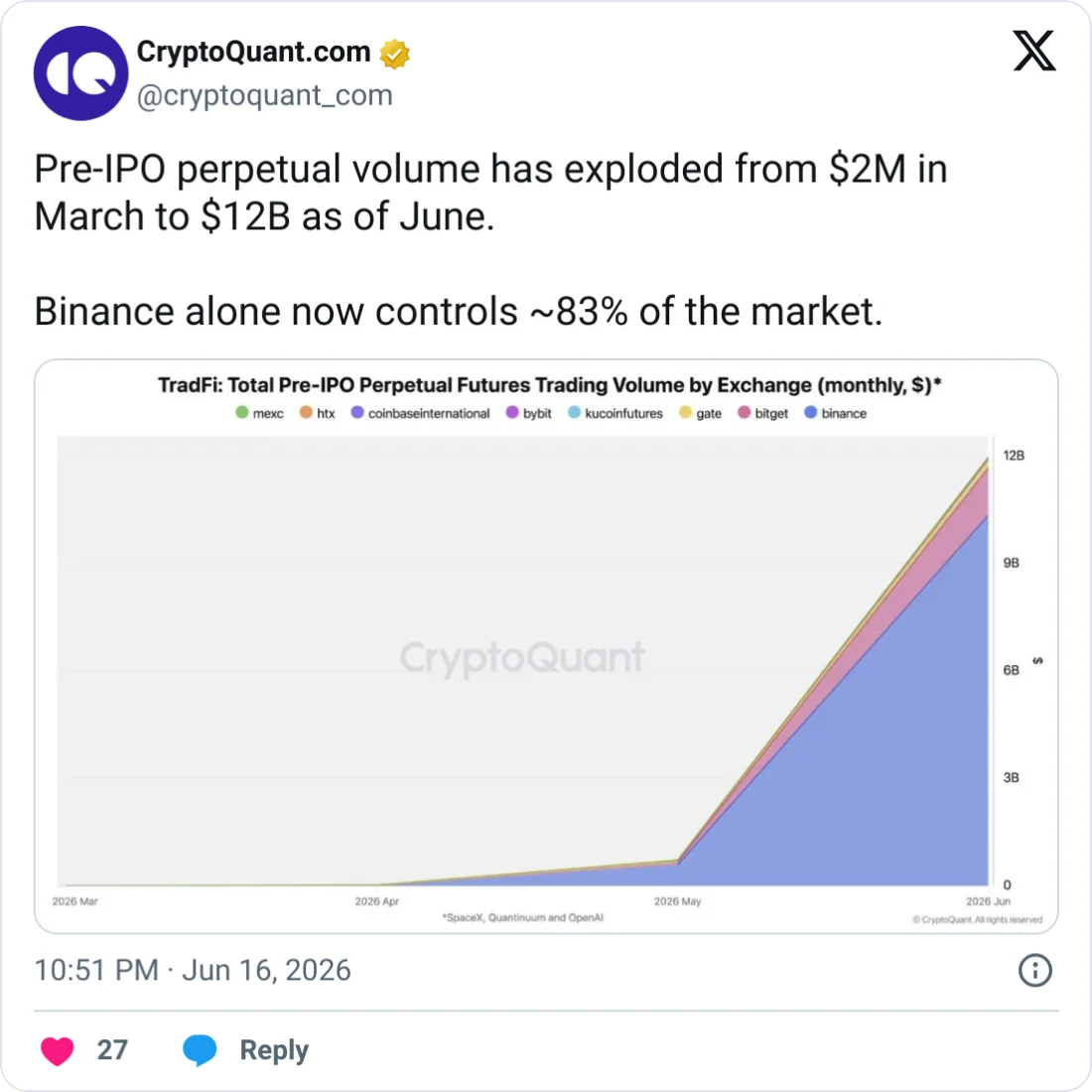
Interest in the category was tied to companies such as SpaceX, OpenAI and Quantinuum. Pre-IPO perpetuals gave crypto traders a way to speculate on private-company themes through perpetual contracts, while exchanges used the product to capture demand outside traditional crypto pairs.
Metals remained the largest traditional-finance product category by overall volume on crypto exchanges. Monthly metals futures volume climbed to nearly $500 billion in March 2026, driven mainly by gold and silver perpetual futures as both metals rallied to record highs. Metals-linked perpetuals were concentrated on Gate.io, Binance and MEXC.
Gate.io briefly became the metals market leader in March 2026, processing nearly $290 billion in metals trading volume during the rally before activity later declined sharply. Binance had steadier metals activity, reaching roughly $100 billion in March and remaining above $50 billion afterward. MEXC moved from almost no metals activity at the start of 2026 to more than $80 billion in May, overtaking Binance as the largest metals trading venue that month.
Equity-linked trading also expanded, though momentum cooled after March. Total equity-linked volume peaked at $34 billion in March before falling to $15.2 billion in May. Even with that decline, equities accounted for 16% of traditional-finance trading volume in June, up from 7% in May.
Binance dominated equity-linked trading. Monthly equity volume on the exchange rose from under $500 million in February to nearly $9.5 billion in May. Bitget ranked second, while Bybit, MEXC and Gate.io trailed at lower levels. CryptoQuant expects equity trading volumes to keep rising, supported by Binance’s expansion of equity offerings.
Binance launched spot trading for more than 7,000 U.S.-listed equities for eligible users in June 2026. Binance also introduced bStocks, tokenized products tracking selected U.S. stocks and ETFs, expanding the exchange’s push into tokenized real-world assets and public-market exposure.
We’ve launched the all-new COIN360 Perp DEX, built for traders who move fast!
Trade 130+ assets with up to 100× leverage, enjoy instant order placement and low-slippage swaps, and earn USDC passive yield while climbing the leaderboard. Your trades deserve more than speed — they deserve mastery.
Crypto Trading Volumes Weaken as Macro Products Gain Attention
Santiment reported on June 11, 2026, that trading volumes for the largest non-stablecoin crypto assets had fallen to levels last seen around mid-2024. Santiment said the low-volume environment reflects “widespread trader capitulation, exhaustion, and disinterest.”
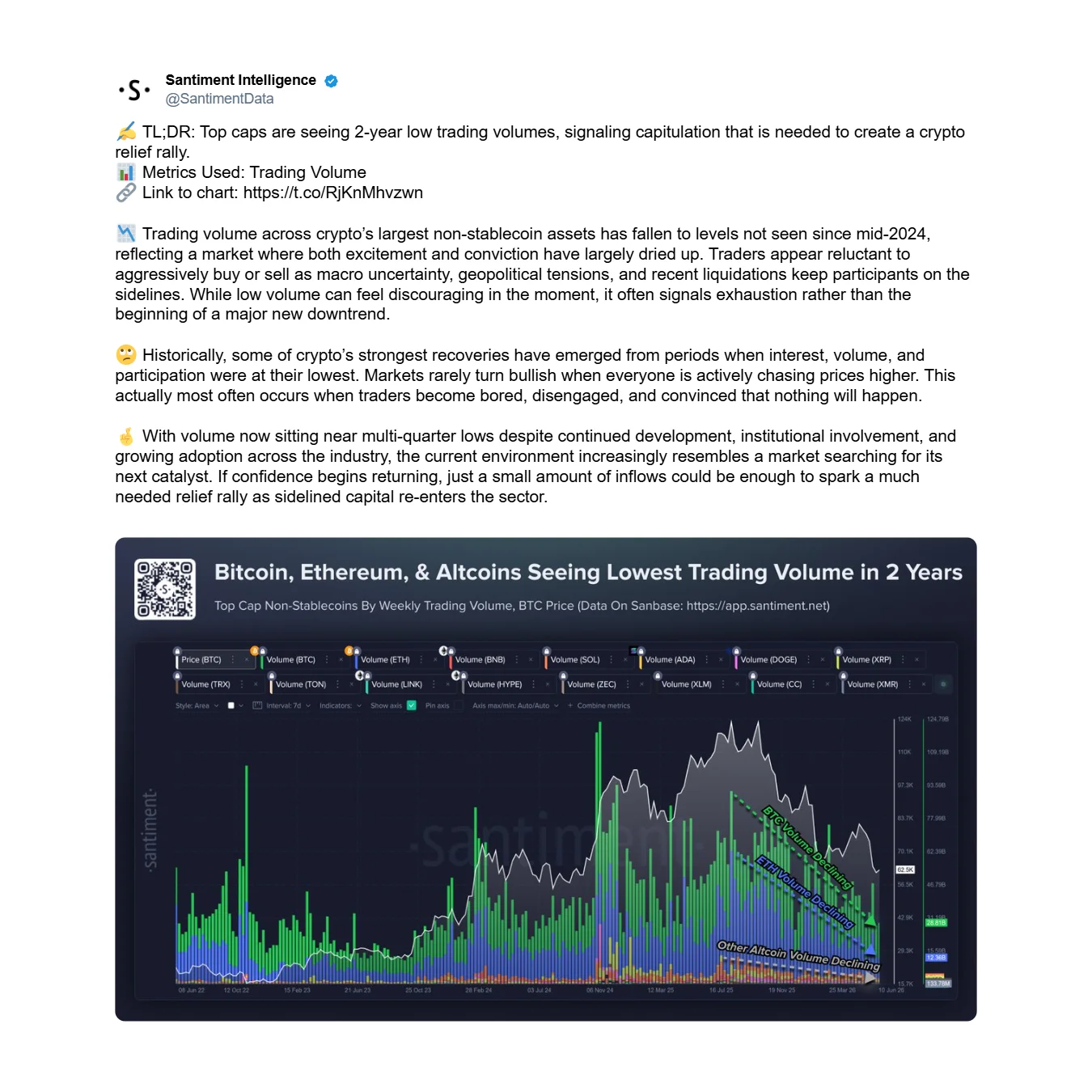
Santiment said traders were reluctant to act aggressively because of broader uncertainty. “Traders appear reluctant to aggressively buy or sell as macro uncertainty, geopolitical tensions, and recent liquidations keep participants on the sidelines,” Santiment said.
Santiment also said top-cap crypto assets were seeing two-year low trading volumes. Santiment framed the low-volume environment as capitulation that may be needed before a crypto relief rally can form.
Central-bank demand for gold offered another reason the metals trade has gained attention. The World Gold Council’s 2026 Central Bank Gold Reserves Survey found that a record 45% of central banks plan to increase their own gold reserves over the next 12 months.
The 45% figure was the highest buying-intent reading since the World Gold Council survey began in 2018. It was also more than double the 20% share recorded in 2020. The survey covered 76 central banks, the largest sample in its nine-year history, and YouGov ran the survey from February 5 to May 19, 2026.
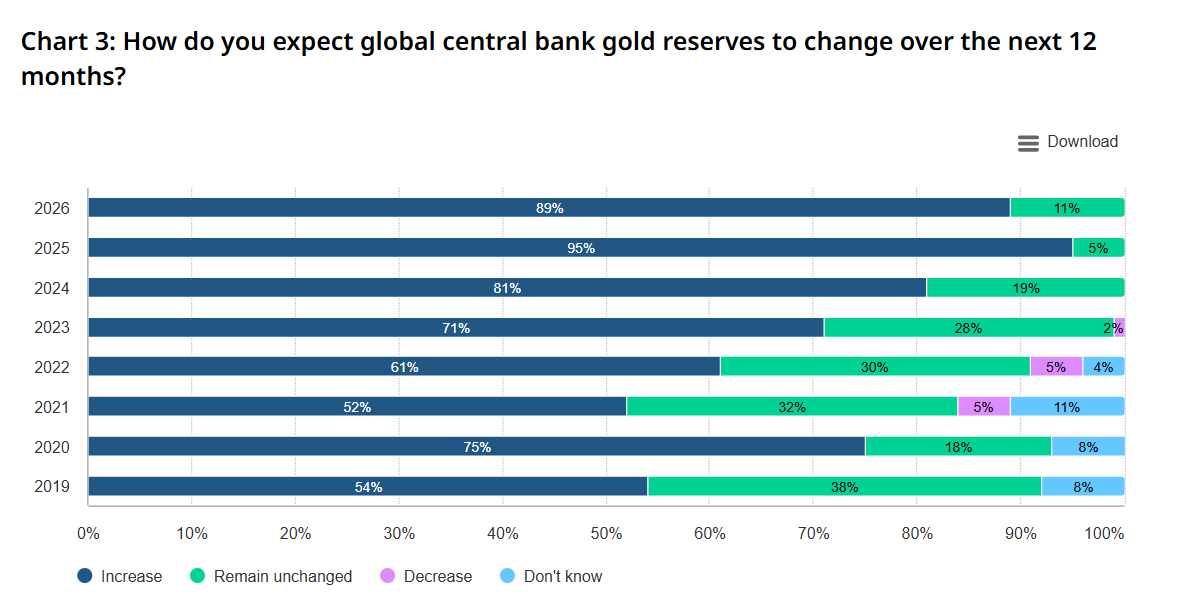
Most survey responses reportedly arrived after the Middle East conflict escalated in early 2026, giving the results a strong geopolitical-risk backdrop. The World Gold Council findings showed 89% of respondents expect global central-bank gold holdings to rise over the next year, down from 95% in the previous year’s survey, while only 1% expect central banks to cut gold holdings.
The survey also showed reserve managers expect gold to take a larger role over time. The World Gold Council found that 83% of central banks believe gold will make up a larger share of total reserves in five years, up from 76% in the previous survey. About 74% expect the U.S. dollar’s share of reserves to fall over the same period.
One respondent said: “We expect that there will be a downward shift in the share of total reserves held in US dollars. This reduction will come primarily from countries whose relationships with the US are likely to be affected by US foreign policy and political relations.”
Fewer central banks now cite historical legacy as the main reason for holding gold. The survey found that only 46% named legacy as the main reason, down from 62% the previous year, while more than 90% of reserve managers viewed gold as a strong performer during crises.
The World Gold Council findings said: “90% of respondents indicated that gold’s performance during times of crisis is highly or somewhat relevant to their organisation, a record high for this factor.” The same findings said 84% of respondents viewed gold’s role as a store of value as relevant, while 83% pointed to its role as a portfolio diversifier.
Interest-rate levels topped the list of economic signals shaping reserve decisions at 92%, the same level as the prior year. Geopolitical instability and inflation followed, with instability edging ahead of inflation. The findings tied the stronger focus on geopolitical instability to the war in Iran and the broader Middle East conflict backdrop in early 2026.
Central banks have bought an average of 1,000 tonnes of gold per year since 2022, double the 500 tonnes averaged over the previous decade. Official buyers resumed net purchases in April 2026, adding 19 tonnes after net sales in March.
The World Gold Council also said gold’s share of reserves had already overtaken U.S. government bonds as the world’s top reserve asset. That reserve trend raised a direct comparison with Bitcoin, whose supporters have often described it as a digital alternative to gold because it is scarce, portable and not controlled by a central bank.
Central banks have not given Bitcoin the same weight as gold. Ray Dalio argued earlier in 2026 that Bitcoin had not lived up to its expected safe-haven role and criticized Bitcoin’s public ledger by saying its traceability makes the asset controllable.
Michael Saylor responded by calling gold “analog capital” and Bitcoin “digital capital.” Saylor also argued that Bitcoin’s transparency is a feature rather than a flaw and said Bitcoin has beaten gold on a risk-adjusted basis since Strategy went all-in on Bitcoin in August 2020.
Gold’s outlook was not presented as one-sided. Bearish options bets targeted a 40% decline in gold prices by 2028, and Citigroup trimmed its gold forecast to $4,000. The tension is whether steady official-sector demand can offset any cooling in private investor appetite.
FAQ
Why are crypto exchanges adding gold, oil and stock products?
CryptoQuant data showed exchanges capturing demand for traditional-finance exposure as crypto trading volume weakened.
Which exchange led pre-IPO perpetual futures?
Binance led, with CryptoQuant saying it controlled about 83% of the market.
Why are central banks buying more gold?
The World Gold Council survey cited crisis performance, store-of-value use, diversification and geopolitical instability.
Did the cited material say Bitcoin replaced gold for central banks?
No. Central banks gave gold stronger reserve status than Bitcoin in the cited material.
This article has been refined and enhanced by ChatGPT.


