




 USD
USD
Flow Blockchain Exploit Triggers Rollback Uproar, Ecosystem Backlash, and Sharp FLOW Price Collapse


Emergency Chain Halt, Contested Rollback Plan, and Market Shock Expose Governance Fault Lines
TL;DR
- Flow blockchain halted after a ~$3.9 million exploit, sparking a controversial rollback proposal that alarmed ecosystem partners.
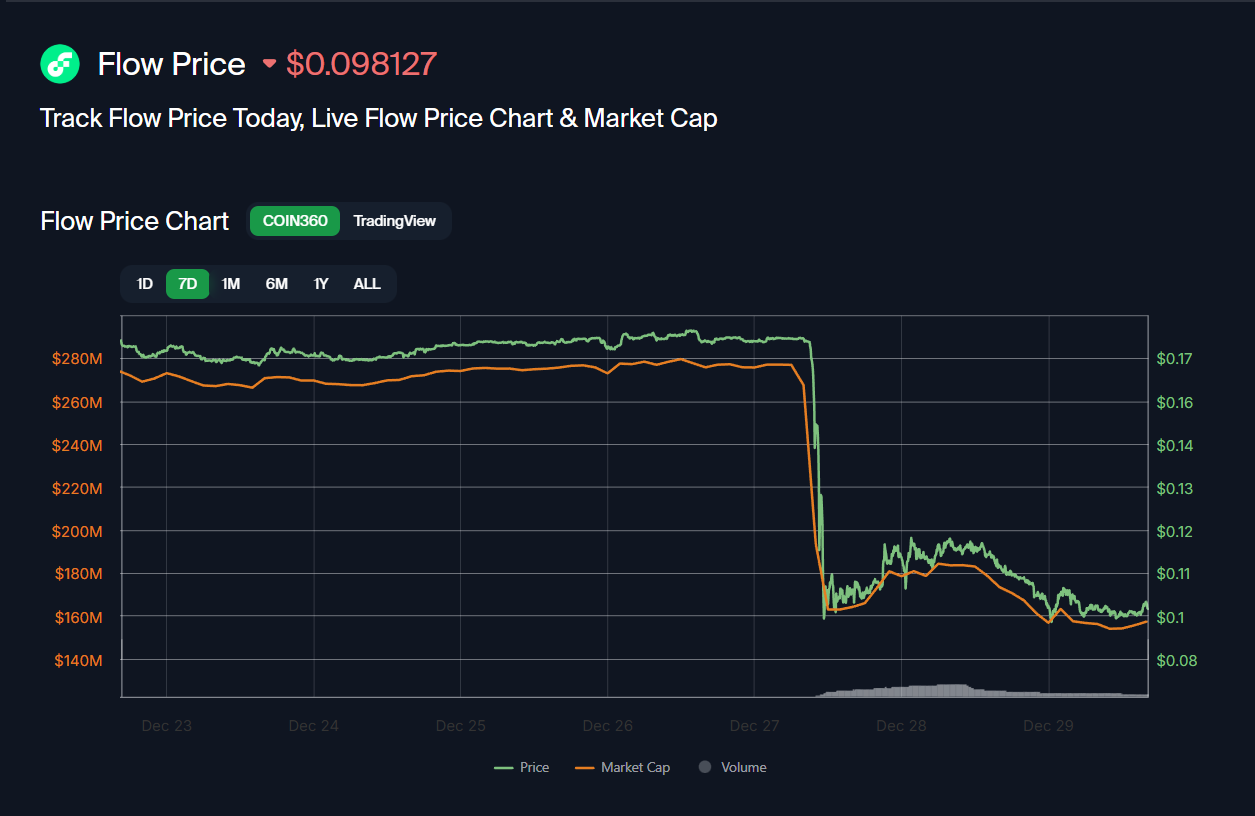
- Governance backlash and rollback uncertainty drove FLOW down more than 40%, with exchanges freezing deposits and withdrawals.
- The incident reignited debates over blockchain immutability, validator power, and trust in cross-chain infrastructure.
We’ve just launched the all-new COIN360 Perp DEX, built for traders who move fast!
Trade 130+ assets with up to 100× leverage, enjoy instant order placement and low-slippage swaps, and earn USDC passive yield while climbing the leaderboard. Your trades deserve more than speed — they deserve mastery.
Flow blockchain was thrust into crisis after a late-December exploit drained roughly $3.9 million from the network, forcing validators to halt block production and triggering one of the most contentious governance debates the ecosystem has faced to date. The incident, disclosed around December 27, involved a vulnerability in Flow’s execution layer that allowed an attacker to mint and move assets off-chain through multiple cross-chain bridges before the breach was detected. Once abnormal activity surfaced, validators coordinated an emergency shutdown to cut off further exits, while forensic teams began tracing the stolen funds across bridge infrastructure connected to other networks.
Core developers and the Flow Foundation initially moved fast with an aggressive remediation proposal: a partial rollback of the blockchain to a pre-exploit state. The plan centered on a so-called Mainnet 28 fix that would rewind several hours of chain history, effectively erasing the attacker’s transactions but also reversing legitimate user activity during the same window. While developers framed the rollback as a contained and technical correction, the proposal immediately rattled ecosystem partners, bridge operators, and market participants who warned that undoing settled transactions risked creating balance discrepancies, broken accounting, and deeper financial damage than the exploit itself.
Tensions escalated as cross-chain partners said they were blindsided by the rollback plan and urged validators to stop processing transactions entirely until a clearer path forward emerged. Critics argued that the ability to rewrite history undermined core assumptions around immutability and decentralization, exposing how much discretionary power validators could wield in a crisis. The debate played out publicly as developers attempted to reassure users that existing balances were not compromised and that the stolen amount, while serious, was manageable relative to the network’s overall activity.
Markets reacted far more brutally than the exploit’s dollar value alone might suggest. FLOW’s crypto price plunged more than 40% at its worst, briefly trading near historic lows as uncertainty over the rollback and broader governance implications spread. Several major exchanges suspended FLOW deposits and withdrawals as a precaution, amplifying panic selling and draining liquidity. Derivatives markets reflected the stress, with negative funding rates, rising short interest, and elevated liquidations as traders repositioned amid the volatility. The move sharply underperformed the broader crypto price index, reinforcing how event-driven risk can overwhelm macro trends tracked by the coin market cap.
Beyond the immediate market fallout and governance backlash, the Flow exploit has triggered a second-order disruption that is now rippling through the network’s NFT-backed lending market. The pause of Flow’s Cadence execution environment until the morning of December 29 prevented borrowers from interacting with smart contracts at critical moments, leaving NFT loans that matured during the halt unable to settle normally. According to Flow-based NFT lending platform Flowty, 11 loans reached maturity while the network was frozen; only one was repaid through an automated process, eight defaulted outright, and two failed to settle due to account restrictions tied directly to the exploit response. Although Flow has since come back online, much of the surrounding ecosystem remains impaired, with token swaps still largely unavailable, meaning borrowers may still be unable to acquire the assets needed to repay outstanding loans.
The situation has effectively placed both borrowers and lenders into what Flowty has described as “limbo,” prompting the platform to pause settlement on all loans as of 2:15 p.m. ET on December 30. Under this temporary framework, loans will neither default nor be repaid until broader functionality stabilizes, and no new interest will accrue for lenders during the pause. Flowty also disabled new loan listings and removed existing offers from its marketplace to limit additional exposure, framing the decision as a way to avoid forced defaults driven by network-wide constraints and the potential loss of NFTs that may be irreplaceable.
This article has been refined and enhanced by ChatGPT.


