


 USD

Global Markets Lose $4.28 Trillion as Bitcoin Falls Below $62K


Fed Rate Hike Fears, AI Stock Weakness, and ETF Outflows Deepen the Worldwide Sell-Off
TL;DR
- Global financial markets lost an estimated $4.28 trillion as U.S. stocks, Asian equities, precious metals, and cryptocurrencies declined sharply.
- Bitcoin fell below $62,000, while U.S. spot Bitcoin ETFs recorded $582.2 million in daily outflows and leveraged crypto liquidations surged.
- Anthropic's record-breaking IPO failed to lift broader markets as investors reassessed Federal Reserve policy, AI valuations, and tightening liquidity.
Trade smarter on Jupiter, Solana’s leading DEX built for fast execution and deep liquidity.
Swap tokens at competitive rates, route across multiple liquidity sources automatically, and access perpetuals, DCA, and advanced trading tools — all in one place!
Global financial markets suffered a widespread sell-off on November 19-20, 2026, wiping out an estimated $4.28 trillion in market value as U.S. equities, Asian stocks, precious metals, and cryptocurrencies declined together.
The Bitcoin price fell below $62,000, reaching its lowest level since early July, while growing expectations of another Federal Reserve interest rate hike and concerns over artificial intelligence financing weighed on investor sentiment. The downturn also coincided with Anthropic's historic public debut, although market data and competing assessments suggest the IPO was not the sole cause of the decline.
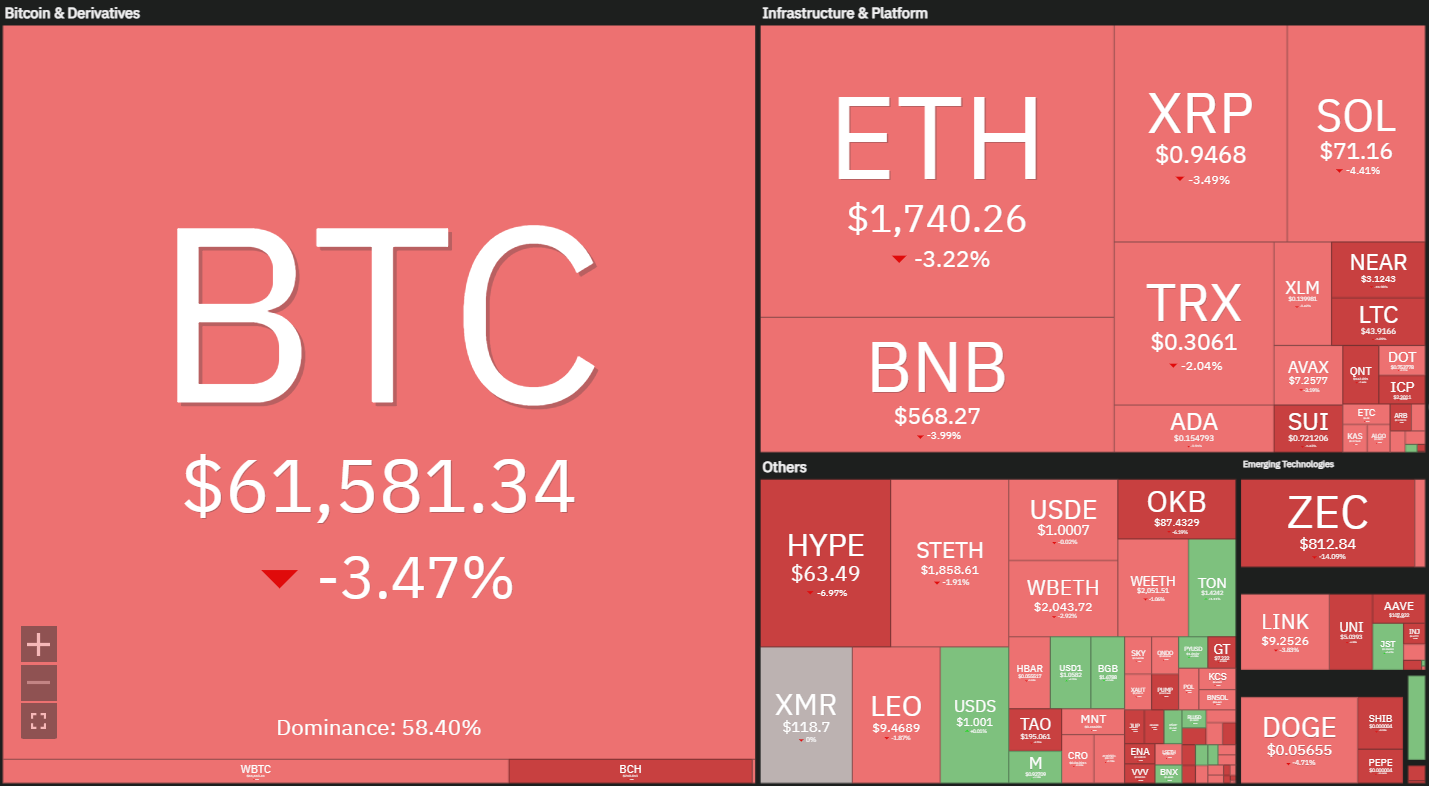
The losses spread across several asset classes, with U.S. equities shedding approximately $1.85 trillion, Asian markets losing around $1.1 trillion, gold and silver surrendering roughly $1.3 trillion, and cryptocurrencies erasing nearly $36 billion.
The simultaneous declines followed a reversal in technology shares, renewed selling across institutional crypto investment products, and a stronger U.S. dollar. Higher Treasury yields added to the pressure as investors increasingly priced in further monetary tightening rather than the rate cuts that previously supported financial markets.
Wall Street, Asian Stocks, and Precious Metals Record Heavy Losses
Wall Street's decline accelerated on Thursday despite Anthropic's successful Nasdaq debut and Nvidia's stronger-than-expected earnings outlook. The Dow Jones Industrial Average lost more than 1,100 points, while the S&P 500 recorded its sixth consecutive losing session, its longest streak since April 2024.
More than 90% of the benchmark's constituents finished lower, with all 11 sectors declining. The index also traded below its 200-day moving average and stood 8.2% beneath its October record.
Technology and AI-linked companies experienced some of the sharpest selling. Nvidia shares declined 3.3%, while Broadcom and Micron each lost 2.1%. The Philadelphia Semiconductor Index fell 2.4%, and the broader technology sector closed 1.9% lower.
Data-center infrastructure companies also suffered, with CoreWeave dropping 6.1% and Nebius falling 9.4%. AMD plunged 7.7%, while SoftBank declined as much as 16%, reflecting widespread pressure on businesses linked to the AI investment cycle.
Asian technology shares extended the downturn after U.S. trading closed. Taiwan's TSMC, South Korea's Samsung, and SK Hynix collectively suffered substantial declines, losing approximately $63 billion, $44 billion, and $38 billion in market value, respectively.
The selling highlighted the exposure of regional stock markets to semiconductor demand and AI-related capital spending. Investors were also weighing concerns about the sustainability of infrastructure investment, rising borrowing costs, and mounting debt associated with the expansion of artificial intelligence services.
The stock-market downturn marked a notable contrast with the previous comparable S&P 500 losing streak. That earlier decline ran from April 12 to April 19, 2024, amid interest-rate concerns, tensions between Israel and Iran, and technology-stock weakness.
Selling ended on April 22, when the index rose nearly 1%, before cooler inflation data helped it reach a record 5,308.15 on May 15, just 26 days after the streak ended. The current downturn began from a deeper drawdown, while interest-rate expectations had shifted toward additional increases.
Bitcoin ETF Outflows and Liquidations Intensify Crypto Selling
The Bitcoin price extended its decline as selling spread across risk-sensitive assets, with COIN360's crypto price coverage reflecting the broader downturn. There was a 24-hour low of $61,273 and a subsequent trading level near $61,780, representing declines of 2.8% over the day and 10% over the week at that snapshot. Ethereum's price approached $1,730, while Solana's price slipped toward $72, and major altcoins including XRP and Dogecoin also declined.
Leveraged positions came under pressure as the downturn accelerated. CoinGlass data showed $727 million in liquidations over 24 hours, approximately 86% of which involved long positions betting on higher prices.
Bitcoin accounted for just under $202 million, while more than 151,000 traders were affected. Earlier market snapshots captured smaller liquidation totals as the selling continued. The forced closures added another source of pressure to a market already facing weakening institutional demand and broader financial-market volatility.
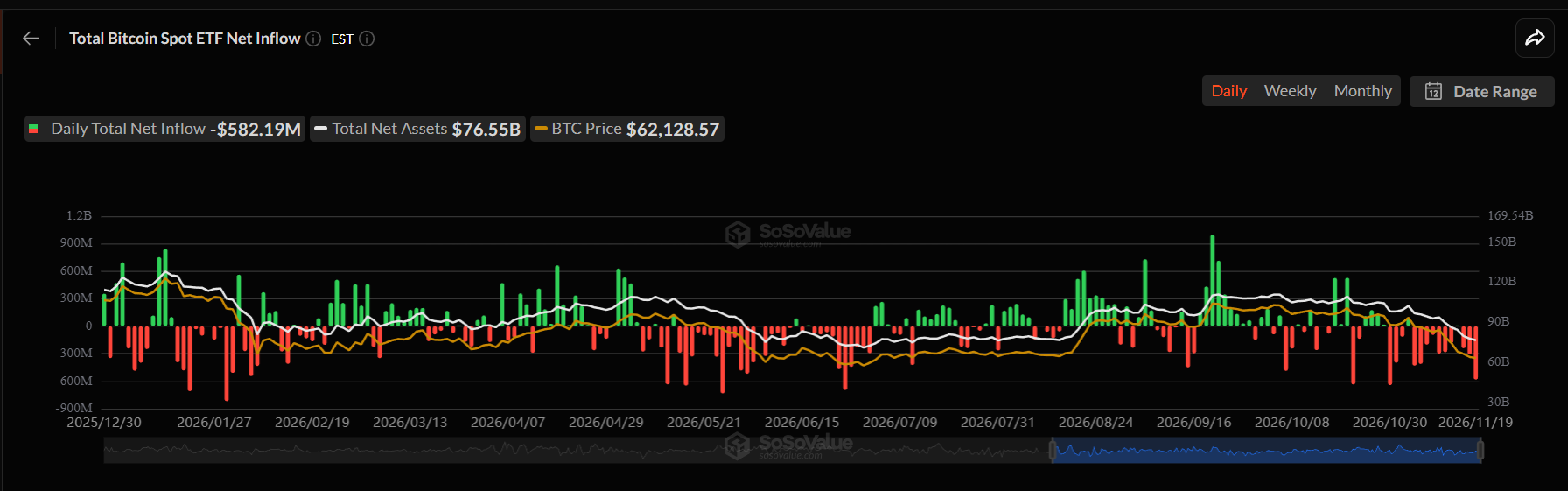
U.S. spot Bitcoin exchange-traded funds also registered substantial withdrawals. According to SoSoValue, the products recorded $582.2 million in net outflows on November 19, their largest single-day withdrawal since October 30. Weekly outflows exceeded $1.1 billion, while cumulative November withdrawals approached $3.5 billion.
Total ETF net assets fell to approximately $76.6 billion. The latest withdrawals followed roughly $306 million in net outflows on November 18, extending a sustained period of institutional selling.
Neil Steinhardt, head of Nexo U.S., said:
"Within crypto, the most telling sign is this month's outflow from spot Bitcoin ETFs, which suggests investors are choosing to stay on the sidelines for now."
On-chain indicators also showed deteriorating conditions for existing holders. Glassnode said Bitcoin remained above its realized price, which represents the average price at which coins last moved on the network, but the margin had narrowed considerably.
Its market value to realized value ratio, or MVRV, was just above 1. A further decline below that threshold would place the average holder at a loss for the first time since early 2023, according to the analytics firm.

CoinShares head of research James Butterfill characterized the downturn as an extension of existing weakness rather than a separate market cycle. "I see this as a continuation of the existing bear market rather than the start of another," he said in a research note, pointing to selling by large holders since late 2025, higher interest-rate expectations, and weaker technology shares.
CoinShares' base case puts Bitcoin between $60,000 and $90,000 through much of 2027, with a potential shift in monetary policy dependent on easing inflation.
Federal Reserve Rate Hike Expectations and AI Financing Risks Add Pressure
Expectations of tighter U.S. monetary policy have become a major factor in the decline across financial markets. CME FedWatch data placed the probability of a quarter-point Federal Reserve interest-rate increase at the December 9 meeting at 99.2%.
The probability of a larger half-point increase had fallen to almost zero from more than 9% on Thursday morning. Federal Reserve Governor Christopher Waller had called for a larger increase unless policymakers signaled another rate rise in January.
JPMorgan strategist Michael Feroli also projected three consecutive 25-basis-point increases in December, January, and March, potentially taking the federal funds rate to 4.50%-4.75%.
The forecast followed the release of minutes from the Federal Reserve's October meeting on November 18, which showed widespread expectations of further monetary tightening. The central bank had raised rates in September for the first time in three years before holding them steady the following month.
Recent economic figures contributed to the changing outlook. U.S. consumer prices rose 0.4% in October from September, while advance retail and food services sales increased 0.2%, within the estimate's margin of error. Industrial production declined 0.4%.
Meanwhile, the Philadelphia Fed's November manufacturing survey showed regional activity falling to 6.3 from 20.9, while its prices-received index rose to 47.0, its highest level since June 2022. These figures accompanied growing concerns that inflationary pressure could limit the Federal Reserve's room to ease monetary policy.
Treasury yields above 5% and a strengthening U.S. dollar also weighed on market sentiment. Fidelity Investments director of global macro Jurrien Timmer said financial markets had moved away from an environment characterized by supportive financial conditions and rising corporate profits.
His investment clock still showed earnings growth above 30%, but the U.S. Dollar Index had climbed to 103.4 and broken above its 200-week moving average for the first time since April 2025.
"It's not the end of the world but it's also no longer all tailwinds," Timmer wrote on X.
Timmer linked the weakness in precious metals and Bitcoin to slower global liquidity growth. Fidelity's data showed global M2 money supply growth cooling from a 12.1% peak to approximately 8.5%. Its gold valuation model pointed toward $4,987, compared with roughly $3,853 on Fidelity's chart and an earlier peak of $5,595. Spot gold was quoted near $3,715 on November 19, before subsequent market updates showed additional selling.
Neil Steinhardt also identified changes in yields and the dollar as potential indicators of a shift in investor behavior. "Because the pressure appears tied to the rate backdrop, and that backdrop has shifted before, a turn in yields or the dollar would likely be the first signal that appetite is returning," he said, identifying the December 4 U.S. jobs report as another important economic checkpoint.
The Federal Reserve's October 27-28 meeting minutes also addressed risks related to the AI investment boom. Policymakers discussed the possibility that returns on AI spending could disappoint investors, particularly given the rapid expansion of debt and complex financing arrangements supporting the sector.
Fed staff identified off-balance-sheet leases and circular financing between AI-related companies as structures that could amplify losses if asset valuations weakened. Elevated valuations and hedge fund leverage were among the vulnerabilities identified, although stronger banking and household balance sheets were seen as potential buffers.
Other concerns involved possible forced selling by leveraged investors and investment funds facing withdrawals. Several officials questioned whether supervisors had sufficient information about banks' indirect exposure to nonbank financial institutions, including private credit funds.
The potential for an AI-related downturn to spread beyond semiconductor companies and affect broader financial markets became increasingly relevant as technology stocks continued to weaken.
Anthropic IPO's Role in Bitcoin Crash Draws Competing Assessments
Anthropic's highly anticipated Nasdaq debut took place amid the global market decline, raising questions about whether the record offering diverted capital from cryptocurrencies and other investments.
The Claude developer raised approximately $81.3 billion after pricing shares at $83, above its initial $70-$78 range. The offering was expanded to 980 million shares, valuing the company at approximately $1.5 trillion at the IPO price and surpassing SpaceX's previous fundraising record.
Trading under the ticker ANT, Anthropic shares opened at $111.50, approximately 34% above their offering price, briefly pushing the company's market capitalization toward $2 trillion. The stock subsequently retreated and closed its first session at $97.17, remaining 17% above the IPO price.
The successful debut contrasted with losses across technology stocks and broader equity benchmarks, leaving investors divided over the listing's influence on the surrounding sell-off.
Crypto analyst Michaël van de Poppe argued on X that investors had been selling Bitcoin to prepare for Anthropic's offering, drawing a comparison with the cryptocurrency's decline before SpaceX's IPO in June. Bitcoin fell almost 29% before that earlier listing before recovering above $80,000. Ripple CEO Brad Garlinghouse presented a similar argument during a CNBC appearance, suggesting capital was shifting toward major public offerings and away from digital assets.
However, Bitcoin's decline had already begun well before Anthropic started trading. The cryptocurrency was approximately $7,300 below its September peak by October 26, when Anthropic's IPO filing became public. That accounted for nearly 30% of the roughly $25,000 decline recorded through the Wednesday preceding the listing.
November also brought political and regulatory concerns, with Democrats winning both chambers of Congress during the midterm elections and voters rejecting data-center projects in 40 of 41 ballot measures, according to CNN.
Selling continued following those developments. Bitcoin experienced a particularly sharp decline on November 5, losing approximately $5,000 to close near $75,700, before subsequent ETF outflows and technology-sector weakness added to the pressure.
BitMEX co-founder Arthur Hayes disputed the idea that Anthropic's offering was directly draining liquidity from crypto. Speaking on van de Poppe's podcast, Hayes argued that the strength or weakness of the public debut would be an indicator of broader appetite for risk rather than a straightforward explanation for Bitcoin selling.
Separate research also challenged the capital-rotation explanation. Block Scholes researcher Thahbib Rahman found that wider financial-market movements explained part of Bitcoin's recent decline, with little evidence that investors had specifically sold the cryptocurrency to purchase AI-related assets.
DWF Labs instead highlighted Bitcoin's historical vulnerability during equity-market downturns. The firm reported on November 19 that Bitcoin declined on 77% of U.S. trading days when QQQ, an exchange-traded fund tracking the Nasdaq-100, fell by at least 1% following the launch of spot Bitcoin ETFs. Yahoo Finance data found 91 Bitcoin declines across 118 qualifying trading sessions, equivalent to 77.1%, with an average Bitcoin log return of minus 1.93%.
The relationship was also visible before spot Bitcoin ETFs began trading, when DWF Labs found Bitcoin declined on 74% of major Nasdaq down days between 2020 and January 2024. The analysis used different closing periods for stocks and Bitcoin, meaning the results included some cryptocurrency trading after the U.S. market closed.
CME Group research similarly identified stronger correlations between Bitcoin and equities during periods of financial stress, when investors may need to sell multiple assets to raise cash.
Bitcoin's exposure to an AI-sector reversal was particularly notable because the cryptocurrency had not participated in the industry's earlier rally. DWF Labs found that the iShares Semiconductor ETF gained 85% from September 2025 through November 13, while Bitcoin declined 39%.
The firm's relative-performance analysis also identified a negative 0.30 correlation between Bitcoin's performance and semiconductor stocks' outperformance of the Nasdaq benchmark from March 2026 through the end of its sample.
Concerns about AI spending were compounded by developments at Nvidia. Its board accepted Jensen Huang's resignation as chief executive on November 11. The company had lost approximately $1 trillion in market capitalization since late October, while Bitcoin fell about $10,300 over the three days following Huang's departure. The episode prompted renewed attention to the financial connections between AI infrastructure, technology shares, and digital assets.
BitMine Chairman Tom Lee had previously identified a mechanism through which this pressure could reach cryptocurrency markets. Referring to selling across chipmakers and Asian equities, he said in an October 19 statement: "Crypto is widely held in the US, Korea and Taiwan. So naturally, when investors in those regions de-risk, this creates spillover pressures in crypto markets."
Other market participants took more defensive positions. Panmure Liberum strategist Joachim Klement said his team was moving fully defensive after the S&P 500 fell below its long-term moving average. His team estimated that an AI market unwind could cut stock prices by 30% or more, although Klement also highlighted repeated crossings of that trend indicator during previous market tops. "Today is thus not the beginning of the end, but the end of the beginning," he said.
Economist and longtime Bitcoin critic Peter Schiff issued a more severe warning on November 20, arguing that falling gold prices could signal significant losses ahead for stocks and real estate. He shared a video titled "The Next Crash Will Be Worse Than 2008" and suggested the Federal Reserve might ultimately change course to prevent a broader financial crisis.
"Gold is signaling deflation. But asset deflation would bust the government and the banking system, so the Fed will pivot to avoid it," Schiff said.
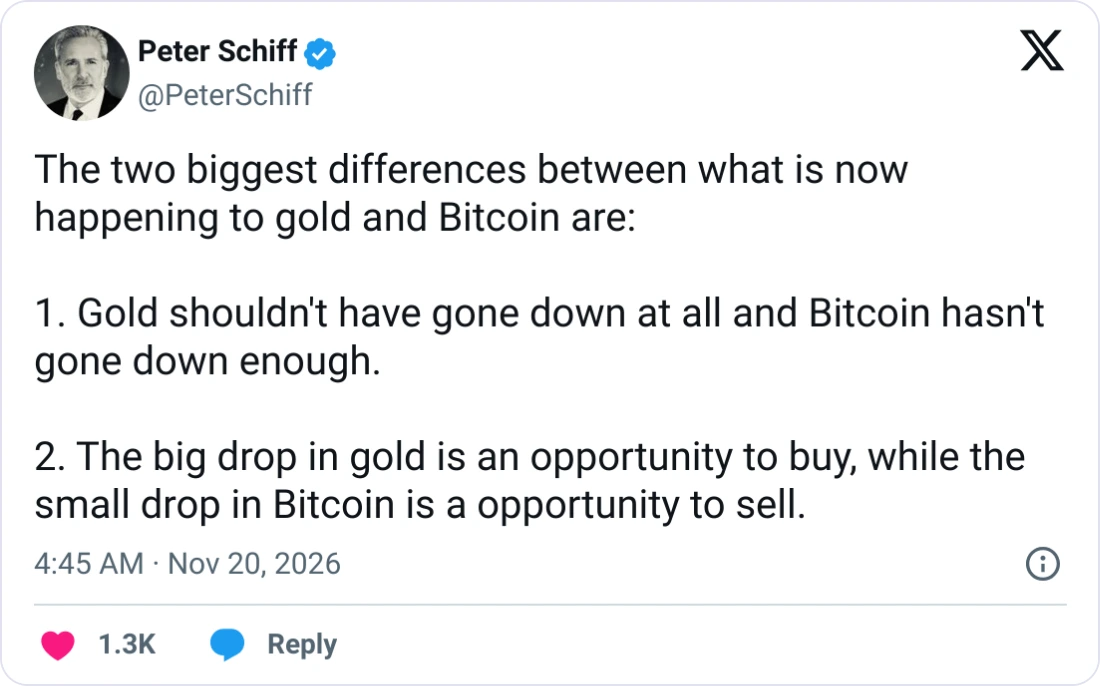
Schiff also warned that the U.S. stock market could surrender its gains since President Donald Trump took office. He pointed to a 12.25% decline in the Nasdaq, a 64% slide in CoreWeave, and a 33.5% retreat in Bitcoin from its 2026 peak.
The economist also cited a U.S. housing market index reading of 25, the lowest since 2012, as evidence of weakness extending beyond the AI sector. His warnings represented forecasts rather than confirmed outcomes as markets continued to assess interest-rate expectations, institutional selling, and the financing risks surrounding artificial intelligence investment.
This article has been refined and enhanced by ChatGPT.


