


 USD

Nvidia Board Rejects Jensen Huang Return as Earnings Beat and Tokenized Trading Surges

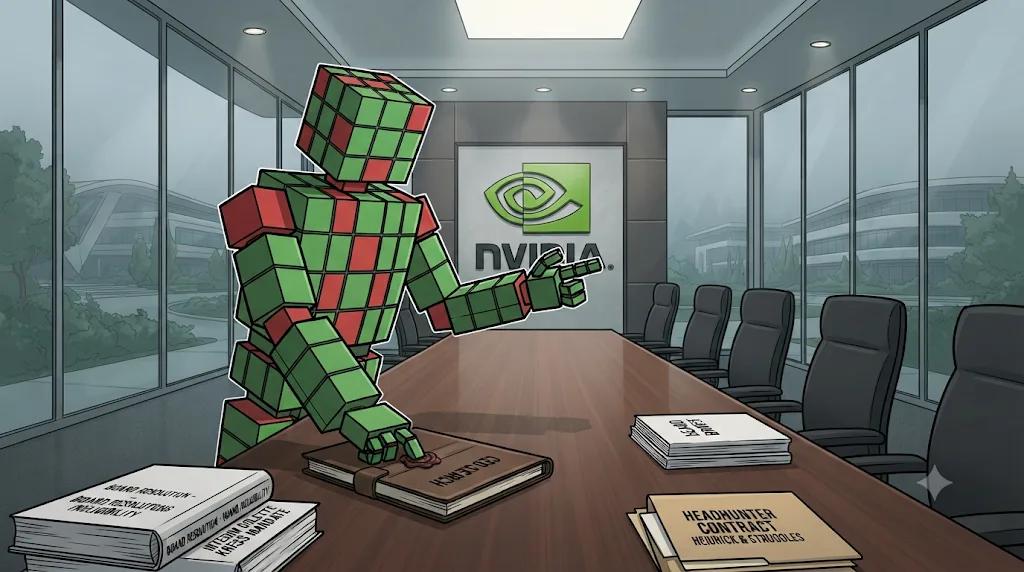
Record quarterly results lift shares while leadership changes and chip export scrutiny reshape Nvidia's outlook
TL;DR
- Nvidia's board ruled out reinstating Jensen Huang as CEO, backed interim chief Colette Kress, and appointed Heidrick & Struggles to lead its search for a permanent replacement.
- Nvidia beat quarterly revenue and earnings expectations, sending shares higher after hours despite continued pressure following Huang's departure.
- Tokenized Nvidia perpetual futures recorded $8.7 billion in trading volume on Huang's resignation day as traders increasingly turned to onchain equity derivatives.
Trade smarter on Jupiter, Solana’s leading DEX built for fast execution and deep liquidity.
Swap tokens at competitive rates, route across multiple liquidity sources automatically, and access perpetuals, DCA, and advanced trading tools — all in one place!
Nvidia's board formally ruled out reinstating co-founder Jensen Huang during its November 17, 2026, earnings call, moving ahead with a permanent CEO search following his November 12 resignation. The decision came as the AI chipmaker reported record fiscal third-quarter revenue of $115.8 billion, up 103% year over year, and shares gained roughly 2% in after-hours trading. Meanwhile, trading in tokenized Nvidia derivatives surged amid the leadership controversy.
Nvidia Board Backs Colette Kress and Expands Export Oversight
Nvidia board chair Harvey Jones made the company's position explicit during the earnings call, rejecting speculation that Huang could resume his leadership role. "The Nvidia board does not intend to reinstate Jensen as CEO," Jones said. He added that directors had unanimously accepted Huang's resignation and would not answer questions about his departure or the ongoing independent investigation. Executive recruitment firm Heidrick & Struggles has been hired to identify a permanent successor, while Chief Financial Officer Colette Kress continues to serve as interim chief executive.
Jones also expressed confidence in the leadership team overseeing the transition.
"We have every confidence in Colette's leadership, integrity and ability to deliver as interim CEO," he said.
Huang had publicly offered to return just hours earlier if directors believed his reinstatement would benefit employees and shareholders.
Before that statement, CNBC cited sources saying the board was not considering his return. President Donald Trump and Elon Musk were among those who publicly supported reinstating Huang, whose departure ended his 33-year tenure at the company.
Huang resigned following revelations about extramarital relationships involving company employees and a businesswoman suspected by U.S. intelligence officials of having connections to China. Those intelligence allegations remain unproven, and an independent investigation is examining his conduct and potential national security implications. Separately, the Securities and Exchange Commission opened a civil investigation into whether Nvidia violated investor-disclosure laws, adding regulatory scrutiny to the company's leadership transition.
Nvidia has also established a National Security and Export Control Oversight Committee, chaired by director Suzanne Nora Johnson. Jones said the committee would strengthen engagement with U.S. officials as Washington investigates how restricted AI chips reached China. The panel will oversee Nvidia's compliance programs and receive reports directly from its national security and trade compliance teams.
The company recorded $2.5 billion in quarterly revenue from sales to Chinese business units under limited export permissions issued by the Trump administration. Those arrangements face additional scrutiny following reports that billions of dollars in restricted Nvidia hardware reached mainland China through overseas intermediaries.
Nvidia Earnings Beat Wall Street Estimates, but Shares Remain Under Pressure
Nvidia's latest earnings demonstrated continued growth in its AI hardware business despite the disruption surrounding its former chief executive. For the fiscal third quarter ended October 25, the company exceeded Wall Street's approximately $109.1 billion revenue forecast. Adjusted earnings also surpassed expectations, while the data center division remained the largest contributor to overall sales. Nvidia's earnings release provided the following financial results and outlook.
The fourth-quarter forecast, which Reuters compared with analysts' expectations, includes an additional reporting week and assumes no data center computing revenue from China. Nvidia also confirmed that its Vera Rubin NVL72 computing platform had begun shipping. Kress sought to reassure investors about operational continuity, saying, "Our momentum is real," in the earnings announcement. She added that the Vera Rubin rollout was progressing strongly and Nvidia's product roadmap remained on track.
Despite the earnings rebound, Nvidia shares remained roughly 35% below their October peak near $240, following a selloff that erased hundreds of billions of dollars in market value. Technical analysis identified immediate support near $150, close to the $148.80 low reached during the previous week's decline. Its analysis placed initial resistance between $164.40 and $165.60, with additional price hurdles around $176 and between $184 and $189. Those levels represent chart-based assessments rather than confirmed future price movements.
Additional indicators continued to reflect downward pressure. The Relative Strength Index stood near 22.5, below the conventional oversold threshold of 30, while the Average Directional Index reached approximately 45.4, indicating a strong prevailing trend with directional signals favoring sellers. The faster exponential moving average remained above the slower average, preserving a positive longer-term configuration despite the recent selloff. The earnings recovery had therefore not yet reversed the broader decline identified in the chart.
Tokenized Nvidia Derivatives Surge as Onchain Traders React to Leadership Shake-Up
Trading in tokenized Nvidia perpetual futures surged following Huang's resignation, according to The Block's November 17 Data & Insights newsletter. Onchain derivatives markets recorded sharply higher activity as traders reacted to developments affecting the chipmaker. Trading continued during the weekend, when conventional stock markets were closed, creating an alternative venue for speculating on Nvidia's share price before regular trading resumed.
The Block reported the following changes in tokenized Nvidia trading activity:
Hyperliquid's tokenized NVDA perpetual also reflected roughly half of the price decline that eventually occurred when traditional stock trading resumed on Monday. The activity demonstrated how onchain markets responded to corporate developments outside regular stock exchange hours. The Block also observed a broader shift in equity derivatives trading, with centralized exchanges gaining 13% of market share from onchain perpetual venues since the beginning of the year as they expanded their own offerings.
This article has been refined and enhanced by ChatGPT.


