




 USD
USD
Grayscale Says Revenue-Producing Crypto Protocols Look Cheap

CLARITY Act Hopes Put Onchain Finance Valuations Back in Focus
TL;DR
- Grayscale said several revenue-generating crypto protocols appear attractively valued ahead of possible U.S. market structure legislation.
- The firm’s thesis centers on protocol revenue, low operating overhead and potential growth in tokenized assets and onchain finance.
- Hyperliquid, Pump.fun, PancakeSwap, Sky, Jupiter, Aave and Aerodrome were among the largest revenue producers highlighted.
Trade smarter on Jupiter, Solana’s leading DEX built for fast execution and deep liquidity.
Swap tokens at competitive rates, route across multiple liquidity sources automatically, and access perpetuals, DCA, and advanced trading tools — all in one place!
Grayscale said many revenue-producing crypto protocols appear attractively valued from a fundamental perspective as the CLARITY Act advances through the U.S. legislative process, with the firm pointing to onchain applications that generate meaningful protocol revenue and trade at relatively low trailing revenue multiples.
Grayscale released the view on June 24, 2026, framing revenue-generating onchain applications as a potential valuation opportunity after a prolonged crypto bear market. The firm said several protocols continued to produce real onchain revenue while token valuations had not fully reflected those cash flows.
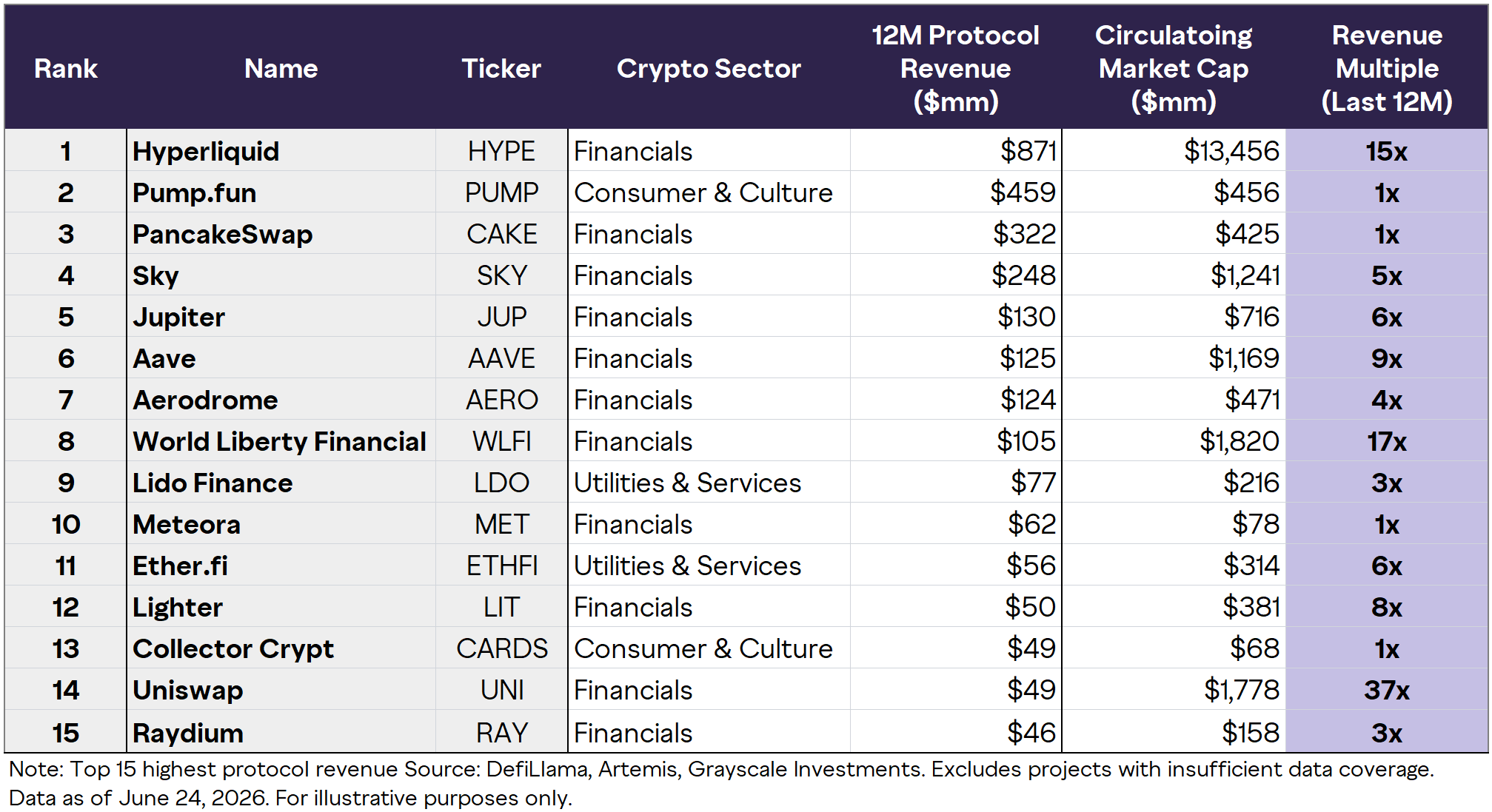
Zach Pandl, Head of Research at Grayscale, said, “Many income-producing blockchain applications now appear attractively valued from a fundamental perspective. In fact, most of the top 15 onchain applications by protocol revenue—including Hyperliquid—are now trading at attractive trailing 12-month multiples, many of them at single digits.”
Grayscale’s screen focused on the top 15 onchain applications by protocol revenue. The data was listed as of June 24, 2026, with DefiLlama, Artemis and Grayscale Investments cited as sources. Projects with insufficient data coverage were excluded, while Chainlink was omitted because its revenue streams mix onchain and offchain sources.
CLARITY Act Seen as a Regulatory Catalyst
Grayscale linked the valuation argument to the Digital Asset Market Clarity Act, or CLARITY Act, which the firm described as a potential catalyst for tokenized assets and onchain finance. Pandl said, “Specifically, CLARITY will help drive growth in tokenized assets and onchain finance.”
The CLARITY Act passed the House in July 2025 and advanced through the Senate Banking Committee by a 15-9 vote in May 2026. The bill’s path has included earlier conflict around stablecoin yield provisions between banks and crypto industry groups, while later sticking points reportedly included ethics language and developer protections in Section 604.
Senator Cynthia Lummis recently said negotiations had been “hardcore,” with final text potentially released around July 4, 2026. It remains unclear whether the latest draft will address the issues that slowed the bill’s progress.
Pandl said, “Many revenue-producing crypto assets are trading at low multiples ahead of potential passage of the CLARITY Act, creating an attractive entry point for fundamental investors, in our view.”
Polymarket assigned a 67% probability of the CLARITY Act passing this year, implying a 33% chance of failure. That probability leaves Grayscale’s regulatory catalyst thesis unresolved, because the firm’s argument depends on both the bill’s passage and the final shape of its market structure language.
Hyperliquid Leads Revenue Group
Hyperliquid ranked first in the revenue screen and was described separately as having generated around $800 million in revenue in 2025. The perpetuals trading platform was presented as one of the highest-earning protocols across the crypto industry.
Hyperliquid’s HIP-3 proposal launched in October 2025 and allows third parties to deploy permissionless perpetual markets on the protocol. The proposal expands possible perpetuals markets to equities, commodities, indices and pre-IPO stocks.
S&P Dow Jones Indices licensed the S&P 500 Index to a HIP-3 deployer in March, leading to the launch of what the accessible reproduction described as the first S&P 500 perpetuals product. Peak open interest across HIP-3 markets reportedly reached $3.2 billion, while cumulative volume approached $200 billion.
Hyperliquid reportedly returns 99% of protocol fees through buybacks, giving HYPE holders a clearer value-accrual mechanism than tokens that rely only on governance rights. Grayscale has also launched a Nasdaq-listed staking ETF for HYPE under the ticker HYPG.
Aave Gets Separate Valuation Framework
Aave was highlighted by Grayscale as a major DeFi leader that may be undervalued relative to its revenue generation and long-term growth potential. A separate Grayscale companion framework valued Aave through discounted cash flow logic, treating Aave Labs as a permissionless onchain bank that earns spreads between borrowers and depositors, along with fees and GHO stablecoin revenue.
That companion framework forecast about $60 million in Aave protocol profit for 2026, with an estimated 50% operating margin. Applying fintech comparables of 20x-25x P/E, Grayscale’s fair value range for AAVE was listed at $80-$100, while AAVE traded near $75 at the time of that framework.
AAVE’s forward P/E was listed at about 18x, below comparable fintech firms. Under Grayscale’s base case, which involved accelerated tokenization adoption and regulatory clarity, AAVE received a one-year target price of about $175, implying roughly 130% upside from current levels in that framework.
We’ve launched the all-new COIN360 Perp DEX, built for traders who move fast!
Trade 130+ assets with up to 100× leverage, enjoy instant order placement and low-slippage swaps, and earn USDC passive yield while climbing the leaderboard. Your trades deserve more than speed — they deserve mastery.
Protocol Types Show Different Revenue Profiles
PancakeSwap was described as the largest decentralized exchange on BNB Chain, with revenue streams across AMM trading, liquidity mining and prediction markets. Jupiter was described as Solana’s largest DEX aggregator and was noted as having recently surpassed both Uniswap and PancakeSwap in daily fee revenue on multiple occasions.
Sky, formerly MakerDAO, was framed as a leading onchain lending and stablecoin protocol. Aerodrome was described as Base’s largest DEX by TVL and trading volume, using a ve(3,3) tokenomics model and concentrated liquidity.
Lido Finance was framed as Ethereum’s largest liquid staking protocol. Ether.fi was described as a leading restaking protocol. Raydium was described as a core Solana AMM benefiting from Solana ecosystem transaction volume and new token launches.
Meteora was described as Solana-based liquidity infrastructure co-founded by Meow, founder of Jupiter. Ben Chow, Meteora’s co-founder, resigned amid allegations of financial misconduct, according to the provided information.
Collector Crypt was described as a consumer-and-culture-focused protocol and the least well-known name among the listed protocols. World Liberty Financial’s valuation was described as stretched compared with fundamentals, with market visibility and political association with the Trump family cited as possible drivers of the premium.
Low Multiples Do Not Mean Uniform Value Capture
Grayscale’s framework treats some crypto protocols more like revenue-generating businesses than commodity-like assets. The firm’s broader point is that valuation tools tied to revenue, earnings and cash flow can apply more directly to protocols with measurable income than to assets driven mainly by supply and demand.
The framework also leaves major differences across token models. AAVE may use buybacks, HYPE may rely on token burns or buybacks, other protocols may use fee rebates or staking rewards, and some tokens may still lack a clear enforceable claim on protocol cash flows.
Legal structure remains an unresolved issue because holding a governance token does not always mean holders have a legally enforceable claim on protocol assets or revenue. DAOs may use varied legal structures, and the final treatment of governance tokens, protocol revenues and tokenholder rights remains a key variable under any regulatory framework.
The valuation gap also differs by business quality. Pump.fun’s revenue is heavily exposed to memecoin speculation, while Uniswap’s token is priced around governance rights and the possibility of a future fee switch. Hyperliquid has the largest revenue base in the group, while Aave offers one of the clearer institutional valuation cases because its lending revenue and GHO stablecoin economics can be modeled more directly.
FAQ
What did Grayscale say about revenue-producing crypto protocols?
Grayscale said many appear attractively valued from a fundamental perspective.
Which protocol led the revenue ranking?
Hyperliquid led the screen by trailing 12-month protocol revenue.
Why does the CLARITY Act matter to Grayscale’s thesis?
Grayscale said CLARITY could drive growth in tokenized assets and onchain finance.
What remains unresolved?
CLARITY’s passage, final bill language and tokenholder value-capture rights remain unresolved.
This article has been refined and enhanced by ChatGPT.


