


 USD

Congress Seeks Huang, Lutnick Testimony as Nvidia Employees Call for CEO's Return

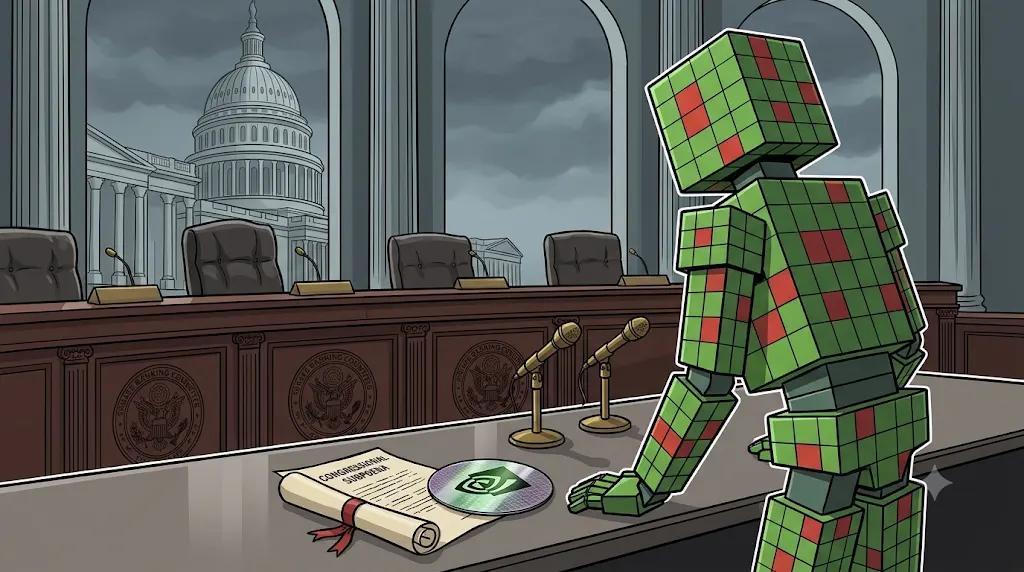
Congressional scrutiny of chip exports intensifies as Nvidia staff question Huang's resignation
TL;DR
- Senate Banking Committee Chairman Tim Scott requested testimony from former Nvidia CEO Jensen Huang and Commerce Secretary Howard Lutnick over national security concerns involving chip exports to China.
- Three House committees separately sought interviews with Huang and Nvidia's top lawyer, focusing on export controls and the company's ties to Megaspeed.
- Nvidia employees are pushing for Huang's reinstatement, with an internal discussion drawing more than 1,600 comments, according to Wired.
Trade smarter on Jupiter, Solana’s leading DEX built for fast execution and deep liquidity.
Swap tokens at competitive rates, route across multiple liquidity sources automatically, and access perpetuals, DCA, and advanced trading tools — all in one place!
Congressional lawmakers are seeking testimony from former Nvidia CEO Jensen Huang and Commerce Secretary Howard Lutnick over U.S. semiconductor exports to China, while some Nvidia employees are urging the company's board to reconsider Huang's resignation. The requests, announced Thursday, November 12, 2026, follow allegations involving Huang's personal relationships and a Singapore-based Nvidia customer under scrutiny over potential export-control violations.
Congress Presses Nvidia and Commerce Officials Over China Chip Exports
Senate Banking Committee Chairman Tim Scott (R-SC) asked Huang to testify voluntarily at a public hearing on December 3, citing public accounts that "raise significant national security concerns." Scott said his committee has authority over export controls, "including their application to NVIDIA's exports of advanced semiconductors." He warned that the committee "is prepared to use all tools at our disposal, including subpoenas" if Huang refuses to appear. Announcing the requests on X, Scott wrote:
"The American people deserve answers."
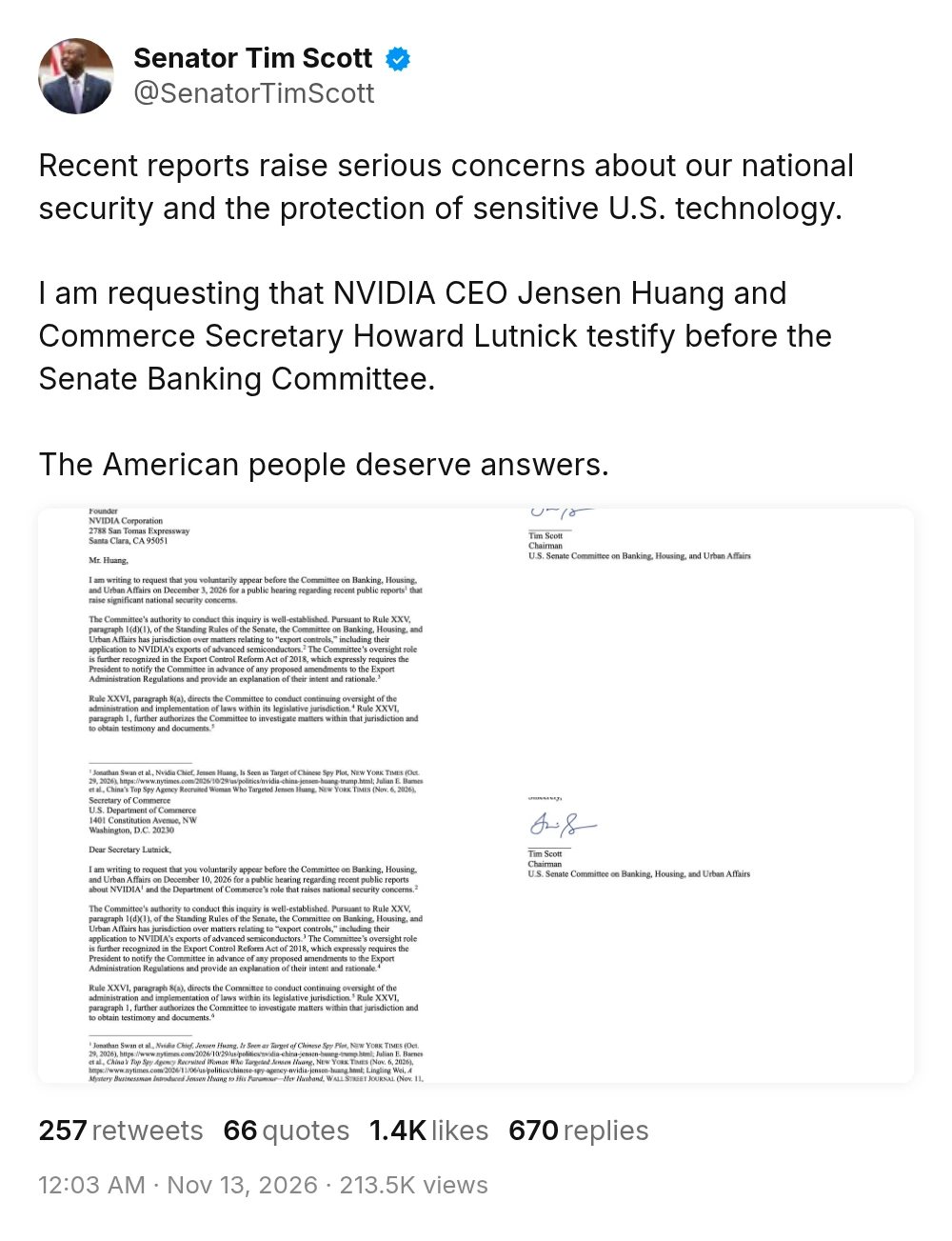
Scott also requested Lutnick's testimony on December 10, citing the Commerce Department's "central role in issuing and enforcing export control regulations." A spokesperson for Lutnick told NBC News that the commerce secretary had "proactively agreed to appear voluntarily." The White House separately said President Donald Trump "maintains complete confidence" in Lutnick.
House Foreign Affairs Committee Chairman Brian Mast (R-FL), House Select Committee on China Chairman John Moolenaar (R-MI) and House Intelligence Committee Chairman Rick Crawford (R-AR) also sent requests to Huang, Nvidia General Counsel Tim Teter and Jeffrey Kessler, the Commerce Department's under secretary for industry and security. The lawmakers requested a closed-door, transcribed interview with Huang on December 1 and a separate interview with Teter on December 2. Both were given until 8 p.m. Friday to agree or face subpoenas. Kessler was invited to a hearing on December 3.
"As reports continue to come to light regarding Jensen Huang, NVIDIA, and MegaSpeed, there are clear national security concerns that need to be addressed immediately," the House committee chairs said.
They also called for four chip security bills to be included in the annual defense authorization legislation. Their latest requests followed a November 4 letter seeking a briefing from Huang on November 18. Mast told reporters Thursday that Huang had agreed to brief lawmakers, according to NBC News.
Moolenaar separately told reporters that Huang had "been one of the strongest proponents for not having export controls," according to Roll Call. On Wednesday, Senate Banking Committee ranking member Elizabeth Warren (D-MA) and Sen. Chris Coons (D-DE) asked Lutnick, Secretary of State Marco Rubio and White House Chief of Staff Stephen Miller to preserve records concerning Nvidia semiconductor exports to China.
Megaspeed Investigation Raises National Security Questions
The congressional inquiries center partly on Megaspeed, a Singapore-based Nvidia customer suspected by U.S. officials of helping Chinese companies circumvent restrictions on advanced artificial intelligence chips. The New York Times reported in October that Megaspeed's sister company in Malaysia purchased at least $4.8 billion in AI equipment containing Nvidia semiconductors between June 2024 and February 2026, citing trade records.
Megaspeed told The New York Times it had hired outside counsel to conduct an internal investigation. Nvidia has maintained that it complies with U.S. export laws, according to NBC News. The scrutiny has also extended to Alice Huang, also known as Huang Le, a former Megaspeed executive whom U.S. officials reportedly suspected of working for Chinese intelligence.
The New York Times reported that U.S. officials had concluded Alice Huang was a Chinese intelligence asset, an allegation China has rejected. However, Attorney General Todd Blanche said Thursday that the Justice Department had not reached such a conclusion. Reuters reported that the FBI was investigating the allegations and had been unable to reach Alice Huang for comment.
Singapore's Ministry of Home Affairs said Alice Huang, who previously served as Megaspeed's CEO and chair, had been investigated over possible false declarations related to the company's server purchases, rather than espionage. Police found insufficient evidence that she had committed any offenses but concluded she had knowingly provided inaccurate information to minimize her role at Megaspeed. She received a stern warning, left Singapore in February and was barred from returning. Investigations involving Megaspeed and six other people remain ongoing.
Bloomberg reported that Alice Huang was living in Beijing with the knowledge of security officials, citing a person familiar with the matter. The New York Times previously reported that surveillance indicated she had developed a "close relationship" with Jensen Huang, while the Financial Times cited a U.S. memo describing the relationship as romantic.
Jensen Huang acknowledged in a Sunday email to Nvidia employees that he had been "unfaithful" to his wife. He subsequently resigned from the company on Thursday. Nvidia's board has stated that it has no reason to believe national security information or company secrets were compromised.
Separate allegations involving relationships with Nvidia employees have also emerged. The New York Times reported Wednesday that Huang had a relationship with Kimberly Powell, Nvidia's vice president of health care, who reported directly to him. Powell has not commented.
Reuters subsequently cited two people familiar with the matter in reporting another intimate relationship involving an unnamed Nvidia employee. Nvidia declined to comment to Reuters, while Huang and a board representative did not respond. According to Wired, Huang has made no further public comments on the allegations since his Sunday email.
Huang and Nvidia also face a proposed shareholder class action related to his alleged ties to Alice Huang.
Nvidia Employees Push Board to Reinstate Jensen Huang
Some Nvidia employees have called for Huang's return following his departure, according to internal communications reviewed by Wired. A longtime engineer submitted a post to the company's internal "suggestion box" before Huang resigned, urging directors to consider employees' views before deciding his future. The discussion subsequently attracted more than 1,600 comments, including requests to reinstate the former CEO.
"If you believe in the mission, bring back THE boss," an anonymous employee wrote.
The original post also asked the board to share the findings of its investigation with employees and formally seek staff opinions about whether Huang should remain CEO. Another employee circulated a companywide email demanding greater transparency surrounding his departure, declaring:
"I stand by Jensen."
Approximately two dozen Nvidia employees publicly expressed support for Huang on LinkedIn shortly after his resignation. Wired said it could not find employee posts supporting his departure. The engineer who submitted the internal suggestion declined to comment, while Nvidia and board chair Harvey Jones did not immediately respond to the publication's requests.
Huang's resignation ended his 33-year tenure at the company he co-founded. He stepped down as president, CEO and a board member, with Chief Financial Officer Colette Kress appointed interim CEO. Jones, a former CEO of Synopsys, became Nvidia's first board chair. Nvidia did not give a reason for Huang's resignation.
The internal calls for Huang's reinstatement follow public criticism of Nvidia's leadership decision from technology and cryptocurrency industry figures. Binance co-founder Changpeng "CZ" Zhao said allowing Huang to resign was a mistake, while Elon Musk said hiring the former Nvidia executive would be "an honor."
Nvidia Shares Fluctuate as China Warns Against Tighter Export Controls
China's foreign ministry warned Friday that additional U.S. semiconductor export restrictions could threaten the stability of global supply chains, according to Al Jazeera.
Nvidia shares closed Thursday down 4.3% at $166.19 before climbing 2.7% to $170.63 in early Friday premarket trading, according to Yahoo! Finance. The company has lost almost $500 billion in market value since the November 6 closing session.
Nvidia is scheduled to report quarterly earnings Tuesday, its first earnings announcement under interim CEO Colette Kress.
This article has been refined and enhanced by ChatGPT.


