




 USD
USD
Traders Sue Polymarket Over Strategy Bitcoin Sale Bet


Lawsuit Challenges “No” Resolution After Strategy Disclosed Bitcoin Sale
TL;DR
- Two traders sued Polymarket after a Strategy Bitcoin sale market resolved “No” despite a later company filing disclosing a sale.
- The lawsuit alleges Polymarket changed the market’s rules after the outcome was known.
- The dispute centers on whether the market required the sale itself or public confirmation before the deadline.
Trade smarter on Jupiter, Solana’s leading DEX built for fast execution and deep liquidity.
Swap tokens at competitive rates, route across multiple liquidity sources automatically, and access perpetuals, DCA, and advanced trading tools — all in one place!
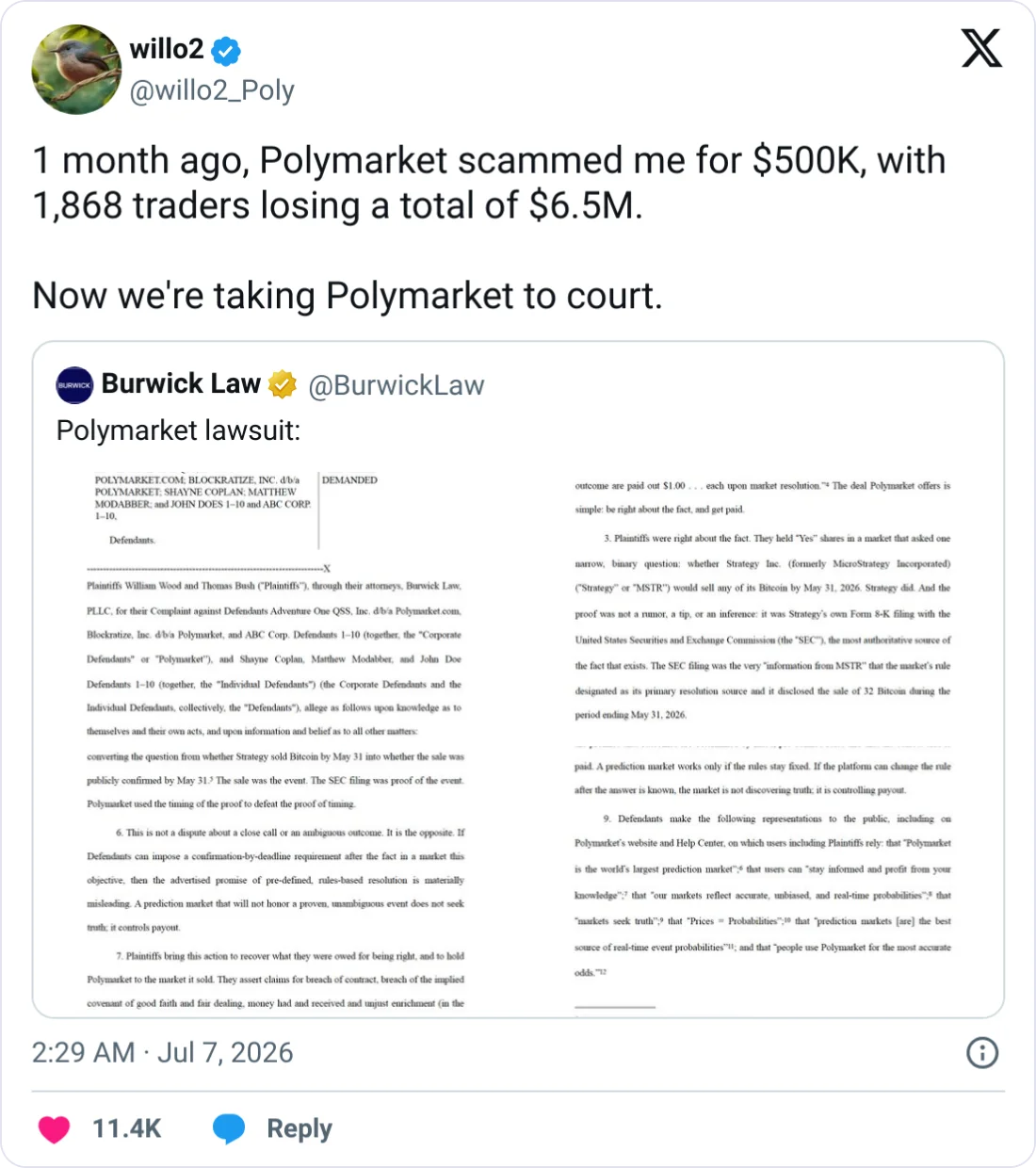
William Wood and Thomas Bush sued Polymarket in New York after the platform refused to redeem their “Yes” shares in a prediction market tied to whether Strategy would sell any Bitcoin by May 31, 2026, even though Strategy later disclosed that it sold Bitcoin during that period.
The lawsuit was filed in the Supreme Court of the State of New York on July 3. Wood and Bush allege that Polymarket’s final “No” resolution ignored Strategy’s own disclosure and converted what they say should have been a winning position into a loss.
The disputed market asked whether Strategy, formerly MicroStrategy, would sell any of its Bitcoin by a set deadline. Strategy filed a Form 8-K on June 1 disclosing that it sold 32 BTC between May 26 and May 31. The sale was described as Strategy’s first Bitcoin sale since December 2022.
Wood and Bush argue that Strategy’s filing was “unambiguous proof” under the market’s own rules because company disclosures were named as the primary resolution source. Their complaint says the market was framed around whether Strategy sold Bitcoin before the deadline, not whether public confirmation appeared before the deadline.
Polymarket resolved the market as “No.” Polymarket said no information from Strategy, on-chain data, or credible reporting had confirmed a sale inside the market’s timeframe. Polymarket also added that “confirmation achieved outside of the market’s timeframe does not qualify.”
Traders Say Polymarket Changed The Resolution Standard
Wood and Bush allege that Polymarket’s clarification changed the market after the outcome was already known. Their claim is that the platform shifted the question from an event-based market about whether Strategy sold Bitcoin into a disclosure-timing market about whether Strategy publicly confirmed the sale before the cutoff.
The complaint says a market that will not honor a proven event “does not seek truth; it controls payout.” The plaintiffs also challenge Polymarket’s marketing, arguing that its claim that markets “seek truth” becomes misleading if the platform can change resolution standards after the outcome is known.
The lawsuit names Polymarket CEO Shayne Coplan and chief marketing officer Matthew Modabber. A summary of the case also names Adventure One QSS Inc. and Blockratize Inc. alongside Coplan and Modabber. The plaintiffs allege breach of contract, breach of the implied covenant of good faith and fair dealing, unjust enrichment in the alternative, deceptive acts and practices, and false advertising.
Wood and Bush are seeking the $1-per-share value of their “Yes” shares, plus damages and legal fees. A separate summary of the plaintiffs’ demands says they are also seeking attorneys’ fees and injunctive relief.
A July 6, 2026 post from willo2 said: “1 month ago, Polymarket scammed me for $500K, with 1,868 traders losing a total of $6.5M. Now we’re taking Polymarket to court.” The post framed the dispute as a wider trader-loss event, not only a private payout fight.
We’ve launched the all-new COIN360 Perp DEX, built for traders who move fast!
Trade 130+ assets with up to 100× leverage, enjoy instant order placement and low-slippage swaps, and earn USDC passive yield while climbing the leaderboard. Your trades deserve more than speed — they deserve mastery.
Market Data Shows A Sharp Swing After Strategy’s Filing
Galaxy Research called the episode the highest-stakes test of Polymarket’s resolution stack since the previous year’s market over whether Ukraine’s president wore a suit. Galaxy Research said the original market text was event-based because it resolved “Yes” if Strategy sold “any of its Bitcoin” by the deadline, with no explicit requirement that the sale be announced inside that window.
After Strategy’s filing was released, “Yes” odds reportedly jumped from around 10% to 80%. One trader reportedly bought about 700,000 “Yes” shares near 76 cents each, treating the filing as an arbitrage opportunity after it appeared to confirm that Strategy had sold Bitcoin.
Polymarket’s clarification reversed the trade’s apparent direction. “Yes” shares fell below one cent after the clarification post. After two disputes and a final review period, the market resolved “No” for a third time.
The disputed market settled through the UMA Optimistic Oracle, which Polymarket uses to settle disputes. The plaintiffs allege that even though UMA handled settlement, Polymarket controlled the rule-writing process by drafting market terms and issuing clarifications.
Another account of the resolution says the contract resolved “No” after a vote by UMA token holders. The case therefore places Polymarket’s market wording and UMA’s dispute process at the center of the payout fight.
Bloomberg and The Wall Street Journal found that a small cluster of large wallets swings many outcomes. They also found that many UMA voters hold stakes in the markets they help judge. Those findings raise conflict-of-interest concerns around market resolution when voters may have financial exposure to outcomes.
Growth And Scrutiny Surround Polymarket
Burwick Law, which brought the case, said it is weighing similar claims from other traders. Polymarket has not publicly responded to the complaint, according to the available material.
Polymarket’s U.S. arm is described as a CFTC-registered exchange. The platform has drawn close to $2 billion from NYSE parent ICE, was last valued at $9 billion, and in April was reportedly seeking to raise $400 million at a $15 billion valuation.
Polymarket is also reportedly under federal investigation. The Commodity Futures Trading Commission is examining several parts of the business, including allegations that Polymarket paid content creators to post videos showing simulated trades and fabricated winnings. Polymarket has not publicly addressed those reported allegations, according to the available material.
The lawsuit is part of a broader pattern of prediction-market payout disputes landing in New York courts. Kalshi faced a lawsuit in March 2026 over its “Ali Khamenei out as Supreme Leader?” market, where the plaintiff alleged that the exchange used a “death carveout” to avoid paying users.
Strategy’s later activity adds context but is not the central dispute. The company later outlined a plan to sell up to $1.25 billion more in Bitcoin to fund dividends and reportedly offloaded around $216 million in Bitcoin this week under its “BTC monetization program.”
The central unresolved question is whether Polymarket was allowed to require public confirmation before the deadline when the plaintiffs say the original market asked whether Strategy sold Bitcoin before that deadline. The lawsuit turns on that distinction: the sale date supports the “Yes” side, while the disclosure date supports Polymarket’s “No” resolution.
FAQ
Who sued Polymarket?
William Wood and Thomas Bush sued Polymarket in New York.
What did Strategy disclose?
Strategy disclosed that it sold Bitcoin during the market’s stated window.
Why did Polymarket resolve “No”?
Polymarket said qualifying confirmation did not appear inside the market’s timeframe.
This article has been refined and enhanced by ChatGPT.


