




 USD
USD
Pump.fun Burns PUMP Tokens After Buyback Debate


Locked buyback plan replaces full revenue repurchase model
TL;DR
- Pump.fun burned previously bought-back PUMP tokens and introduced a locked buyback-and-burn plan.
- The move removed a large share of circulating supply but triggered backlash from traders expecting possible rewards.
- Alon Cohen defended the new revenue split as a way to preserve funds for growth.
We’ve launched the all-new COIN360 Perp DEX, built for traders who move fast!
Trade 130+ assets with up to 100× leverage, enjoy instant order placement and low-slippage swaps, and earn USDC passive yield while climbing the leaderboard. Your trades deserve more than speed — they deserve mastery.
Pump.fun burned all previously bought-back PUMP tokens on April 28, 2026, removing about 36% of circulating supply and introducing a one-year program that will direct 50% of future core product revenue to buybacks and permanent burns.
The burn destroyed tokens Pump.fun valued at around $370 million and came after months of concern over transparency, the certainty of buybacks, and how repurchased tokens would ultimately be used. PUMP rose more than 6% over 24 hours after the announcement and traded near $0.0019, while broader large-cap crypto assets were under pressure.
The tokens were burned through treasury-controlled transactions using the Squads Program. The burn instructions permanently removed the tokens from circulation instead of transferring them to another wallet or reserving them for later distribution. The action is irreversible, meaning Pump.fun and any other organization cannot recover the destroyed tokens or return them to circulation.
Pump.fun framed the move as a direct response to unresolved doubts around the prior buyback model. “Over the past ~9 months, despite being one of the biggest revenue-generating platforms in crypto and allocating 100% of revenue to buybacks, we believe there was a lack of trust in the longevity of the business, the certainty of buybacks, and what the bought-back tokens would be used for,” Pump.fun said.
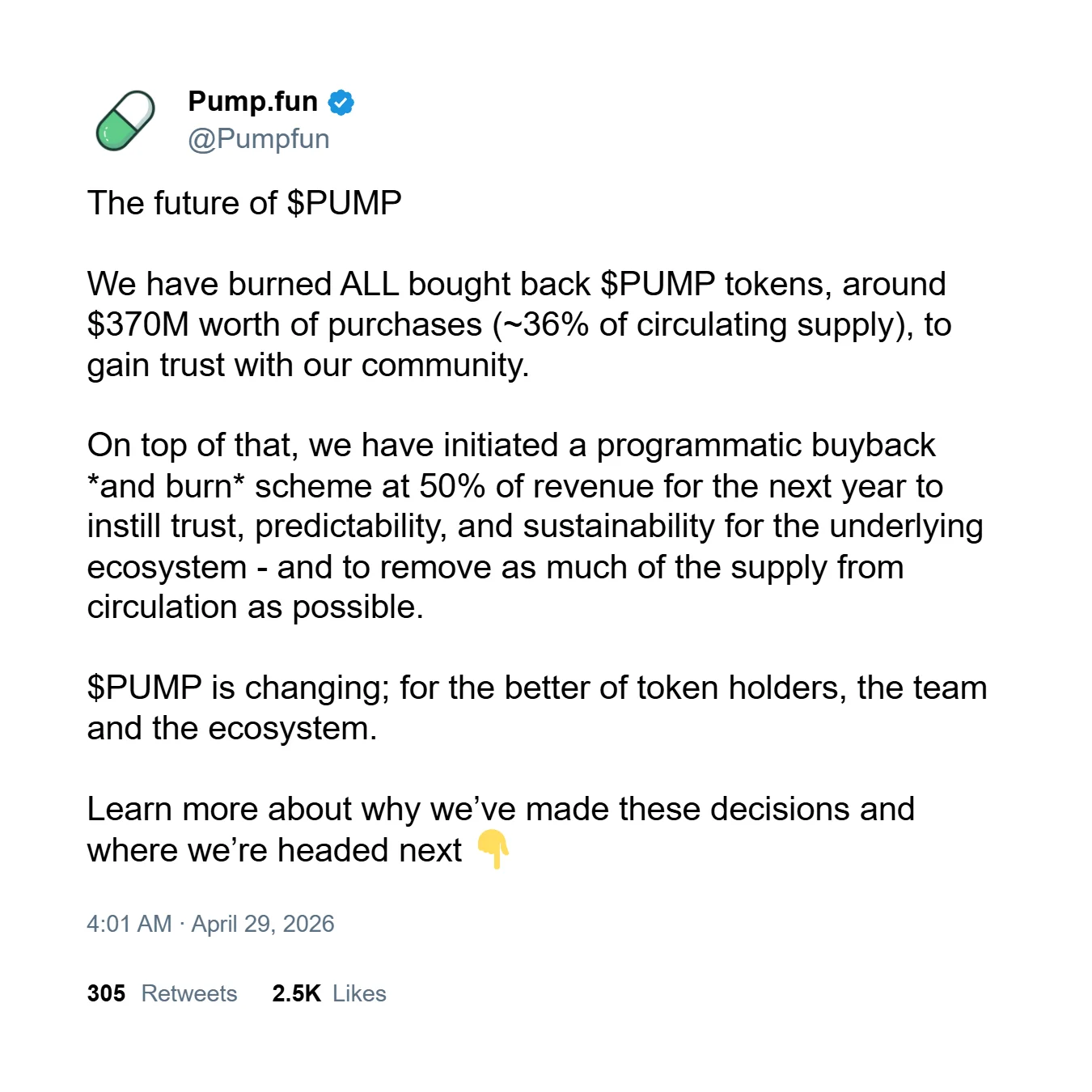
Pump.fun added, “Today, uncertainty is being addressed head-on by taking a community-first approach,” positioning the burn as a way to settle questions around accumulated repurchased tokens. The new program will draw revenue from the bonding curve system, PumpSwap, and Terminal, with funds routed through intermediary wallets before being consolidated into one or two wallets that purchase and burn PUMP.
Backlash centered on airdrop expectations and lost community value
The backlash centered on traders who believed accumulated buyback tokens could become a reserve for future ecosystem incentives, including airdrops and community rewards. Those expectations collided with Pump.fun’s decision to permanently destroy the tokens, turning what some users saw as potential redistributable value into a final supply-reduction event.
Critics argued that the burn eliminated deferred community value without delivering an immediate direct benefit to users. The debate intensified because traders had interpreted the growing buyback balance as a possible future incentive reserve, while Pump.fun treated the same tokens as supply that needed to be removed to restore confidence and clarify tokenomics.
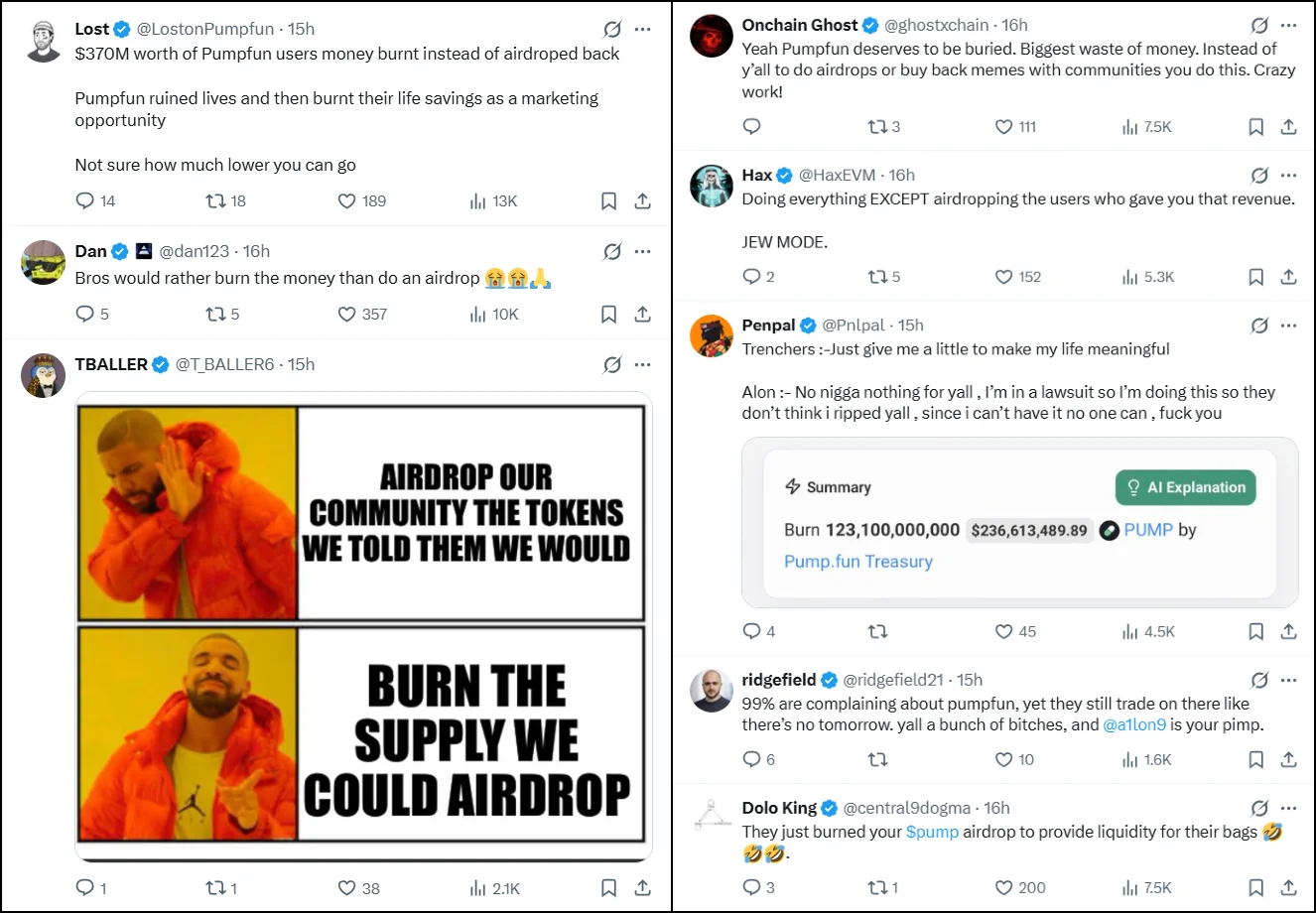
The reaction exposed a split between short-term participants focused on rewards, airdrop upside, and engagement incentives, and longer-term holders who favored scarcity, predictability, and reduced ambiguity around PUMP’s supply. Supporters viewed the burn as disciplined supply control, while critics said it weakened community-aligned incentives that helped drive participation and speculation around the platform.
The dispute also became a communication problem. Pump.fun called the burn a trust-building step, but angry traders treated it as evidence that unclear expectations around buybacks, airdrops, and token use had been allowed to build for too long.
Alon Cohen, Pump.fun’s co-founder, defended the revised revenue split by saying a sizable treasury gives the platform flexibility to make major moves over the next five to ten years. Cohen argued that money not burned can still support the same long-term goal if invested wisely into product development and growth.
Pump.fun said, “If we forgo retaining a portion of revenues for operations and growth, we run the risk of our treasury being throttled by burn rather than being used for high-impact strategic investments, such as impactful acquisitions & new product ventures.”
The new structure replaces the previous model with a split designed to balance supply reduction against operational sustainability. The remaining 50% of future revenue will be retained for business expansion, including product development, hiring, marketing, infrastructure, ecosystem growth, strategic opportunities, and potential acquisitions.
Pump.fun’s reset followed strong financial growth. The platform became the first Solana platform to exceed $1 billion in cumulative revenue since launching in January 2024.
FAQ
What did Pump.fun burn?
Previously bought-back PUMP tokens held after repurchase activity.
Why did traders criticize the burn?
They expected possible airdrops, community rewards, or other ecosystem incentives.
What replaces the old buyback model?
A locked programmatic buyback-and-burn model funded by core product revenue.
Can the burned PUMP return to circulation?
No. The burn was described as irreversible.
This article has been refined and enhanced by ChatGPT.


