




 USD
USD
Robinhood Chain Outage Collides With AMC Stock Token Fight

Fast-growing network faces reliability test as AMC challenges its tokenized-equity structure
TL;DR
- Robinhood Chain halted block production for at least 6 minutes on September 4, 2026, while the cause remained publicly undisclosed at publication.
- AMC Entertainment CEO Adam Aron demanded Robinhood stop trading a token linked to AMC shares, arguing investors could mistake it for actual equity.
- Robinhood refused, as its Stock Token business continued expanding alongside surging network fees, liquidity and tokenized-stock trading.
Trade smarter on Jupiter, Solana’s leading DEX built for fast execution and deep liquidity.
Swap tokens at competitive rates, route across multiple liquidity sources automatically, and access perpetuals, DCA, and advanced trading tools — all in one place!
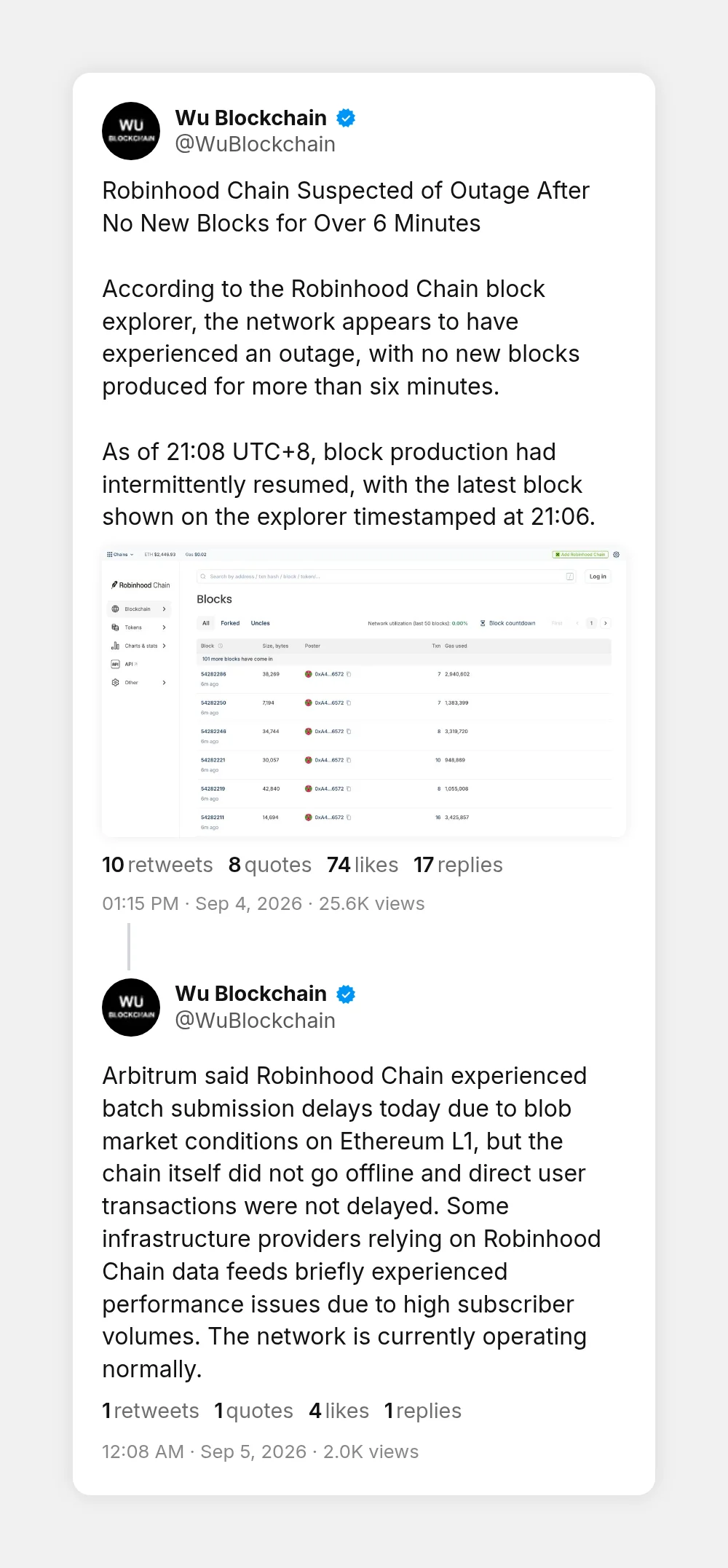
Robinhood Chain temporarily stopped producing blocks on September 4, 2026, just as AMC Entertainment escalated a separate challenge to Robinhood's fast-growing Stock Token business, putting both the reliability of the young Ethereum layer-2 network and the legal structure of its tokenized equities under scrutiny. The network interruption lasted more than six minutes before transactions began recovering.
The disruption came roughly two months after Robinhood Chain's public mainnet launch, a period in which the network had already become a major source of layer-2 revenue and accumulated substantial decentralized-finance and tokenized-asset activity.
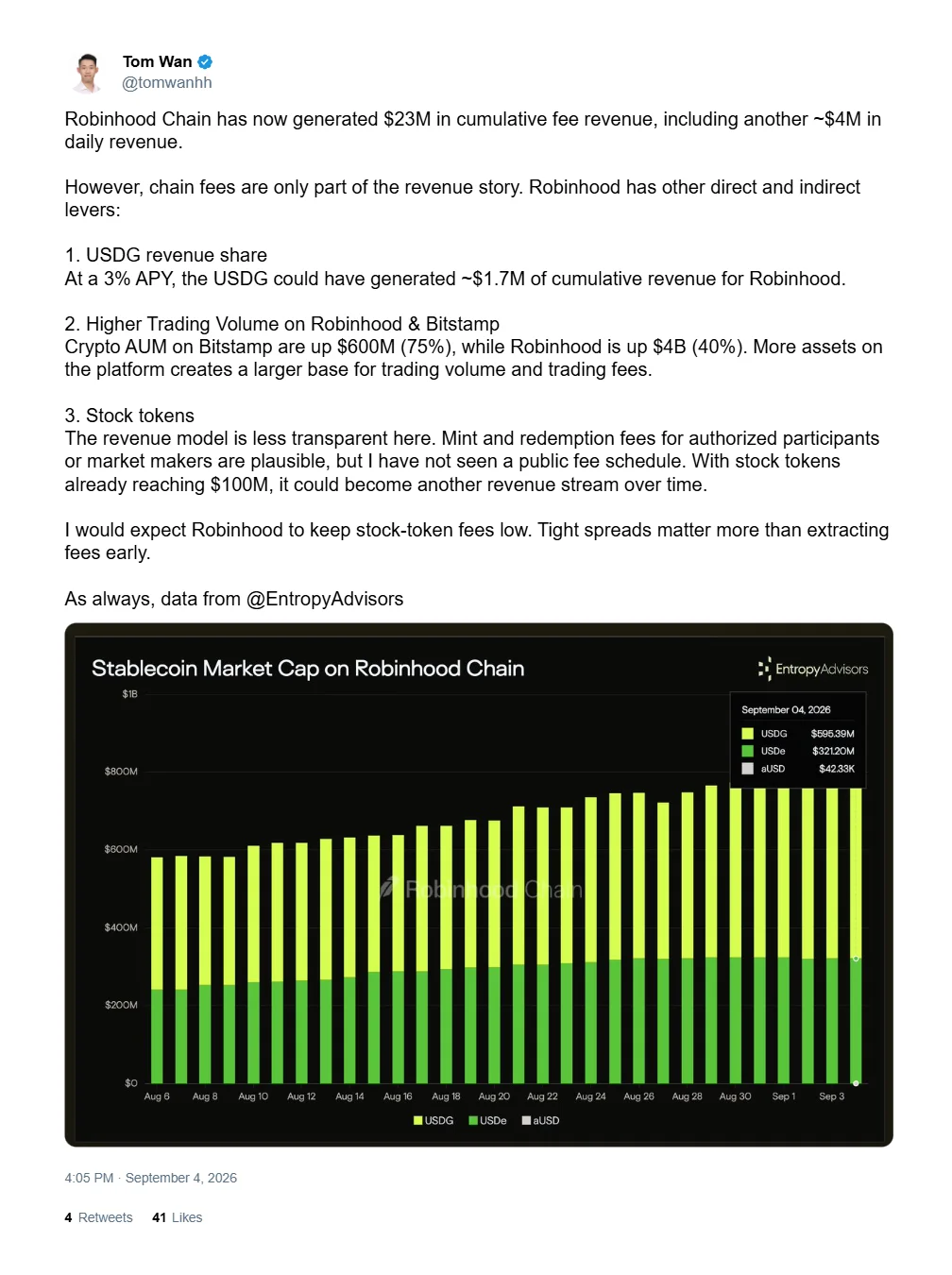
Entropy Advisors' Tom Wan said Robinhood Chain had generated about $23 million in cumulative fees, including roughly $4 million during a recent 24-hour period. Token Terminal separately estimated that the network accounted for 78.5% of layer-2 blockchain revenue over the previous 30 days.
Token Terminal data also showed Robinhood Chain's daily revenue reaching $4.6 million. Maintaining that pace would translate to roughly $1.7 billion on an annualized basis, although the figure extrapolates a short period of elevated activity rather than representing a formal revenue forecast.
DeFi activity expanded alongside fee generation. Total value locked on Robinhood Chain climbed as decentralized-exchange activity accelerated with more assets and trades moving onto the network. Wan also estimated that Robinhood could generate additional economics from USDG, while rising crypto assets held across Robinhood and Bitstamp could support trading revenue.
Stock Tokens offer another potential revenue stream, although Robinhood has not published a detailed fee schedule covering possible minting and redemption charges for authorized participants or market makers.
AMC Challenges What Robinhood Stock Token Holders Actually Own
AMC Entertainment CEO Adam Aron challenged Robinhood after discovering a token linked to AMC shares on the platform's Ethereum layer-2 network. AMC had no role in issuing or approving the product, while the token used the company's share price as its reference.
Aron wrote: “They are not registered under U.S. securities laws !!!!!! I find this practice to be contemptible, outrageous, disgusting, detestable, inexcusable, vile. How can it possibly be legal? We have no connection to this at all, and do not condone it in any way.”
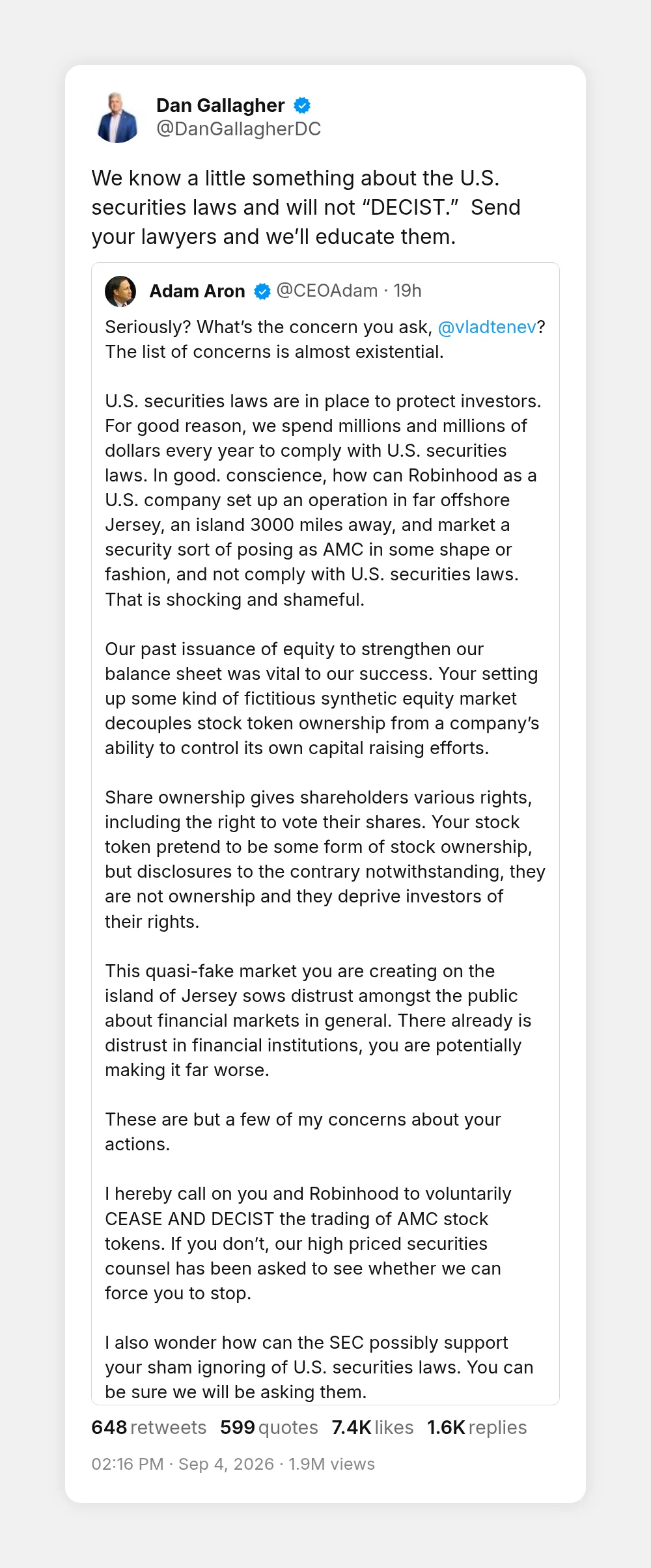
Aron said AMC would ask outside securities counsel to examine the product and called on “Robinhood to voluntarily CEASE AND DECIST the trading of AMC stock tokens. If you don’t, our high priced securities counsel has been asked to see whether we can force you to stop.”
His objection centered in part on whether investors could mistake the product for actual AMC equity. Buyers of Robinhood's Stock Tokens do not own the shares being referenced. The products instead give holders economic exposure to the performance of the underlying security through a separate instrument.
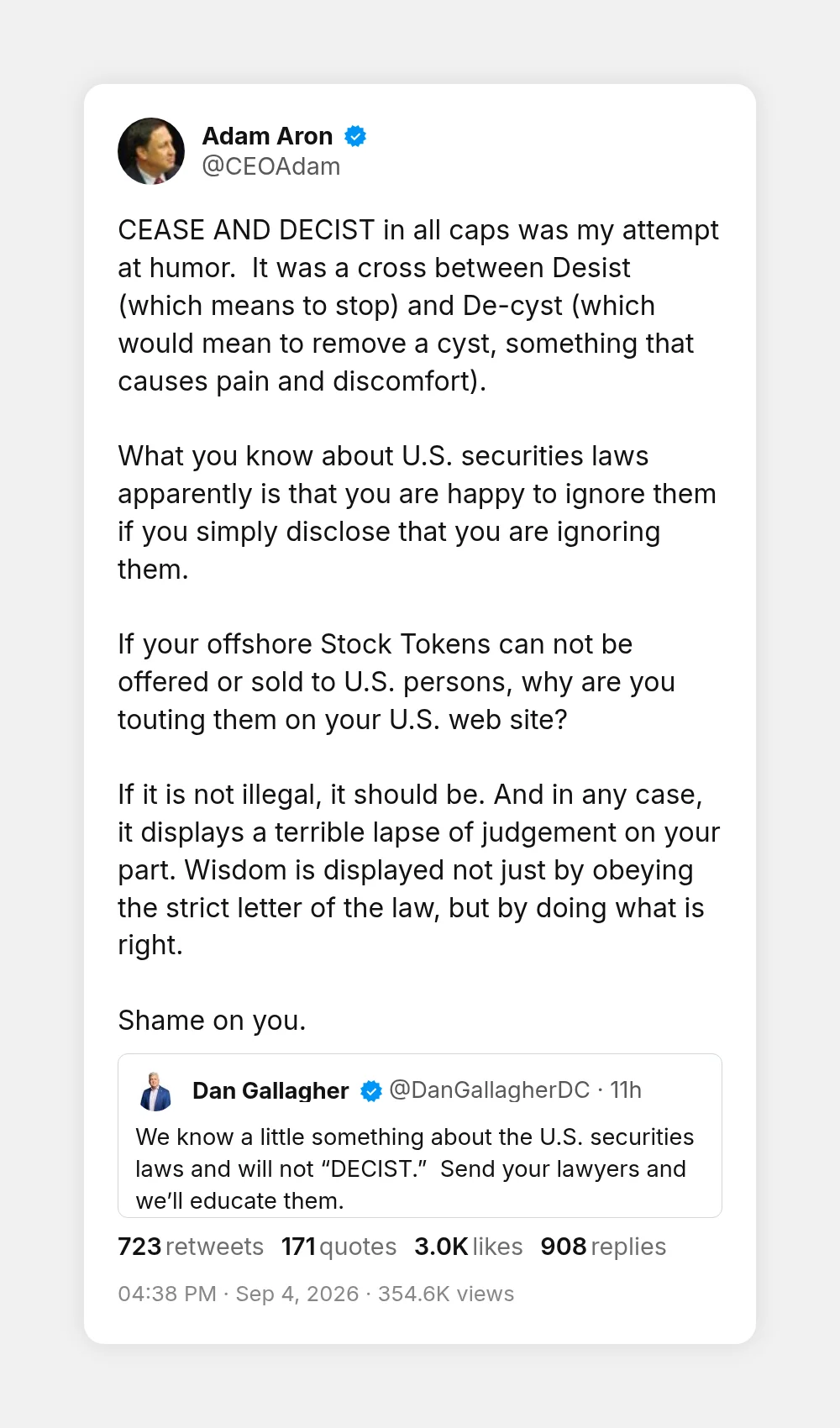
Robinhood Chief Legal Officer Dan Gallagher, a former SEC commissioner, publicly rejected AMC's demand the same day. Gallagher wrote: “We know a little something about the U.S. securities laws and will not ‘DECIST.’ Send your lawyers and we’ll educate them.”
Aron later said his spelling of “CEASE AND DECIST” was intentional humor, combining “desist,” meaning to stop, with “de-cyst,” meaning to remove a cyst causing pain and discomfort. He continued challenging Robinhood's legal position.
Robinhood describes Stock Tokens as the flagship real-world asset on Robinhood Chain. The ERC-20 instruments provide economic exposure to U.S. stocks and exchange-traded funds and can be transferred or used within onchain applications.
The instruments are debt securities issued by Robinhood Assets Limited. Holders receive exposure to the performance of the referenced security but gain no legal or beneficial ownership of the underlying shares, no voting rights and no claim against the company whose stock is being tracked. Generally, holders also have no right to exchange the token for the underlying equity.
The tokens are not registered under U.S. securities laws and cannot be offered or sold to U.S. persons. Robinhood's structure allows an instrument linked to AMC's share price to be issued without AMC participating, with the legal relationship instead running between the token holder and Robinhood's Jersey entity.
Fintech lawyer Ariel Givner highlighted the distinction between the token and the underlying security. AMINA Bank Chief Product Officer Myles Harrison put the issue this way: “The token isn’t the asset. It’s a representation of a claim.” He added that ownership rights “live in the record of ownership, not in the token itself.”
The dispute sits within a wider $37 billion tokenized-assets market. Investor Ross Gerber took a more critical view of synthetic securities, characterizing them as a “Ponzi scheme” and warning that such products could create risks for Robinhood.
OpenAI had previously objected after Robinhood introduced tokens referencing the privately held company. OpenAI said those instruments were not OpenAI equity, that it had not partnered with Robinhood and that it did not endorse the offering.
Tokenized-Stock Adoption Keeps Expanding
Corporate resistance has not stopped Robinhood's Stock Token business from accumulating users. Token Terminal data showed Robinhood becoming the largest Stock Token issuer by holder count in roughly two months.
Trading expanded with the holder base. PancakeSwap and Uniswap accounted for the overwhelming majority of decentralized-exchange activity in tokenized stocks, while Robinhood Chain accumulated substantial Stock Token and stablecoin balances.
The scale of that activity puts additional focus on network reliability after the block-production interruption. Robinhood is using the chain for financial products designed to trade and move onchain while simultaneously defending a Stock Token model that some referenced companies have openly rejected.
The AMC dispute also turns on an important product distinction: Robinhood is not giving Stock Token holders ownership of AMC shares. The tokens are separate debt securities tied to the economic performance of the referenced stock, leaving the legal relationship with Robinhood's issuing entity rather than AMC.
This article has been refined and enhanced by ChatGPT.


