




 USD
USD
SATA Raises BTC Capital as STRC Selloff Hits Digital Credit


Strive Says Leverage Liquidations Drove Preferred-Equity Volatility
TL;DR
- Strive’s SATA raised enough capital for an estimated 603 BTC purchase during its first week of daily dividends.
- Matt Cole said the selloff in SATA and Strategy’s STRC was caused by leverage liquidation, not weaker credit quality.
- SATA and STRC both rebounded from intraday lows, but the price action exposed stress in Bitcoin treasury preferred-equity products.
Trade smarter on Jupiter, Solana’s leading DEX built for fast execution and deep liquidity.
Swap tokens at competitive rates, route across multiple liquidity sources automatically, and access perpetuals, DCA, and advanced trading tools — all in one place!
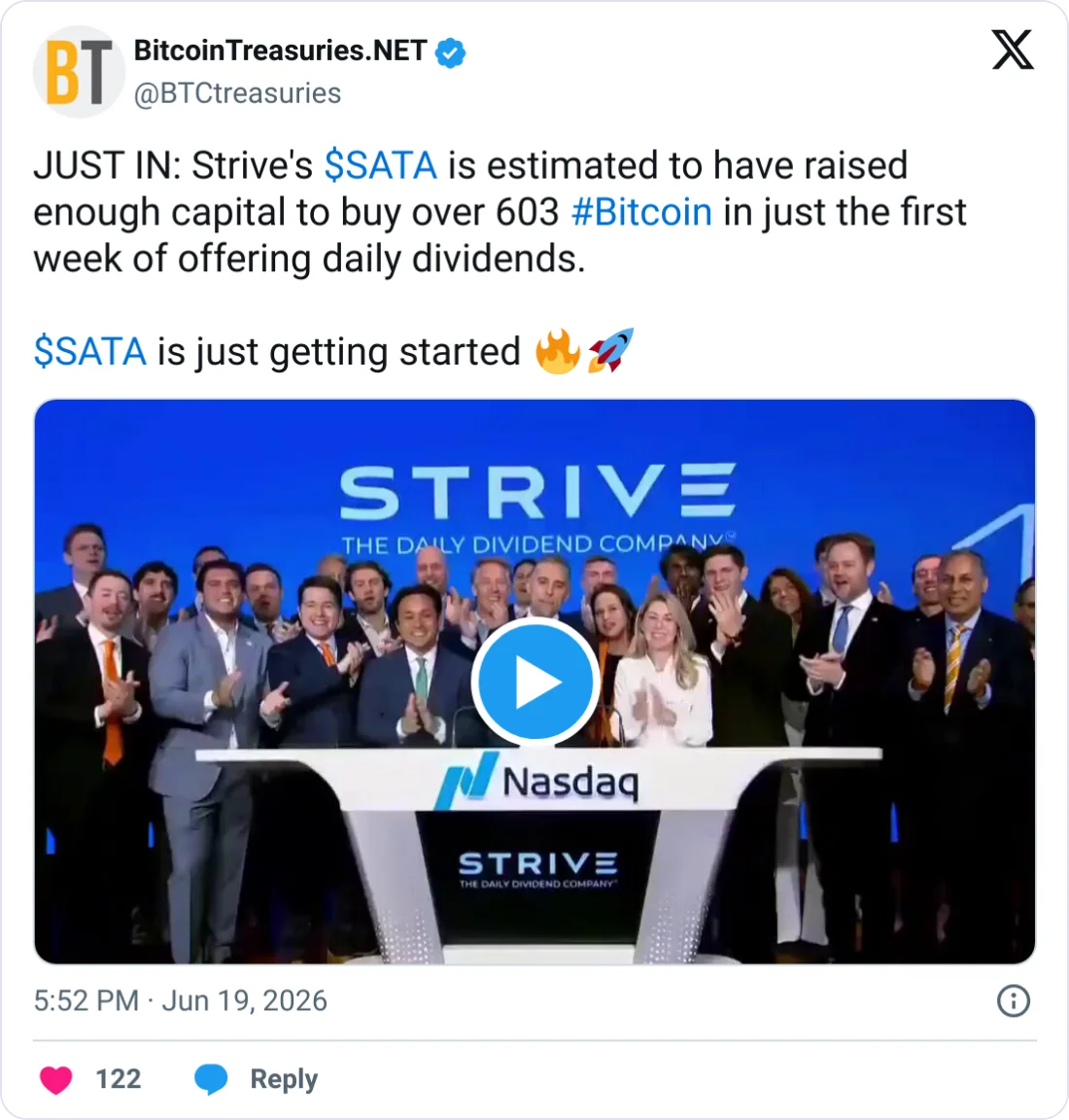
Strive’s SATA raised enough capital for an estimated 603 BTC purchase during its first week of daily dividend payments, even as SATA and Strategy’s STRC sold off sharply in what Strive CEO Matt Cole described as a leverage liquidation event rather than a deterioration in credit quality.
SATA, Strive’s high-yield perpetual preferred stock, is designed to trade near a $100 par value while giving Strive another capital-raising channel for its Bitcoin treasury strategy. The shift to daily dividends was presented as a way to reduce dividend-related price swings and create steadier demand from income-focused investors.
BitcoinTreasuries.net ATM Tracker data showed that SATA raised enough capital through at-the-market activity to support estimated Bitcoin purchases across the first three trading days of the week. The activity was concentrated from June 15 through June 17, before SATA failed to reach its par value during regular trading on June 18. U.S. markets were closed on June 19 for the Juneteenth federal holiday.
Strive currently holds about 19,105 BTC, making SATA’s estimated purchase capacity equal to roughly 3.2% of the company’s Bitcoin holdings. For comparison, Strategy would need to raise enough capital to buy about 26,728 BTC to match the same treasury increase relative to its reported 846,842 BTC holdings.
Strive Frames the Selloff as Forced Deleveraging
SATA’s capital-raising momentum coincided with a sharp selloff across digital credit products. Strategy’s STRC fell to a record intraday low of $82.53, while SATA dropped from around par into the low $90s before both instruments recovered.
Cole called the session “the most difficult day in the history of digital credit.” He said the move was “a leverage liquidation event, not a deterioration in underlying credit quality,” directly rejecting the idea that the selloff reflected weakening issuer fundamentals.
Cole expanded on that explanation by describing the way investors may have used borrowed money to amplify exposure to high-yield, low-volatility instruments. “Many eventually decide that owning it is not enough. They borrow against it. They lever it,” Cole wrote. “That works until it doesn’t.”
Cole also wrote on X on June 18, 2026: “Today was the most difficult day in the history of Digital Credit. $STRC traded as low as $82.50 before recovering sharply. $SATA traded from par down to the low 90s before also rebounding. It was a difficult day for many investors.”
Strive said its dividend reserves remain intact and that the company is not under stress. Cole also said both STRC and SATA attracted buying interest near intraday lows, helping the instruments recover from the sharpest part of the selloff.
We’ve launched the all-new COIN360 Perp DEX, built for traders who move fast!
Trade 130+ assets with up to 100× leverage, enjoy instant order placement and low-slippage swaps, and earn USDC passive yield while climbing the leaderboard. Your trades deserve more than speed — they deserve mastery.
Trading Volumes Pointed to a Heavy Market Flush
Trading activity was elevated during the selloff, supporting Strive’s view that forced deleveraging had hit the market. One set of figures showed STRC recording $10.6 million in volume versus an average of $3.6 million, while SATA recorded $1.57 million versus an average of about $386,698.
Strive Chief Risk Officer Jeff Walton cited a separate set of trading-volume figures, saying SATA and STRC saw their second- and fourth-largest trading days. Walton’s figures put SATA volume at $153 million and STRC volume at $941 million. The volume figures differ sharply and should not be treated as a single dataset.
Walton argued that the large trading volumes made a leverage unwind more likely, especially when compared with the smaller daily trading volumes of larger preferred equity instruments such as JPMorgan’s JPM.PD and BlackRock’s PFF. “Leverage appears to have been flushed, fundamentals intact, and the instruments absorbed the flow and found bids throughout the day,” Walton wrote.
When asked on X for more detail on where SATA leverage had been concentrated, Walton said Strive was “aware of a couple anecdotal sources” and was working on a “deeper postmortem analysis” it planned to share. That leaves the exact concentration of leverage unresolved.
Dividend Questions Remain Central to the Structure
The broader concern around preferred-equity products is how dividend obligations are funded when market conditions weaken. Analysts said STRC can normally trade below par after its dividend date, but the current weakness appears tied to uncertainty over how Strategy intends to pay dividends, causing “continued weakness.”
Strategy sold 32 BTC for $2.5 million last month after Michael Saylor telegraphed the move. Strategy then acquired 1,587 BTC the following week. The sequence showed that Strategy could sell small amounts of Bitcoin for preferred obligations while continuing its larger Bitcoin accumulation strategy.
Michael Saylor did not directly address STRC’s price action, but wrote that “volatility is never easy” and that “Bitcoin keeps working.” Bitcoin advocate Samson Mow said STRC was designed to reduce Bitcoin volatility exposure while offering investors a structured income product.
Mow said STRC can trade below $100 because it moves according to market forces, while below-par pricing may create opportunities for long-term capital. He argued that there was nothing structurally wrong with STRC, SATA or similar products unless investors believe Bitcoin will not appreciate over the long term, and he emphasized that STRC is not a stablecoin.
Preferred products such as SATA and STRC are designed to help Strive and Strategy raise capital for Bitcoin accumulation without relying only on common-stock issuance or direct debt. When the instruments trade near or above par, the issuing company can sell more shares through ATM programs and use the proceeds to buy Bitcoin or support treasury operations.
When the instruments trade below par, that capital-raising engine becomes harder to use because issuing below the intended anchor can become more expensive or damaging for investor confidence. The June 18 session showed that products marketed to income-focused investors can still trade materially below par when leverage and liquidity pressure collide.
FAQ
What is SATA?
SATA is Strive’s high-yield perpetual preferred stock tied to its Bitcoin treasury strategy.
What caused the selloff, according to Matt Cole?
Cole said it was leverage liquidation, not deterioration in underlying credit quality.
Did Strive say it was under stress?
No. Cole said Strive’s dividend reserves remain intact.
What remains unresolved?
Walton said Strive was still working on a deeper postmortem analysis.
This article has been refined and enhanced by ChatGPT.


