




 USD
USD
Solana Launches On-Chain Governance Framework

Validators and stakers gain formal protocol voting roles
TL;DR
- Solana introduced Solana Governance Proposals to move major protocol decisions into an on-chain voting process.
- Validators can initiate governance proposals only after meeting a high delegated-stake threshold.
- Delegators can override validator votes, a design the Solana Foundation describes as “staker sovereignty.”
Trade smarter on Jupiter, Solana’s leading DEX built for fast execution and deep liquidity.
Swap tokens at competitive rates, route across multiple liquidity sources automatically, and access perpetuals, DCA, and advanced trading tools — all in one place!
Solana launched Solana Governance Proposals on July 2, 2026, creating an on-chain governance framework that lets validators and stakers formally participate in major protocol decisions while separating broad community approval from technical implementation work.
The Solana Foundation introduced the system as a way to move protocol decision-making from mostly off-chain coordination into stake-weighted voting recorded on-chain. The framework gives validators and people who delegate stake to them a formal process for voting on major questions affecting Solana’s long-term direction, economics and technical roadmap.
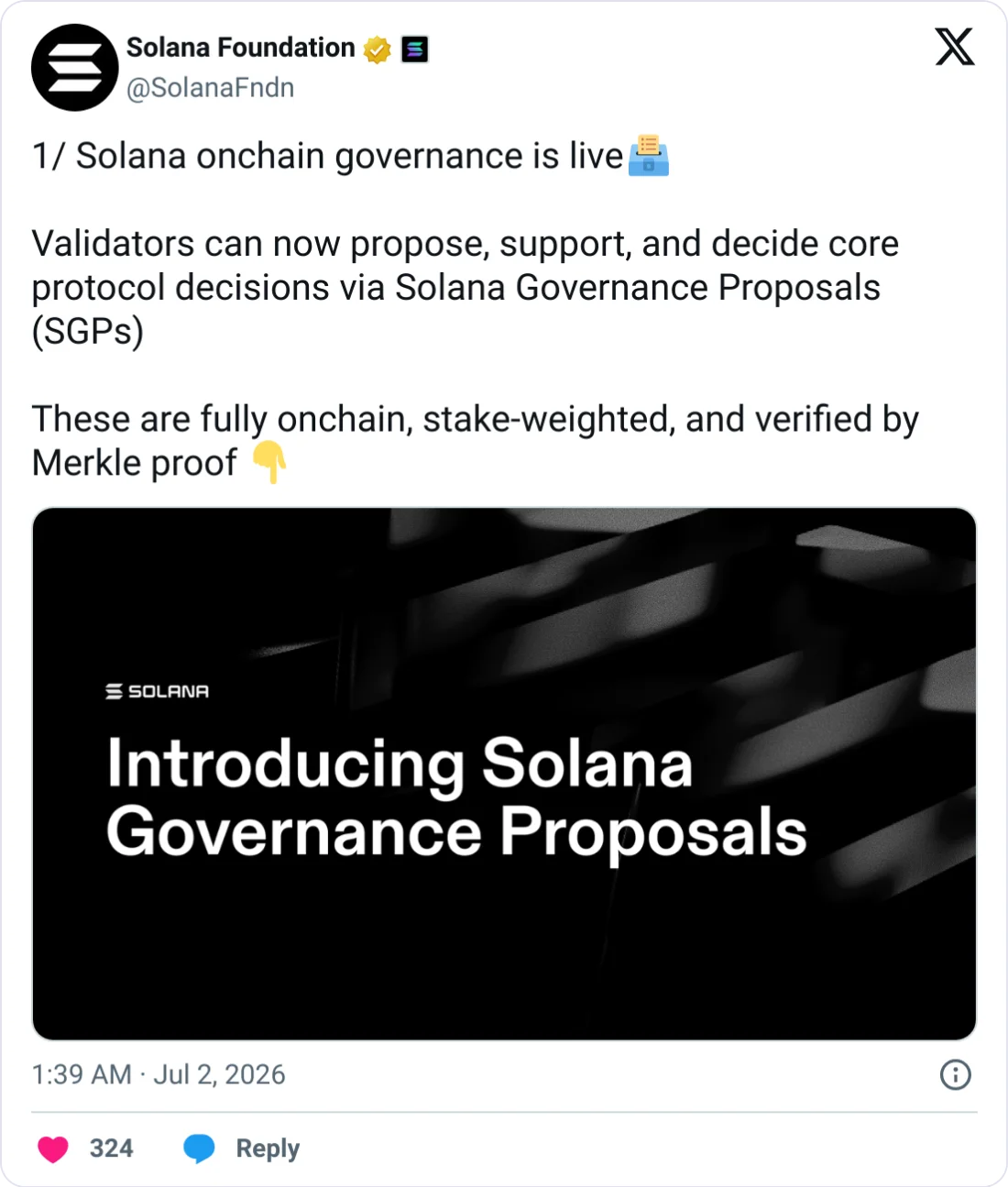
SGPs are designed to capture a stake-weighted answer to whether Solana should pursue a major direction. A separate process, Solana Improvement Documents, or SIMDs, remains focused on implementation details reviewed by core developers. The Solana Foundation described the distinction as the difference between asking “Should we do this?” through an SGP and asking “How exactly do we do this?” through a SIMD.
Governance rules set thresholds for proposals and votes
The framework applies several filters before a proposal can become binding. Validators must meet a high delegated-stake requirement to submit proposals, proposals must gain broad stake support before advancing, and final approval requires a supermajority among participating stake.
Delegated stake counts toward the proposal-submission requirement, so a validator does not need to personally own all the SOL used to qualify. The threshold is meant to limit spam and low-commitment proposals while still allowing validators with meaningful network support to participate. If a proposal does not clear the support stage, it expires instead of moving to a binding vote.
Votes are conducted on-chain and verified through Merkle proofs. The Solana Foundation released voting programs, a governance dashboard and open-source tooling to support the process. Each SGP has a public markdown document explaining the proposal, rationale and voting question, along with an on-chain proposal account created through the svmgov program that links to the document.
Abstain votes do not count toward the supermajority calculation, and there is no minimum turnout requirement. That means a proposal can pass if participating stake reaches the required approval level, even if overall participation is low. Stake-weight snapshots are published on-chain before voting so each vote is measured against a shared record of voting weight.
We’ve launched the all-new COIN360 Perp DEX, built for traders who move fast!
Trade 130+ assets with up to 100× leverage, enjoy instant order placement and low-slippage swaps, and earn USDC passive yield while climbing the leaderboard. Your trades deserve more than speed — they deserve mastery.
Delegators get override power after inflation debate
The central design feature is delegator override power, which the Solana Foundation describes as “staker sovereignty.” Individual delegators can override their validator’s vote using their own stake account, and they can also cast a vote if their validator does not participate. The mechanism prevents validators from fully controlling the voting power of delegated SOL by default.
The launch follows months of debate after the failure of SIMD-0228, an inflation-reduction proposal. That proposal would have reduced SOL inflation but did not pass. The failed vote drew criticism that only validators could directly participate in governance even though tokenomics changes affect every SOL holder.
Critics argued that validators had a possible financial incentive to oppose inflation reduction because inflation increases staking rewards. That criticism raised questions about whether validator incentives and broader community interests always align. The SGP framework addresses part of that concern by giving delegators a direct override path when they disagree with a validator or when a validator abstains.
The new framework could be used before major economic policy decisions return to Solana governance. SIMD-0550 is described as a new disinflation proposal that revisits changes to SOL’s issuance model. SIMD-0553 proposes an additional base fee on transactions that would eventually be burned, with estimates saying it could burn up to 9,000 SOL per day.
Alpenglow, Solana’s proposed consensus upgrade, is used as an example of how the framework could operate. An SGP could first measure community support for pursuing the upgrade, while one or more SIMDs could define the technical implementation. A successful SGP gives core developers a clearer community-backed mandate, but it does not replace technical review and implementation work through the SIMD process.
SGPs are intended for long-term directional decisions with on-chain economic implications where stake-weighted community input is useful. If fewer than the required share of network stake supports holding a vote, the ordinary SIMD process can continue without an SGP.
Stake distribution and market data frame the launch
Blockworks data cited in the uploaded material said the Solana Foundation Delegation Program accounted for 4.92% of total staked SOL in Q2 2026. That share represented approximately $1.6 billion in delegated SOL and was described as the program’s lowest quarterly share on record. The declining share suggests more staking power sits with the broader validator and staking community than with the Foundation’s delegation footprint.
Dr. Nick Almond, Head of Governance at Jito Foundation, described the launch as a major milestone and said Solana now operates what he believes is the “most advanced decentralized governance system in operation.” Michael Hubbard, CEO of SOL Strategies, said previous Solana governance votes relied on manually issuing voting tokens and tallying results, and he framed the new system as a significant improvement.
Michael Hubbard added that enabling validators to represent the stake entrusted to them strengthens the long-term health and safety of the network and ecosystem. Michael Repetný, Co-Founder and CEO of Marinade Labs, said protocol decisions that previously happened through Discord discussions and private conversations can now be proposed, voted on and verified directly on-chain. He emphasized that anyone can independently verify governance outcomes.
The framework is presented as a governance protocol addition, not a full validator-software fork. The uploaded material also cautioned that a verified governance development can strengthen a thesis but does not remove execution risk, liquidity risk, regulatory uncertainty or the possibility that traders fade the initial reaction.
FAQ
What are Solana Governance Proposals?
SGPs are on-chain proposals for stake-weighted decisions on major Solana protocol directions.
Can delegators vote separately from validators?
Yes. Delegators can override validator votes or vote when their validator does not participate.
Do SGPs replace SIMDs?
No. SGPs address broad approval, while SIMDs cover technical implementation details.
Is the framework a validator-software fork?
No. It is described as a governance protocol addition.
This article has been refined and enhanced by ChatGPT.


