




 USD
USD
Vitalik Buterin Maps Ethereum Toward a ‘Cryptographic World Computer’ After Hegota


Recursive proofs, split block construction and faster finality define Ethereum’s post-Hegota roadmap
TL;DR
- Vitalik Buterin said Hegota is likely to be Ethereum’s last “normal” fork before the protocol shifts toward recursive STARKs, formal verification and quantum-safe cryptography.
- His proposed architecture would replace major parts of traditional blockchain verification, consensus and block construction while expanding privacy and parallel computation.
- Buterin’s roadmap targets shorter block slots and faster finality by the end of the decade while reducing the hardware needed to independently verify Ethereum.
Trade smarter on Jupiter, Solana’s leading DEX built for fast execution and deep liquidity.
Swap tokens at competitive rates, route across multiple liquidity sources automatically, and access perpetuals, DCA, and advanced trading tools — all in one place!
Ethereum co-founder Vitalik Buterin has outlined a post-Hegota roadmap that would turn Ethereum from a conventional blockchain into what he calls a “cryptographic world computer,” using modern proof systems, distributed block construction and mathematically verified software to reshape how the network processes and verifies activity.
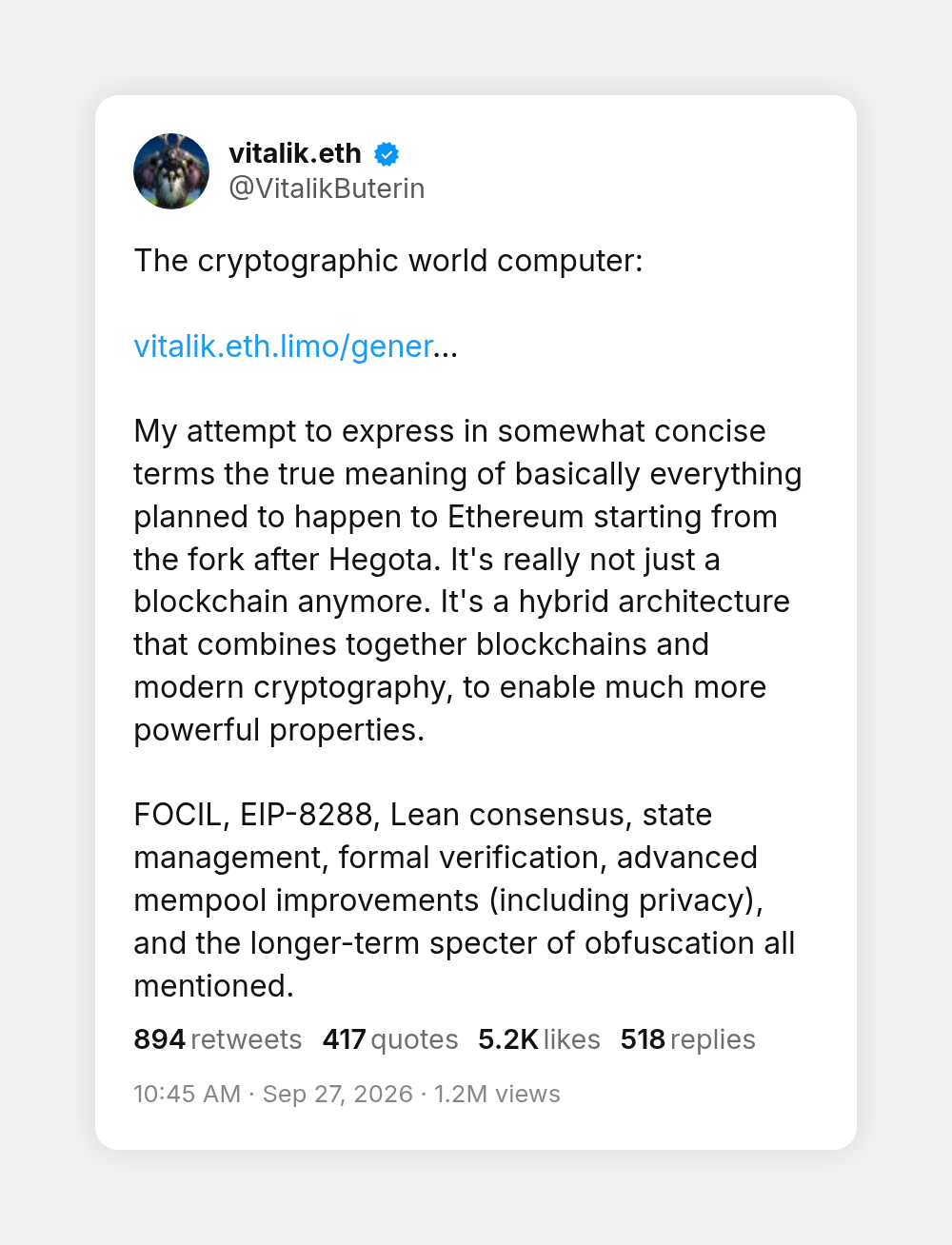
Buterin set out the vision in an essay titled “The cryptographic world computer,” released on Sept. 27, 2026.
Buterin summarized the shift on X: “It’s really not just a blockchain anymore.” He described Ethereum as “a hybrid architecture that combines together blockchains and modern cryptography, to enable much more powerful properties.”
He said the essay explains “basically everything planned to happen to Ethereum starting from the fork after Hegota,” framing the roadmap as an end-state architecture rather than a description of a single upgrade.
Buterin said a post-Lean Ethereum network would still retain ideas rooted in Bitcoin and Satoshi Nakamoto’s design, but would combine them with cryptographic techniques that either did not exist or were not mature in 2009. He said calling such a system a “blockchain” is true “to a large extent for historical reasons.”
Another description of the roadmap characterized that architecture as a hybrid drawing from roughly 50 years of cryptographic research alongside what Buterin called “core Satoshian ideas.”
Hegota marks the break from Ethereum’s familiar upgrade cycle
Hegota, planned for 2027, is “likely to be Ethereum’s last ‘normal’ fork,” Buterin said. The upgrade combines Bogotá, a Devcon host city representing the execution layer, with Heze, a star representing the consensus layer.
Everything after Hegota would increasingly rely on recursive STARKs, automated formal verification, heavily optimized consensus algorithms and quantum-safe cryptography.
STARKs, or scalable transparent arguments of knowledge, allow participants to prove that computation was performed correctly. Recursive STARKs allow proofs to verify other proofs, compressing increasingly large amounts of computation into layers of cryptographic verification.
Automated formal verification uses mathematical proofs to establish that software behaves according to its specification, while quantum-safe cryptography is intended to protect Ethereum against future attacks from sufficiently capable quantum computers.
The roadmap overlaps with the Ethereum Foundation’s technical “Strawmap,” a draft schedule covering seven forks through 2029. Buterin called that document “a very important document” after Justin Drake published it in February 2026.
Buterin’s essay takes a broader approach than the Strawmap, describing the architecture those upgrades are intended to produce rather than mapping technical dependencies fork by fork.
The work also sits within the wider “Lean Ethereum” initiative. Buterin said in July 2026 that the effort would replace almost every major component of the protocol, and he has compared its scope with the Merge, Ethereum’s 2022 transition to proof-of-stake. He has also called the process a “ship of Theseus” rebuild.
Glamsterdam comes before Hegota and is expected in the fourth quarter of 2026, according to an Ethereum Foundation update cited in the source material. The upgrade combines Gloas and Amsterdam and had previously been projected for the first half of 2026.
Buterin illustrated Ethereum’s changing architecture by annotating five sections of the Bitcoin whitepaper and comparing its original assumptions with how Ethereum already works or is expected to operate around 2030.
Nodes would verify proofs instead of re-running everything
Traditional blockchain nodes generally download and execute blocks themselves. Buterin’s roadmap moves Ethereum toward a model in which nodes sample data through PeerDAS and verify compact cryptographic proofs such as SNARKs instead of independently repeating every computation.
PeerDAS already shipped with Ethereum’s Fusaka upgrade in December 2025 and allows validators to sample blob data rather than download all of it. Buterin wrote that PeerDAS “later will cover full block contents.”
He identified verification, consensus and block construction as three core Ethereum properties being replaced outright.
A SNARK, or succinct non-interactive argument of knowledge, is a compact proof that lets a verifier establish that computation was performed correctly without executing the entire computation again.
Consensus would move toward what Buterin called a “much better optimized” proof-of-stake system, while block construction would become less dependent on a single participant deciding a block’s contents.
Buterin called single-producer construction a “hidden assumption” in the Bitcoin whitepaper that has “already heavily degraded in reality.”
He said FOCIL “and possible later extensions will much more deeply enshrine multi-participant split-authority block construction.”
FOCIL, or fork-choice enforced inclusion lists, is planned as a Hegota feature. A committee of validators would independently publish lists of pending transactions that the next block must include, while Ethereum’s fork-choice rules would enforce those lists. Buterin said the mechanism is intended to provide “guaranteed real-time transaction inclusion.”
Signature verification would also become more compressed. Buterin wrote that signatures “will be aggregated offchain, a single one onchain per block.”
The design connects with EIP-8288, a draft proposal Buterin co-authored with Thomas Coratger in June 2026. Under Buterin’s description, “only entry nodes see individual signatures and proofs.”
Privacy becomes part of the architecture
Buterin said privacy systems built around ZK-SNARKs already weaken the assumption that every transaction must be openly broadcast with all underlying information visible.
ZK-SNARKs allow users to prove statements without revealing the private information behind them. Buterin wrote that “FOCIL and EIP-8288 will make such transactions much more first-class citizens.”
The roadmap divides privacy across several layers rather than treating it as a single feature. General-purpose computation would remain relatively expensive and only partly private, while specialized applications could achieve what Buterin called “very strong privacy” through zero-knowledge proofs and private account abstraction.
Network-level privacy would also use onion routing and mixnets to make it harder to identify where data and requests originate. The Ethereum Foundation created a dedicated privacy cluster in October 2025.
Buterin said decentralized networks can sometimes improve metadata privacy because they make it harder to determine “where data and requests are coming from.”
Ethereum targets faster slots and finality
Buterin’s roadmap sets several performance targets that differ by milestone.
Buterin cautioned that “Ethereum itself will never have latency that competes with servers, but infrastructure built around it could.”
The proof-based architecture is also intended to lower the hardware burden for independent verification because nodes would not need to reproduce every expensive computation or download every piece of data.
Gas pricing could change as well. Buterin said identical computation should cost more “if you shove it all into one inscrutable serially-executed transaction,” while workloads that expose explicit dependencies and can run in parallel could be cheaper.
That approach would encourage applications to make parallel processing visible to the protocol instead of forcing execution into opaque sequential workloads.
Cryptography could turn decentralization into a performance tool
Buterin said decentralization has historically been “a burden incurred in the name of safety and robustness,” but modern cryptography is beginning to make decentralized architecture beneficial for performance in “a few limited cases.”
“The decentralized network allows larger volumes of data to be stored in parallel,” he wrote.
“It allows a high volume of computation to happen in parallel, in many cases inside the mempool.”
“In a few cases, it increases privacy, because only decentralized networks can effectively hide metadata.”
That idea revives ambitions Ethereum developers pursued in the mid-2010s, when randomly sampled committees were proposed as a way to divide work across many nodes. Buterin said those systems were “complicated to set up and expensive,” added latency and offered “no recourse if the committee fails.”
Modern cryptographic proofs change that model because separate participants can perform work and prove its correctness without requiring every node to repeat it.
“Now, with modern cryptography, this problem is solved, and the overhead factor of that solution is decreasing month by month,” Buterin wrote.
He does not view proof generation itself as Ethereum’s hardest unresolved technical problem. Buterin called fast, secure zero-knowledge proofs a form of “encapsulated complexity,” and the source material said optimization is already being accelerated with AI tools.
Ethereum state is a harder challenge, he said. Handling “very large amounts of state” is likely to be “more difficult, and systemically complex” because the network must efficiently coordinate access to a growing record of balances, smart-contract storage and other persistent data.
Indistinguishability obfuscation could reshape Ethereum later
A further architectural shift could come if indistinguishability obfuscation, or iO, becomes practical.
The technique is designed to scramble a program so thoroughly that it can still run correctly without revealing meaningful information about its internal implementation. Buterin has called obfuscation cryptography’s “final boss” and a cryptographic “holy grail.”
Practical iO could reduce the tradeoff between privacy and general-purpose computation by allowing arbitrary software to execute without exposing its logic or secrets.
Buterin stressed that Ethereum’s current roadmap does not depend on that technology. “All of the conclusions in this post will apply long before any of that becomes available,” he wrote.
The proposed architecture instead advances through successive changes to verification, data availability, consensus, privacy and block production. Nodes would increasingly validate proofs instead of replaying all activity, while block construction would be distributed across multiple actors and private applications could expose cryptographic proofs rather than raw data.
ETH price was near $2,700 on Sept. 27, 2026, and was roughly flat over the preceding 24 hours. That market observation was presented separately from Buterin’s technical roadmap and was not identified as a reaction to the essay.
Buterin’s “cryptographic world computer” vision ultimately keeps the blockchain as Ethereum’s coordination and settlement base while moving more of the network’s verification, privacy, scaling and security functions into advanced cryptography.
FAQ
What is Hegota?
Hegota is Ethereum’s planned post-Glamsterdam upgrade and may be its last conventional fork.
What changes after Hegota?
Ethereum would increasingly rely on recursive STARKs, formal verification, optimized consensus and quantum-safe cryptography.
What is FOCIL designed to do?
FOCIL would distribute transaction-inclusion authority across multiple validators to strengthen censorship resistance.
Does Ethereum’s roadmap depend on indistinguishability obfuscation?
No. Buterin said the roadmap’s conclusions apply long before that technology becomes practical.
This article has been refined and enhanced by ChatGPT.


