




 USD
USD


8.64 / 10

Summary
Get a structured breakdown of Extended Perp DEX’s performance across access, liquidity, execution speed, security, and overall UX. Clear scores, concise reasoning, and practical takeaways show where the platform excels—and where it still needs to grow.
Pros

Vast Asset Variety
Fast Order Execution
Transparent Risk Engine
Self-Custody
Cons

Single-Collateral Only
Limited Blockchain Support
Extended Review Scores
8.64
Overall

8.6
Market Access & Leverage
8.8
Liquidity & Market Efficiency
8.5
Network Performance & Scalability
8.7
Security & Transparency
8.6
Experience & Incentives
Extended Perp DEX Review: A High-Precision Trading Venue Built for Serious Crypto Users
Perpetual DEXs have shifted from experimental toys into full-fledged trading venues. Extended Perp DEX enters this landscape aiming to close the final performance gap between decentralized and centralized derivatives platforms — and it takes that ambition seriously.
Key Takeaways
- Delivers CEX-level execution with low latency, deep liquidity, and competitive fees across 70+ crypto and synthetic markets.
- Risk management is transparent, with clear margin tiers, partial liquidations, and insurance-fund safeguards.
- Starknet performance is hidden behind a smooth EVM-only interface, enabling gas-free trading but limiting non-EVM access.
- USDC-only collateral reduces capital flexibility, though a unified multi-collateral system is planned.
- Security is strong with audited contracts, self-custodial design, and trustless settlement rules.
- Trader experience is polished, offering advanced order types, instant order handling, and a points program for active users.
Extended Pros and Cons
Pros
- Broad market coverage across crypto and synthetic assets
- High-performance trading engine with low latency and deep liquidity
- Clear risk framework with transparent margin and liquidation rules
- Self-custodial design with strong security and audit history
Cons
- Single-collateral model limiting capital flexibility
- EVM-only deposits with no native support for non-EVM chains
Market Access & Leverage Framework: Broad Coverage With a Professional Risk Engine
Extended Perp DEX positions itself as a multi-market trading hub, not just another crypto-only derivatives platform. At launch on Starknet, the exchange already supported 70+ perpetual markets including BTC, ETH, SOL, and other majors, but also pre-markets, forex pairs, gold, oil, and an S&P 500 index.
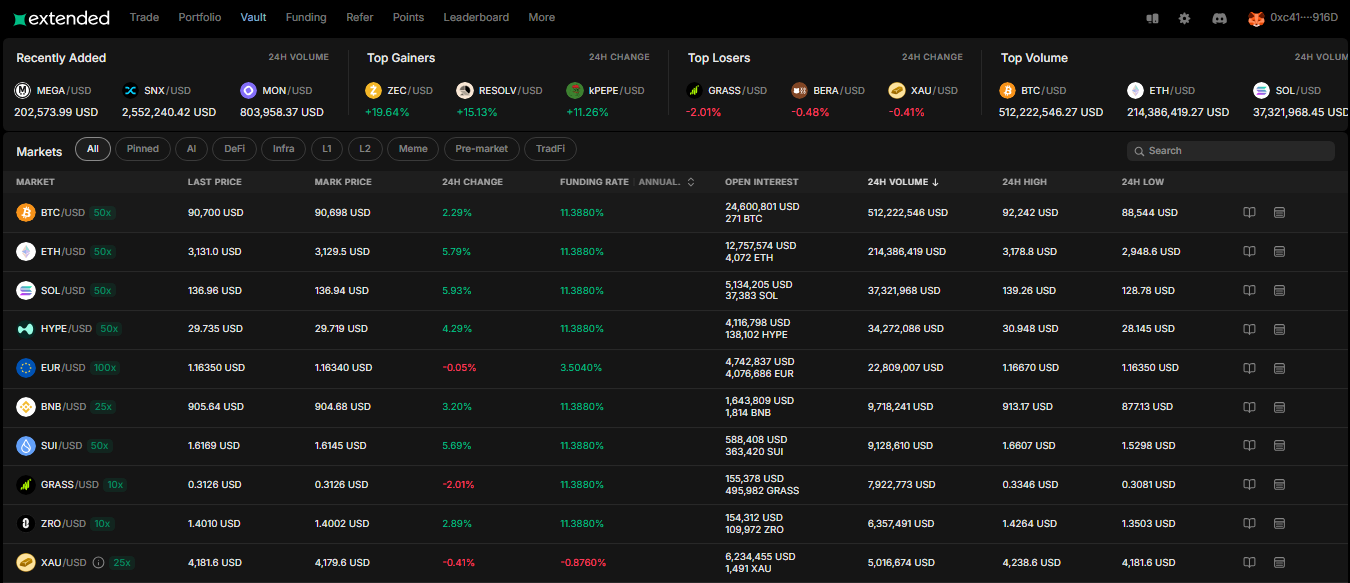
For traders who prefer a single venue for both crypto and synthetic TradFi exposure, this variety is genuinely useful — especially when you want to overlay a BTC long with an SPX hedge without switching platforms.
Leverage runs as high as 100× on the EUR/USD pair while cryptocurrencies see a maximum leverage of 50×, with a tiered margin schedule that scales requirements for very large notional sizes. In practice, traders get the freedom to size aggressively on smaller positions while institutions or whales face progressively higher margin. Both cross-margin and isolated sub-accounts are supported, and creating up to 10 sub-accounts lets you sandbox strategies the way you would in a multi-portfolio CEX environment.
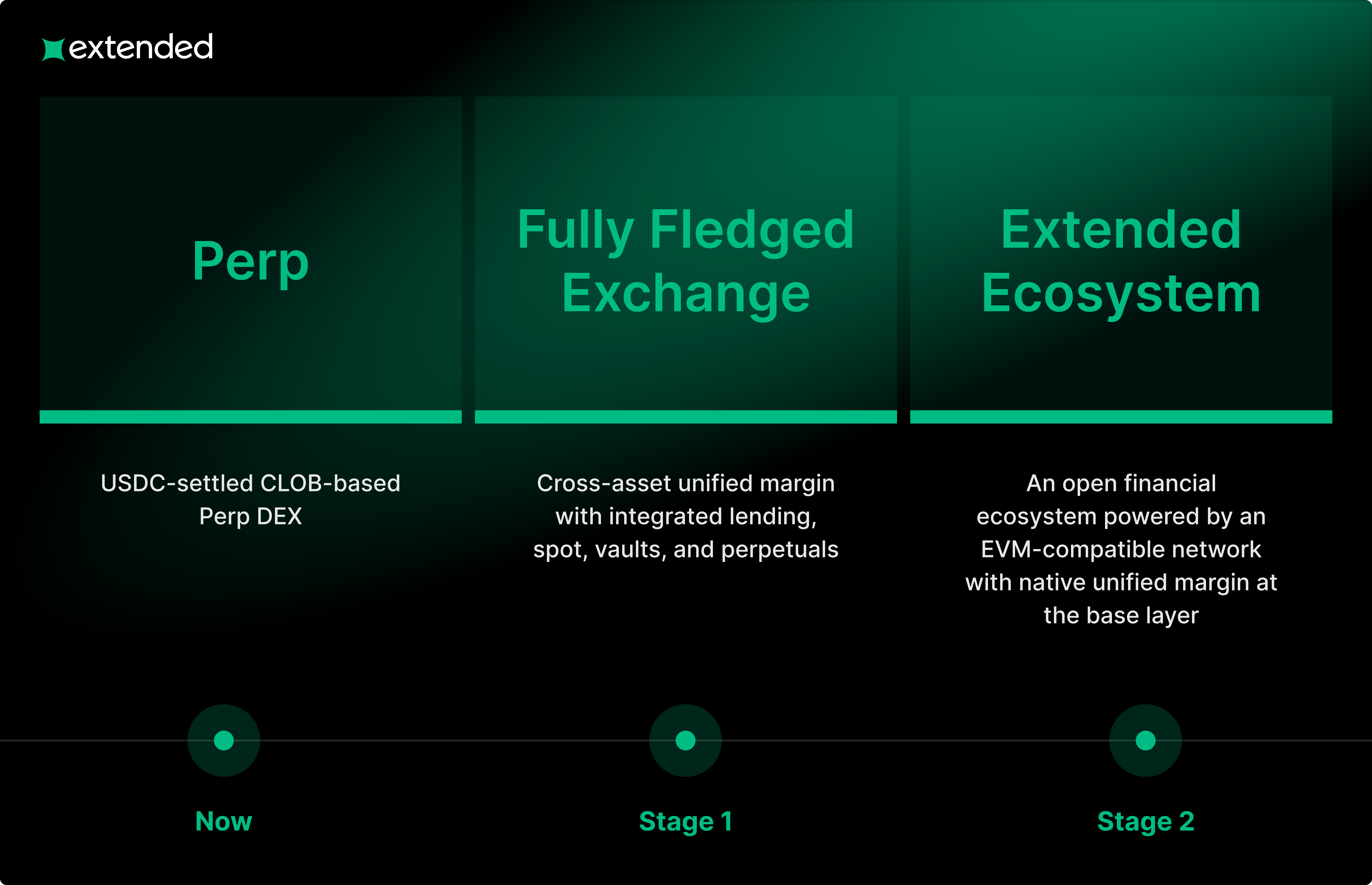
At the time of writing, Extended Perp DEX still operates on a single-collateral model, accepting only USDC deposits for trading. For a platform that positions itself as a multi-market derivatives venue, this is a real limitation. Most advanced traders prefer to park capital in diversified assets — stables, ETH, liquid staking tokens, or yield-bearing collateral — and being forced into pure USDC reduces flexibility and adds an extra conversion step.
Luckily, they are working on it: Extended plans a unified margin system that eventually accepts multiple collateral types and ties spot/lending into the same risk layer. It’s not live yet, but the roadmap suggests a platform still expanding its capital efficiency vision.
As a user, what stands out is the transparency. Margin call levels, liquidation triggers, and maintenance ratios are stated clearly in the docs, so you rarely feel blindsided by hidden thresholds.
The drawback? Because markets include synthetic TradFi instruments, liquidity on those pairs behaves like their underlying schedule — meaning spreads widen during off-hours, and weekend trading on FX or indices won’t feel as tight as BTC/ETH. That’s not a flaw in Extended; it’s structural reality, but still something users should expect.
Liquidity & Market Efficiency: Surprisingly Deep for a Young DEX
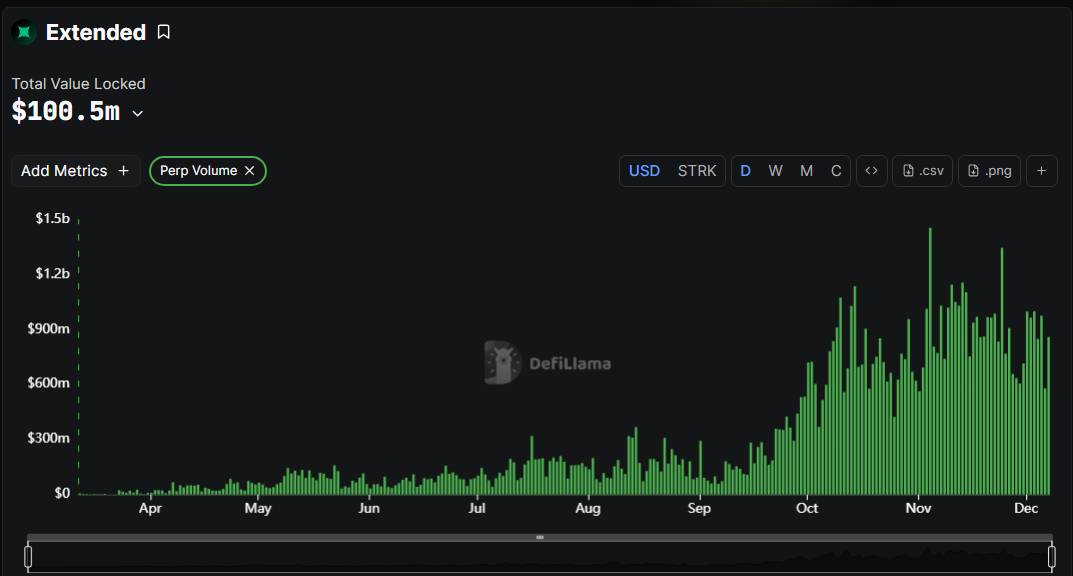
Extended’s hybrid infrastructure gives it a liquidity profile that feels much closer to a CEX than some on-chain venues. With monthly volumes hitting ~$27.2B and open interest above $72.4M over the past 30 days as per DefiLlama, the platform already competes in the upper tier of perp DEXs by raw activity.
Liquidity comes from two pillars:
- Active market makers quoting two-sided books
- The Extended Vault, which seeds baseline depth and executes liquidations when needed
For the core majors, slippage on ~$100K notional orders is minimal. Altcoin perps see thicker-than-expected books because the Vault helps stabilize quotes rather than leaving responsibility entirely to external makers.
Weekend trading is the one caveat. Because Extended lists non-crypto markets like EUR/USD and SPX, spreads on those instruments naturally open up when underlying markets close. If you’re familiar with CME Globex or FX rollover windows, the behavior is predictable.
Overall, the execution quality lands firmly in “professional-grade” territory, and the consistency of spreads on majors is one of Extended’s standout traits.
Network Performance & Scalability: Starknet Without the Starknet Friction
Extended built its exchange on Starknet, using a zk-rollup backend capable of extremely low fees and high throughput. The platform’s design makes Starknet almost invisible. You connect an EVM wallet, deposit USDC from Ethereum or L2s, and Extended pipes the assets into Starknet without separate wallet setup or bridging steps.
The result is a chain-agnostic user experience:
- Deposits accepted from six EVM networks
- Withdrawals possible to any supported chain, regardless of where you deposited
- No need to manage Starknet keys manually
- Gas-free trading because on-chain settlement is aggregated in batches
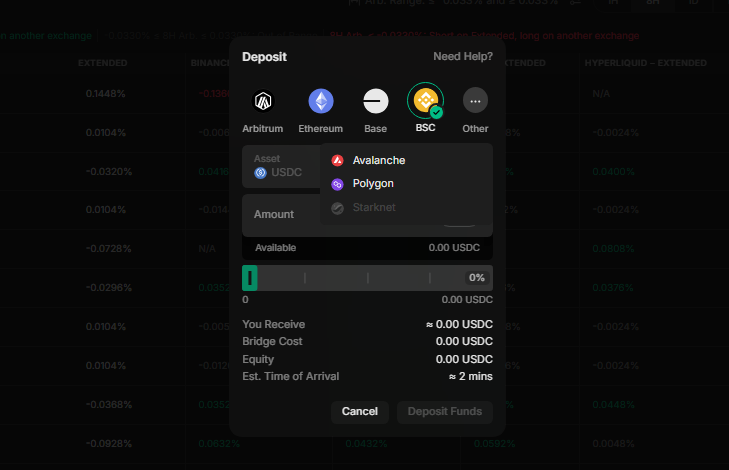
Extended essentially hides the L2 complexity beneath a polished interface.
Throughput and latency reflect that design: Starknet proofs seal state transitions roughly every ~2 seconds, while the off-chain matching engine handles order flow at CEX-like speeds. Extended’s approach scales well; even under bursts of volatility, the trading layer keeps functioning while settlement queues harmlessly compress on-chain.
That said, the EVM-only scope is still a limitation. There’s no native support for Solana, Sui, or any non-EVM chain, which means traders holding capital outside the Ethereum ecosystem have to bridge through an intermediary layer before they can even fund an account.
Security & Transparency: Fully Self-Custodial With On-Chain Guarantees
Extended takes the non-custodial model seriously. User funds sit in Starknet smart contracts controlled by the trader’s wallet-derived key; the exchange cannot move or freeze funds even if it wanted to. If Extended disappeared, users could still submit on-chain withdrawals directly.
Trade settlement is also trustless. Every order is signed with strict parameters, and the smart contract rejects any settlement that violates price or size constraints. This ensures the operator cannot execute at worse-than-agreed prices — a structural safeguard many centralized venues simply do not offer.
The platform enforces liquidation rules transparently:
- Early warnings at 66% and 80% margin ratio
- Partial liquidations in 20% batches
- Insurance fund protection with capped daily drawdowns
- Auto-deleveraging only as a last resort
Extended underwent external audits including ChainSecurity and a Code4rena audit contest, and to date has no reported exploits. From a design standpoint, Extended blends the execution flow of a CEX with the fail-safes of on-chain settlement.
The caveat is sequencing: while trades are settled on-chain, order sequencing itself isn’t recorded on-chain, so full price-time priority cannot be independently verified. Extended mitigates this with public market feeds and settlement constraints, but it’s still a hybrid trust model.
Trader Experience & Engagement: CEX-Like UI With Earn Mechanics That Actually Matter
Extended Perp DEX feels intentionally familiar — charting, order books, and PnL panels look and behave like a polished centralized exchange. Order latency clocks in under 10 ms end-to-end, which is wild for a DEX and genuinely changes how active traders behave. Placing, canceling, and modifying orders feels instant, and stop-loss execution doesn’t suffer the lag typical of on-chain venues.
Order types are unusually rich for DeFi:
- Standard market/limit
- Conditional orders on Mark, Index, or Last
- TWAP
- Scaled entries
- OCO (one-cancels-the-other)
- Reduce-only and post-only flags
The UX is clean enough that you rarely need documentation — which is exactly how trading software should behave.
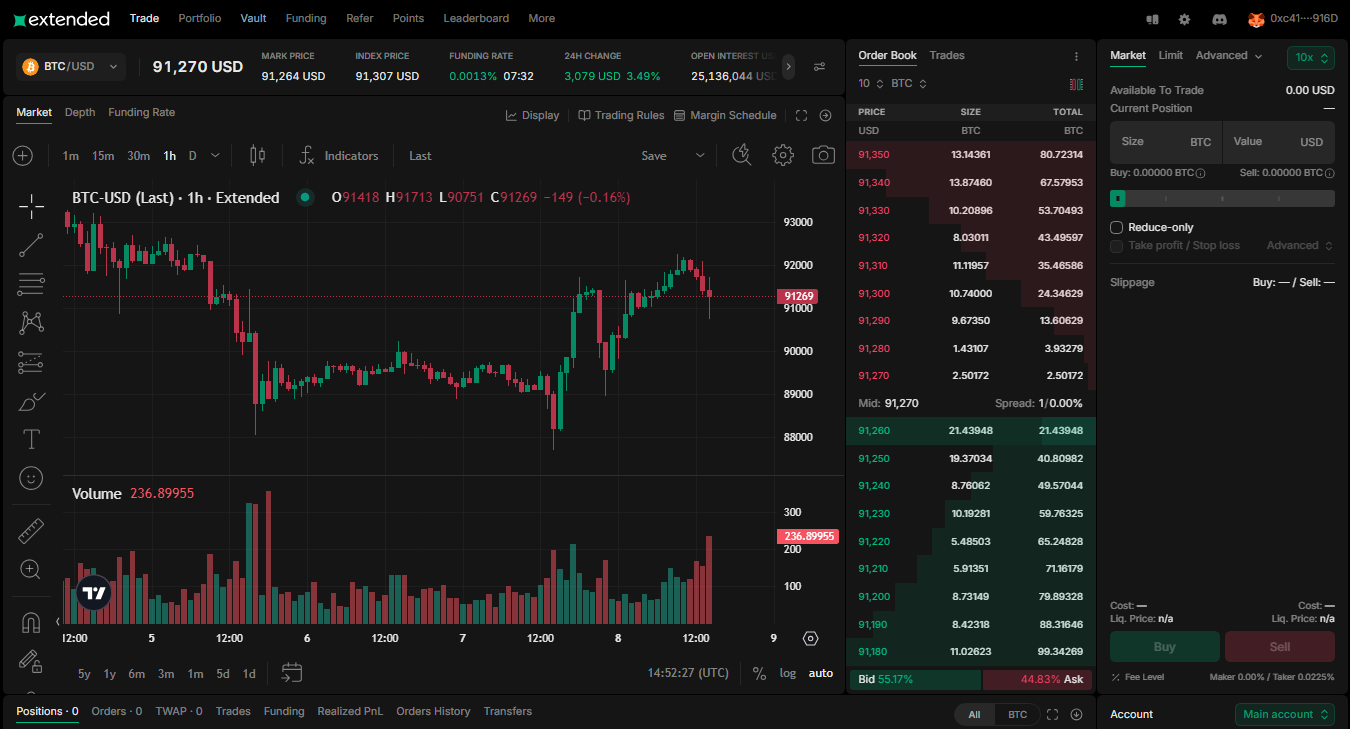
On the engagement side, Extended runs a Seasonal Points Program distributing up to 1.2M points weekly to traders, LPs, and referrers. There’s no token yet, but incentives are often designed with future governance or airdrops in mind. Referral rewards are meaningful: referees get a 10% fee discount for their first $50M in volume, and referrers earn 10% of net fees plus bonus points.
Fees & Funding: One of the Lowest-Cost Trading Environments in DeFi
Extended’s fee structure is aggressively competitive:
- 0.000% maker fee
- 0.025% taker fee
- Maker rebates up to 0.0175% for high-volume liquidity providers
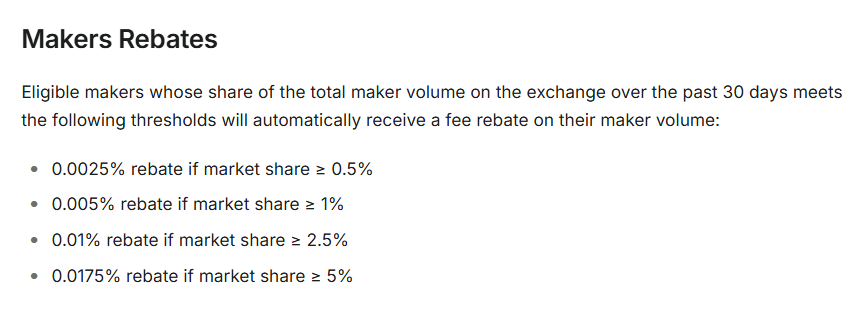
Trading is also gas-free due to off-chain matching. For active traders — especially scalpers or TWAP users — this cost profile is a meaningful advantage.
Funding rates are calculated hourly, with caps on extreme deviations — which prevents “funding shocks” during volatile periods. Funding logic mirrors CeFi standards but with more frequent sampling to smooth spikes.
As always, crypto markets with low activity or synthetic TradFi pairs during closed hours can experience wider funding premiums. That’s standard behavior, not an Extended-specific flaw, but worth noting.
Conclusion
Extended Perp DEX feels like a serious attempt to merge CEX-level execution with DeFi guarantees. Its liquidity, speed, and UX are already competitive, and the roadmap hints at bigger ambitions around unified margin and broader collateral. The platform isn’t frictionless, but it’s far ahead of most decentralized derivatives venues in both precision and user experience.


