




 USD
USDBitcoin’s BIP-110 Nears August Deadline With Almost No Miner Support


Temporary data restrictions face broad resistance over censorship and network-split risks
TL;DR
- BIP-110 would temporarily restrict non-financial data in Bitcoin transactions, but miner signaling remains below 1%.
- The proposal needs 55% miner support to lock in before an early-August 2026 deadline.
- Michael Saylor, Adam Back and Jameson Lopp warned that the consensus change could create greater risks than transaction spam.
Trade smarter on Jupiter, Solana’s leading DEX built for fast execution and deep liquidity.
Swap tokens at competitive rates, route across multiple liquidity sources automatically, and access perpetuals, DCA, and advanced trading tools — all in one place!
Bitcoin’s BIP-110 proposal is approaching an early-August 2026 activation deadline without enough support to alter the dominant network. The temporary soft fork would restrict arbitrary or non-financial data for about one year, but miner signaling has remained below 1%, no major mining pool has backed it, and participating nodes could instead create a small minority chain.
Developer Dathon Ohm introduced BIP-110, formally titled the “Reduced Data Temporary Soft Fork,” in December 2025. The proposal targets transaction methods used to embed images, text, token metadata and other information directly into Bitcoin. Its supporters say those uses increase blockchain storage and bandwidth requirements, while opponents say valid transactions should remain acceptable when users pay the required fees.
The disagreement has developed into a broader dispute over Bitcoin governance. Supporters believe the network should primarily serve as peer-to-peer electronic cash and should prevent blockspace from becoming general-purpose data storage. Opponents argue that developers, miners and node operators should not classify transactions according to their purpose when those transactions already comply with Bitcoin’s rules.
Bitcoin transactions can carry monetary transfers alongside additional information. OP_RETURN provides a designated field for small data entries, while script and witness data pushes can hold larger payloads. Ordinals inscriptions, BRC-20 tokens, Runes and related systems use those transaction paths to record digital content or token information on Bitcoin.
Taproot, activated in 2021, helped create the technical conditions for developers to embed images, text and other data more efficiently. That development was followed by Ordinals, Bitcoin-based NFT-like assets, and Runes, which can be used to mint fungible tokens and memecoins.
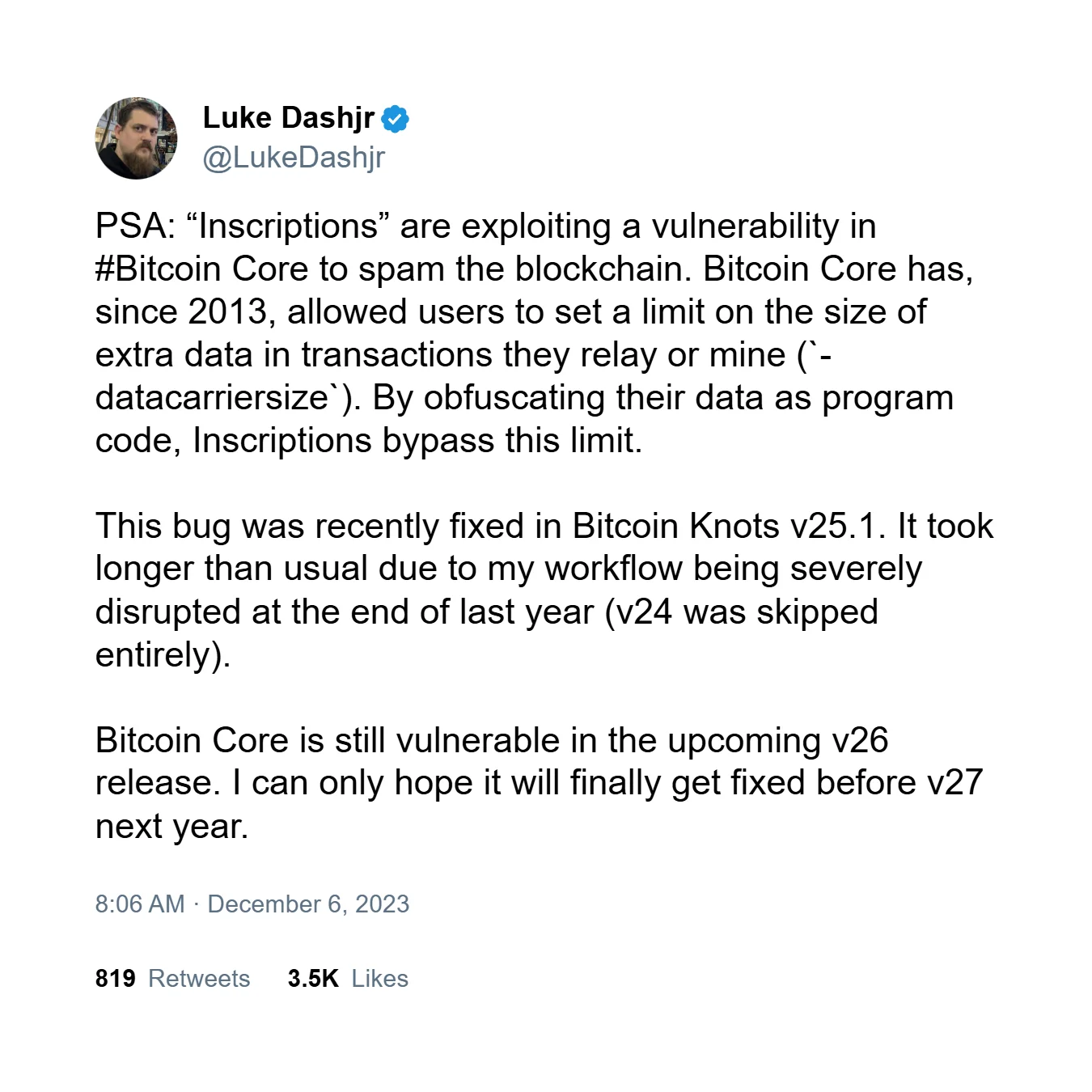
Veteran Bitcoin developer Luke Dashjr and other inscription critics maintain that those applications exploit unintended technical openings. Their concern is that persistent non-financial data enlarges the blockchain, increases the resources required to operate a full node and could gradually favor miners and infrastructure companies with greater storage, bandwidth and capital.
Ordinals supporters take the opposite position. They argue that users purchasing scarce blockspace through transaction fees are using Bitcoin according to its existing rules, regardless of whether a transaction transfers money, records an image or creates a token.
What BIP-110 would change
BIP-110 would make many current inscription methods invalid or uneconomical by tightening several consensus limits. The restrictions would be temporary rather than permanent, allowing developers and users to reconsider the issue after the proposal expired.
Inputs spending coins created before activation would remain permanently exempt. That grandfathering provision is designed to prevent older coins from becoming unspendable because their scripts do not meet the proposed limits.
The restrictions would expire after approximately one year. Supporters present that period as a defensive pause intended to reduce blockchain growth and preserve monetary blockspace while developers consider longer-term options.
Critics say the proposal goes beyond transaction-policy measures and would create a consensus-level prohibition. Individual miners and nodes can already decide which transactions they relay or prioritize, but BIP-110 nodes would reject blocks containing transactions that remain valid under Bitcoin’s current rules.
That distinction carries the risk of a blockchain split. Nodes enforcing BIP-110 could reject a block that the rest of the network accepts, leaving two groups following incompatible transaction rules.
Saylor, Back and Lopp oppose the proposal
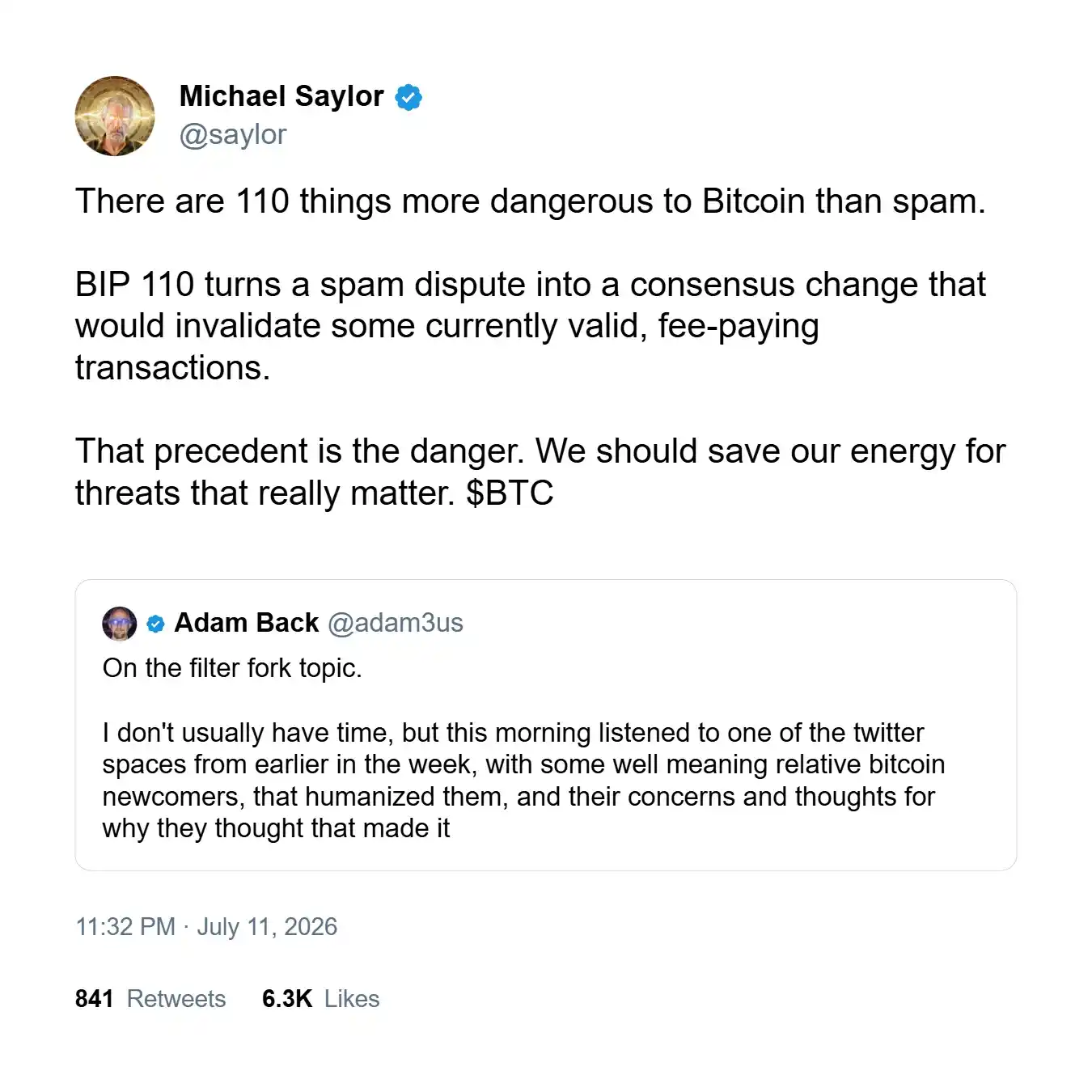
Strategy founder Michael Saylor opposed BIP-110 on July 11, 2026, arguing that the proposed response posed a larger governance risk than the disputed data usage.
“There are 110 things more dangerous to Bitcoin than spam,” Saylor said.
Saylor said BIP-110 “turns a spam dispute into a consensus change that would invalidate some currently valid, fee-paying transactions,” adding that “that precedent is the danger.” He said the community should reserve its efforts for threats that genuinely matter.
Blockstream co-founder and CEO Adam Back also rejected the proposal. Back acknowledged that spam was a legitimate concern but said Bitcoin already manages blockspace demand through fees, miner incentives and decentralized consensus.
Back told supporters: “Bitcoin respectfully says no to what you want.” He said users remained free to coordinate a separate network under different rules, but “bitcoin won’t be joining it.”
Back also warned that users supporting the change could become disillusioned without understanding why the wider network had rejected it.
“If these are the people with #110 in their handles, I’m sad to see them about to fork off and get disillusioned without understanding why bitcoin rejected 110 robustly,” Back said.
Back said both sides viewed themselves as protecting Bitcoin rather than deliberately harming it.
“It would be sad if bitcoin lost people disillusioned due to simple lack of understanding of what’s going on there, we’re all trying to defend bitcoin and keep it on mission,” Back said.
Developer Jameson Lopp also opposed BIP-110 and characterized its activation parameters as reckless. His objection centered on the possibility that an attempted activation without broad agreement could force exchanges, wallets, miners and node operators to account for two incompatible networks.
We’ve launched the all-new COIN360 Perp DEX, built for traders who move fast!
Trade 130+ assets with up to 100× leverage, enjoy instant order placement and low-slippage swaps, and earn USDC passive yield while climbing the leaderboard. Your trades deserve more than speed — they deserve mastery.
Miner signaling remains negligible
BIP-110 uses a user-activated soft-fork structure. Participating nodes would begin enforcing the stricter rules even if most miners did not voluntarily support them.
Supporters say user activation prevents miners from having final authority over consensus changes, particularly when miners receive fees from the transactions targeted by the proposal. Opponents say activation without broad coordination could reproduce the network-split risks associated with the 2017 block-size conflict.
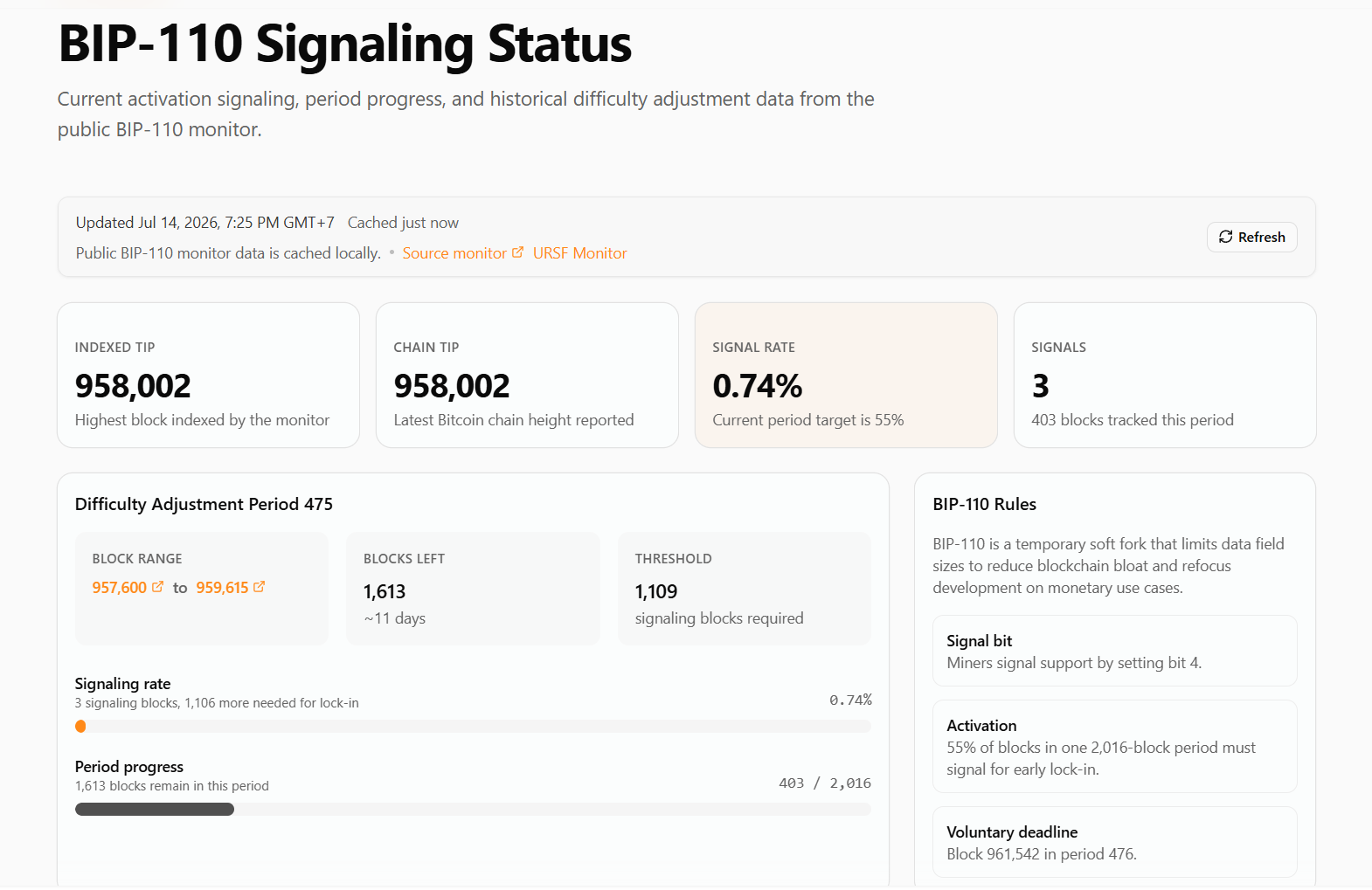
The proposal requires 55% miner signaling to lock in, equal to 1,109 supporting blocks during a 2,016-block difficulty period. That threshold is substantially lower than the 95% level associated with several earlier Bitcoin soft forks.
Available signaling measurements vary according to the observation date and difficulty period, but every reading shows support far below the required level.
No major mining pool had committed to the proposal. Most nodes identified as participating were running Bitcoin Knots, an alternative implementation to the dominant Bitcoin Core software, while overall node adoption remained in the low single digits.
Miners signal support by setting a designated bit in a mined block’s version field. Their lack of signaling means mining operators have not committed to enforcing the proposed restrictions.
Miners also receive fees from inscription and token transactions when those transactions compete successfully for blockspace. BIP-110 supporters see that fee incentive as a reason users must retain authority to activate rules without miner approval. Opponents say miners should remain free to include any valid transaction paying a competitive fee.
Institutional investors showed little appetite for another Bitcoin governance conflict. A contested split could create uncertainty around custody, settlement, exchange listings, ticker symbols, withdrawals, replay protection and the treatment of coins that existed before the fork.
Activation timelines remain inconsistent
The stated activation schedule contains an unresolved discrepancy. One timeline placed the current signaling period between block 957,600 and block 959,615, followed by a voluntary lock-in deadline at block 961,542 in early August. A separate timeline placed the mandatory signaling point near block 961,632.
The difference between those two proposed deadline heights is 90 blocks. The available information does not establish whether that gap resulted from different interpretations, revised timing estimates or a typographical error.
A successful lock-in would place activation near block 965,664, projected for approximately September 1, 2026. Nodes running the BIP-110 software would then reject blocks containing transactions that violated the temporary data restrictions.
The deadline can arrive even without broad adoption. A small number of participating nodes could begin enforcing BIP-110, but they could not compel the dominant network to follow those rules.
Current support levels make a minority chain more likely than a network-wide upgrade if proponents proceed. Such a chain would have little miner participation, substantially lower hash power, less predictable block production and limited support from exchanges, wallets and other infrastructure providers.
A split could still create operational work for service providers. Exchanges and custodians would have to determine whether to recognize both networks, how to name the minority asset and how many confirmations to require for deposits.
Falling Ordinals activity weakens the emergency case
The disagreement over non-financial data has not disappeared. Bitcoin blocks have carried more such data since an October policy change, supporting concerns among some users that the blockchain is moving beyond a primarily monetary role.
Ordinals activity, however, had already fallen sharply by the time the activation deadline approached. Fewer than 10,000 Ordinals were added per day for roughly one month before July 12, a level identified as an all-time low.
That decline reduced the urgency behind a consensus intervention. Opponents could point to falling usage as evidence that transaction fees and changing demand were already limiting inscription activity without a fork.
Supporters could still argue that lower current demand would not prevent another wave of inscriptions. Miner and node adoption, however, remained too limited to demonstrate broad agreement that the risk justified changing Bitcoin’s consensus rules.
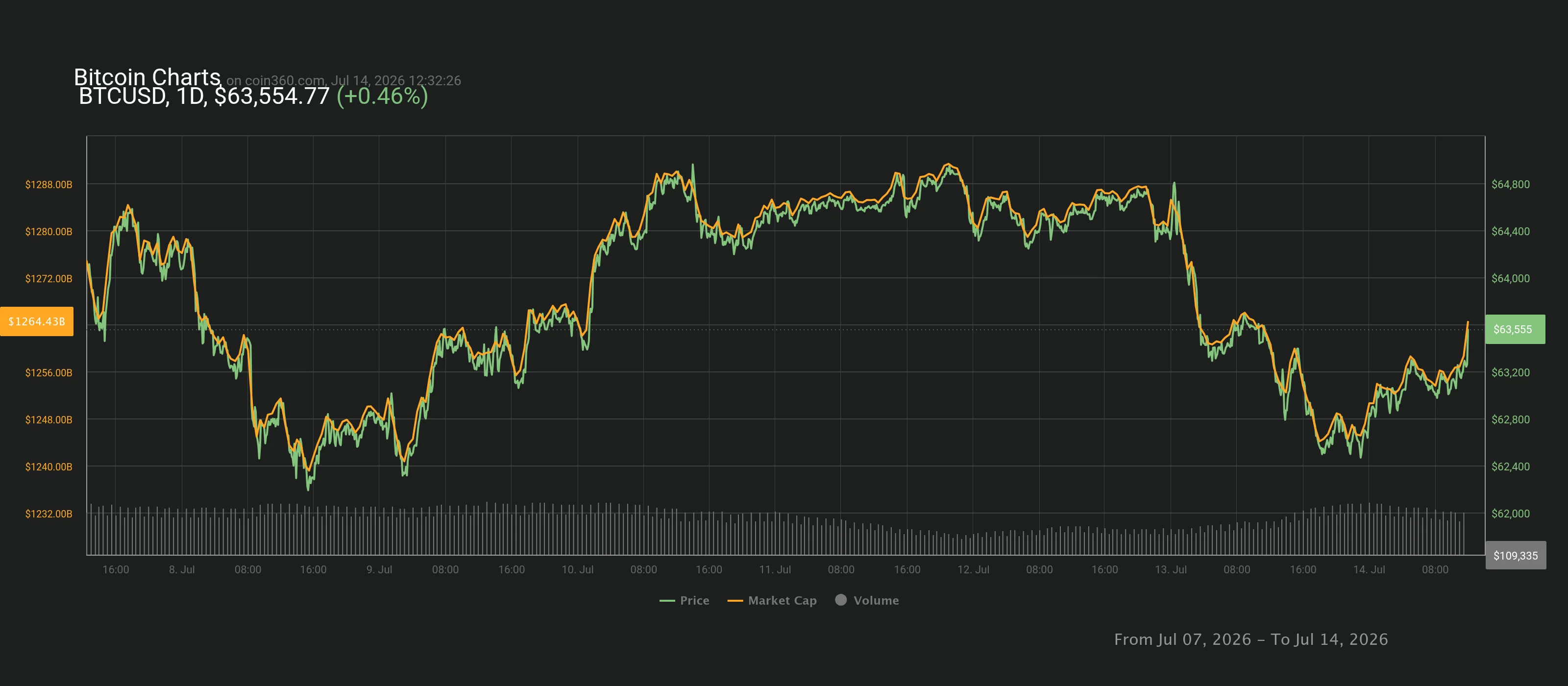
COIN360 data showed no clear Bitcoin price panic tied to the BIP-110 dispute during the reporting period.
FAQ
What does BIP-110 target?
It targets methods used to embed arbitrary or non-financial data in Bitcoin transactions.
Can BIP-110 activate without miners?
Participating nodes can enforce it, but negligible miner support would likely produce a minority chain.
Does BIP-110 permanently ban inscriptions?
No. Its restrictions would expire after approximately one year.
Has BIP-110 reached its activation threshold?
No. Observed miner signaling remains far below the required 55%.
This article has been refined and enhanced by ChatGPT.


