




 USD
USD
What Are Crypto Derivatives and Why Do Traders Use Them?

If you've spent any time around crypto markets, you've probably seen terms like "futures," "perpetuals," or "options" thrown around like everyone just knows what they mean. Most people nod along and quietly Google it later. This article is for those people — and it's also for anyone who wants to actually understand why derivatives exist, not just what they're called.
Here's the short version: derivatives are one of the most powerful tools in financial markets, and in crypto, they dominate everything. Let's break down why.
We’ve launched the all-new COIN360 Perp DEX, built for traders who move fast!
Trade 130+ assets with up to 100× leverage, enjoy instant order placement and low-slippage swaps, and earn USDC passive yield while climbing the leaderboard. Your trades deserve more than speed — they deserve mastery.
What Is a Financial Derivative?
A derivative is a financial contract whose value is derived from something else — an underlying asset. That asset can be a stock, a commodity, a currency, or in this case, a cryptocurrency.
You're not buying the asset itself. You're entering a contract that tracks its price and pays out based on how that price moves.
Think of it like this: instead of buying a concert ticket to attend the show, you're buying a bet on whether the ticket price will go up or down before the event. You never go to the concert. You just profit (or lose) based on the price movement.
This concept has existed in traditional finance for decades. Derivatives are used in everything from oil markets to foreign exchange. Crypto just took the same framework and applied it to Bitcoin, Ethereum, and beyond.
What Are Crypto Derivatives?
Crypto derivatives are contracts that let traders gain exposure to cryptocurrency prices without holding the actual coins.
When you trade a Bitcoin derivative, you're not buying Bitcoin. You're trading a contract that reflects Bitcoin's price. If Bitcoin goes up and you positioned correctly, you profit. If it goes down and you were wrong, you lose — often faster and harder than in spot markets.
This might sound abstract, but the mechanics are straightforward once you understand the core principle: price exposure without asset ownership.
Spot Trading vs. Derivatives Trading
In spot trading, you buy and own the actual asset. You purchase 1 BTC, it sits in your wallet, and its value rises and falls with the market. Simple.
Derivatives trading is different. You're not buying Bitcoin — you're trading a contract based on Bitcoin's price. This creates a fundamental difference in how risk, capital, and opportunity work.
| Spot Trading | Derivatives Trading | |
| Asset ownership | Yes | No |
| Capital required | Full asset value | Fraction (via margin) |
| Profit from price drops | Not directly (requires margin borrowing) | Built-in (short positions) |
| Complexity | Lower | Higher |
The key advantages derivatives offer over spot trading — leverage and the ability to short — are also what make them considerably more dangerous. More on that in a moment.
Types of Crypto Derivatives
There are three main types you'll encounter in crypto markets:
- Futures contracts are agreements to buy or sell an asset at a predetermined price on a specific future date. A Bitcoin futures contract might lock in a price for delivery 30 days from now. Traditional futures have an expiration date, after which the contract settles.
- Perpetual futures are the most popular derivative in crypto by a significant margin. Unlike traditional futures, perpetual contracts have no expiration date — traders can hold positions indefinitely. They stay anchored to the spot price through a mechanism called the funding rate. Perpetual futures account for the vast majority of crypto derivatives volume and will be explored in detail in a dedicated article in this series.
- Options contracts give the buyer the right, but not the obligation, to buy or sell an asset at a specific price before a set date. They're commonly used for hedging and for more sophisticated directional bets. Options introduce additional complexity like strike prices and expiry dates that go beyond the scope of this overview.
Each of these instruments has its own mechanics, risk profile, and use cases — and each gets a dedicated deep-dive in the broader series.
Knowledge gives you the framework. Exploration builds conviction. Use COIN360’s top perpetual DEXs and top crypto exchanges lists to see where perpetual trading happens, compare leading platforms, and take the next step with a clearer view of the market landscape.
Why Traders Use Crypto Derivatives
There are three primary reasons traders reach for derivatives over spot markets:
1. Speculation with capital efficiency
Derivatives let traders control large positions with relatively small amounts of capital. This is leverage — the ability to amplify exposure without putting up the full value of a trade. A trader with $1,000 in margin might control a $10,000 Bitcoin position.
The upside is obvious: bigger exposure, bigger potential profits. The downside is equally obvious: losses scale the same way. Leverage mechanics and their risks are covered in depth in a separate article in this series.
2. Hedging
Not everyone in derivatives markets is speculating. A significant portion of derivatives activity comes from traders and institutions trying to reduce risk, not increase it.
Imagine a miner who produces Bitcoin but is worried prices will fall before they can sell. They can short Bitcoin futures to lock in their current price exposure — if prices drop, their futures position profits and offsets the loss in their holdings. This is hedging: using derivatives to protect against unfavorable price moves.
Institutional investors, funds, and market makers all use derivatives for similar risk management purposes. This is actually one of the reasons derivatives markets exist in the first place.
3. Short selling
In spot markets, profiting from price declines is complicated. In derivatives markets, going short — betting that price will fall — is as simple as going long. This two-way market structure makes derivatives attractive for traders who want to express a bearish view or hedge existing positions.
How Derivatives Improve Market Liquidity and Price Discovery
Here's something that often gets overlooked: derivatives don't just benefit individual traders. They make the entire market function better.
Liquidity refers to how easily assets can be bought and sold without significantly moving the price. Derivatives markets attract enormous trading volume — far more than spot markets in most cases. This deep liquidity means tighter bid-ask spreads and better price discovery for everyone, including spot traders.
Price discovery is the process by which markets find the "correct" price for an asset. Because derivatives markets allow efficient two-sided trading (long and short) with capital efficiency, they attract a wide range of participants with different information and views. The resulting price action is often a more efficient reflection of market consensus than spot trading alone.
In crypto specifically, derivatives markets — particularly perpetual futures — are often leading indicators of where spot prices are heading. Traders, analysts, and institutions watch metrics like open interest and funding rates to gauge market sentiment. Open interest, which represents the total value of outstanding derivative contracts, is one such indicator covered separately in this series.
Risks of Trading Crypto Derivatives
None of this comes without serious risk. Derivatives amplify everything — including losses.
Volatility risk is inherent in crypto, and derivatives magnify it. A 10% move in Bitcoin's spot price can mean a 50% or 100% loss in a leveraged derivatives position.
Liquidation risk is unique to derivatives. When a leveraged position moves against you beyond a certain point, the exchange automatically closes your position to prevent your losses from exceeding your margin. This is liquidation — and it's fast, ruthless, and doesn't wait for you to react. The mechanics of liquidation are detailed in a dedicated article in this series.
Complexity risk is real too. Derivatives involve more moving parts than spot trading: funding rates, margin requirements, contract types, expiries. Traders who don't understand the instrument they're using are at a significant disadvantage.
Why Derivatives Dominate Crypto Trading Volume
This one surprises newcomers: derivatives consistently account for the majority of total crypto trading volume globally — often by a factor of five to ten times spot volume on major exchanges.
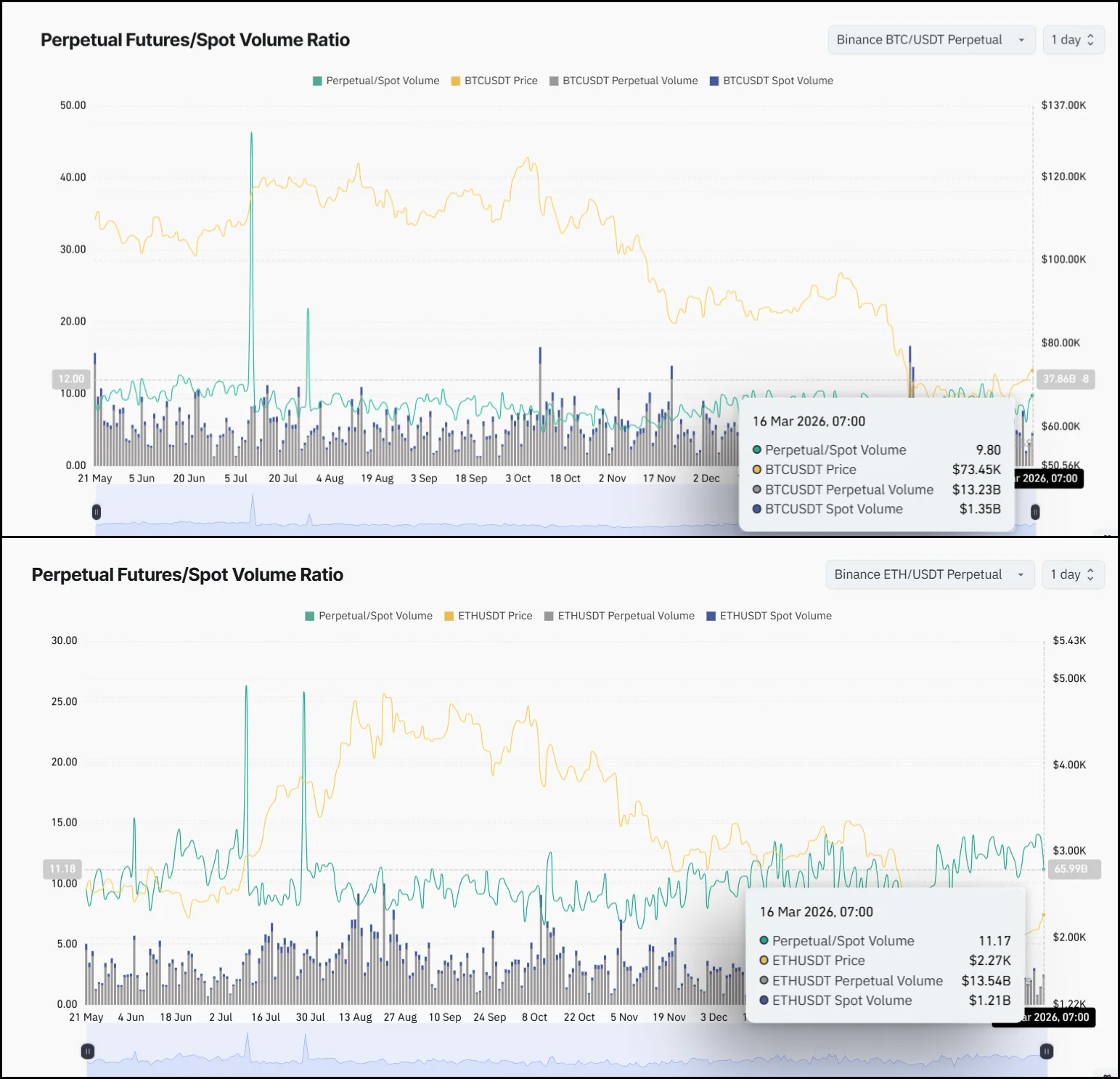
The reason is structural. Derivatives offer capital efficiency, directional flexibility, and hedging capabilities that spot markets simply can't match. Institutional participants in particular prefer derivatives because of the risk management tools they provide.
For exchanges, derivatives are also higher-margin products. This has created a financial incentive to develop and promote derivatives products, further concentrating liquidity in these markets.
The result is a crypto ecosystem where derivatives markets set the tone. The sentiment reflected in perpetual futures funding rates, the positioning data from open interest, and the volatility signals embedded in options pricing all feed back into how spot markets move.
Understanding derivatives isn't optional if you want to understand how crypto markets actually work. It's foundational.
The Takeaway
Crypto derivatives are financial contracts that let traders gain exposure to cryptocurrency prices without owning the underlying asset. They exist because they solve real problems: they let traders speculate efficiently, hedge risk, and access both sides of the market.
They also come with serious complexity and amplified risk. The same leverage that creates opportunity can wipe out a position in minutes.
The articles that follow in this series go deep on the specific instruments and mechanics introduced here — perpetual futures, leverage, funding rates, liquidation, and more. This article is the map. The rest of the series is the territory.


