




 USD
USD
Coin360 Weekly Dispatch | Crypto Market Updates & Highlights | February 1-7, 2026


Trade Like You Mean It: The COIN360 Perp DEX Is Live
We’ve launched the all-new COIN360 Perp DEX, built for traders who move fast!
Trade 130+ assets with up to 100× leverage, enjoy instant order placement and low-slippage swaps, and earn USDC passive yield while climbing the leaderboard. Your trades deserve more than speed — they deserve mastery.
Weekly Crypto Market Performance
Period: February 1-7, 2026
Total crypto market cap: $2.34T
Crypto Fear & Greed Index: 6 (Extreme Fear)
BTC.D: 59.14%
Price Action
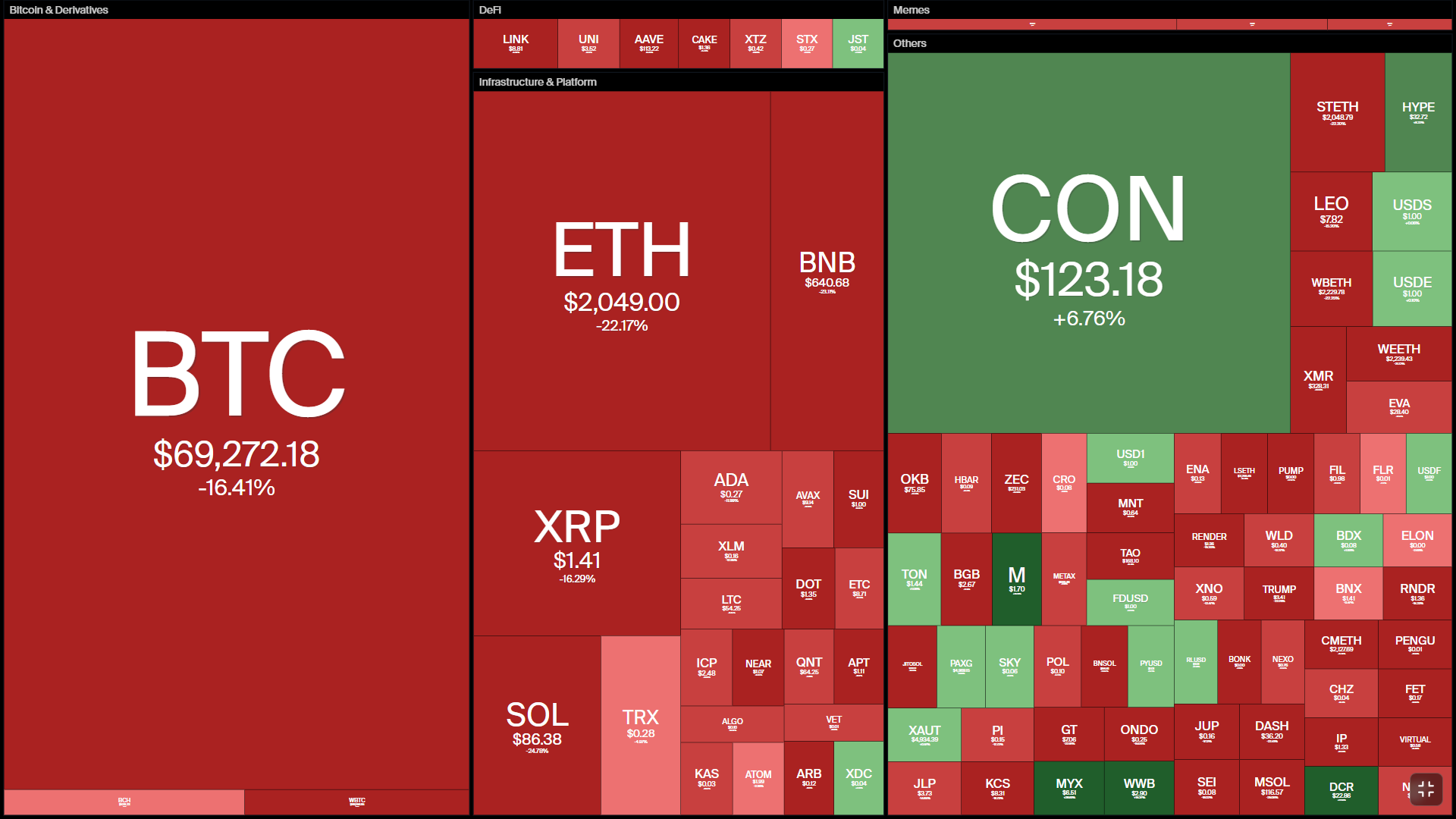
BTC fell -16.41% (week high ~$79.4K on Feb 1, week low ~$60.2K on Feb 6) and ETH declined -22.17% (high ~$2,474, low ~$1,775) as the market shifted decisively into a liquidation-driven regime, with the sharpest break on Feb 5 when BTC logged its largest one-day drop since Nov 2022.
Institutional De-Risking Dominates
The selloff occurred against a backdrop of broad institutional de-risking and rising global risk aversion, rather than crypto-specific fundamental stress, with Jefferies explicitly warning that near-term price stabilization should not be mistaken for a market bottom. Despite the drawdown, ETF holders largely remained in place even while sitting on significant paper losses, signaling reluctance to capitulate rather than panic selling.
The rebound into Feb 6, which saw Bitcoin reclaim $71K and Ethereum stabilize near $2,000, happened alongside a broader risk-on snapback in equities, but it followed a positioning washout rather than a clean, low-volatility rotation. Despite an approximate 18% recovery from the $60.2K low, sentiment remained negative, with insufficient evidence of renewed bullish positioning, reinforcing that the bounce reflected short-covering and exhaustion of sellers rather than fresh demand. Attribution across “technical versus macro” drivers is shared, as the verified record shows both large forced liquidations and macro-driven risk repricing interacting within the same window.
Flows were directionally split—US spot BTC ETFs netted -$358.5M over Feb 2–6, while ETH ETFs saw -$170.4M in outflows, implying relative institutional preference for BTC even as both assets sold off. Zooming out, this period marked the first time on record that crypto funds experienced three consecutive months of net outflows, underscoring sustained caution across both retail and institutional cohorts rather than a single-week shock.
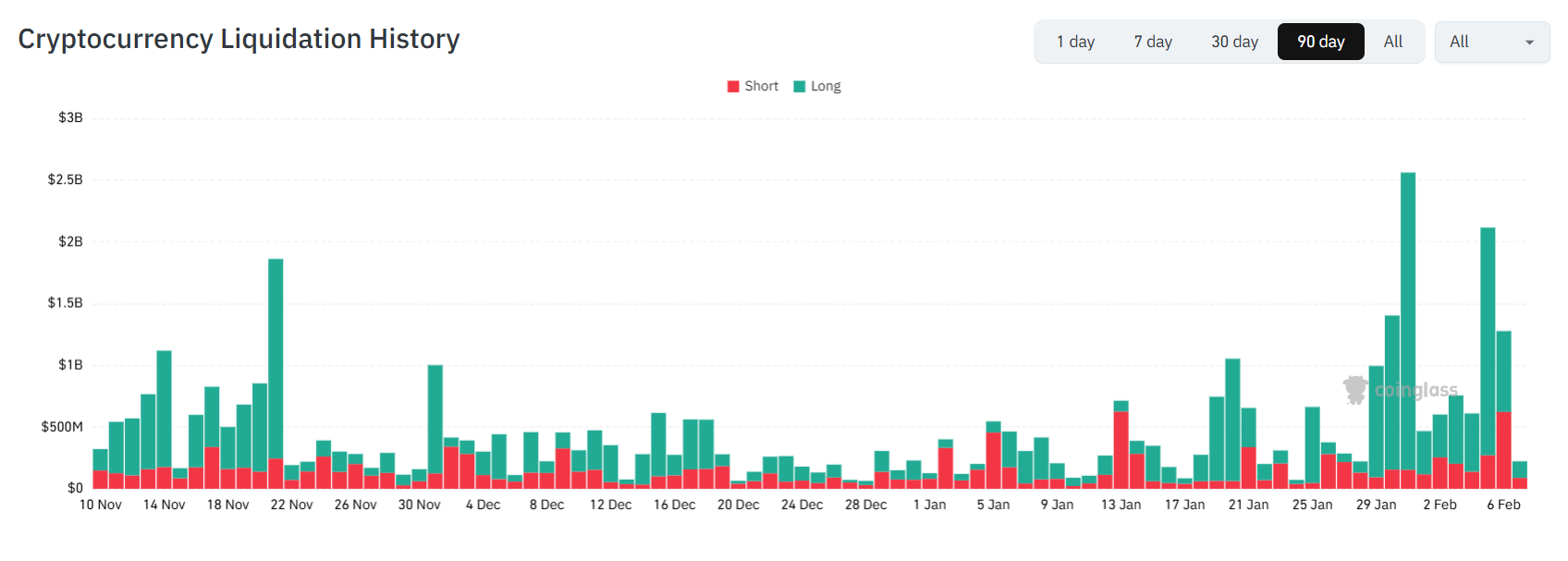
Liquidations were material (~$2.12B on Feb 5 and ~$1.28B around Feb 6), consistent with a leveraged long squeeze amplifying spot declines, while the volatility shock also translated into sharp drawdowns for crypto treasury companies, whose balance sheets extend beyond BTC and ETH into altcoins, magnifying downside through equity-market sensitivity.
Macro Policy Overhang
Policy uncertainty around the Warsh nomination and Fed messaging on Feb 6—with Mary Daly flagging potential rate cuts while emphasizing inflation and tariff risks—coincided with crypto trading in lockstep with broader risk assets. On Feb 6, the Dow pushed above 50,000 as BTC bounced, reinforcing that crypto price action during the week remained dominated by macro risk appetite rather than crypto-idiosyncratic drivers, even as volatility reached levels that Bloomberg Intelligence’s Mike McGlone likened to historical crash dynamics in traditional markets.
Corporate & Treasury Balance Sheet Stress
Crypto Treasury Losses Mount as Strategy, BitMine Report Billions in Unrealized Declines Amid Bitcoin, Ethereum Selloff
Publicly listed crypto treasury firms reported aggregate unrealized losses above $25 billion across Bitcoin and Ethereum holdings in reports dated Feb. 5–6, with balance sheets falling below cost basis during the first week of February. Strategy was cited with roughly $9.2 billion in Bitcoin unrealized losses as of Feb. 5, alongside disclosures that it bought 855 BTC for $75.3 million at an average $87,974 and held 713,502 BTC acquired for about $54.26 billion at a blended $76,052.
BitMine Immersion Technologies was cited with up to about $8.4 billion in unrealized losses tied to Ethereum after ETH dropped below $2,000, with an earlier Feb. 3 disclosure referenced at 4.285 million ETH held (about 3.55% of circulating supply) and $6.6 billion in unrealized losses at that time. Strategy executive Phong Le was quoted framing existential risk as contingent on Bitcoin falling to roughly $8,000 and staying there for multiple years, while BitMine chair Tom Lee characterized drawdowns as inherent to the strategy.
Binance Deploys $250M From SAFU Fund to Buy 3,600 Bitcoin
Binance confirmed it purchased 3,600 BTC for its SAFU fund on Feb. 6, converting “250M USD stablecoins,” and said the SAFU BTC address now holds 6,230 BTC. The update followed earlier additions on Feb. 2 and Feb. 4 totaling 2,630 BTC, with the report noting those buys occurred while Bitcoin traded in a $74,000–$76,000 range.
The conversion was framed as part of a Jan. 30 plan to convert a $1 billion SAFU reserve from stablecoins into Bitcoin within 30 days, executed incrementally with an estimated ~$33 million per day pace to limit disruption. The article restated SAFU’s role as an emergency insurance pool funded via trading fees and referenced a rebalance trigger if fund value fell below $800 million.
Institutional Positioning, Capital Flows & Liquidity
Institutional Crypto Exposure Retreats as $73B Exits Since October 2025 and Trading Volumes Slide to 2024 Levels
JPMorgan’s 2026 Global Family Office Report showed 89% of surveyed family offices reported zero crypto exposure, covering 333 family offices across more than 30 countries with an average net worth of $1.6 billion. A separate Coinbase/Glassnode survey cited nearly 70% of institutional respondents viewing Bitcoin as undervalued, with 62% reporting maintained or increased exposure during sell-offs.
The article cited CoinShares data estimating roughly $73 billion in outflows from digital-asset investment products since October 2025 peaks. Exchange volume data showed trading declining from about $2 trillion in October 2025 to around $1 trillion by late January 2026, with Binance Bitcoin spot volume falling from roughly $200 billion to about $104 billion. It also referenced Nomura reducing crypto exposure after losses and Kyle Samani stepping back from full-time crypto VC work.
Stablecoin Activity Tops $10T in January as USDC Leads Volumes While Exchange Liquidity Contracts
On-chain stablecoin transaction volume exceeded $10 trillion in January 2026, with USDC accounting for more than $8.4 trillion. The report compared this scale with traditional card networks’ monthly processing volumes of around $2 trillion and highlighted concentration in a single dollar-backed token.
Despite record throughput, exchange liquidity data showed deployable stablecoin balances turning to net outflows. After about $9.7 billion in inflows during October 2025, aggregate outflows totaled roughly $4 billion by early February. Stablecoin market capitalization declined from $162 billion to $155 billion, while the article noted Circle shares falling about 80% from recent highs as USDC usage expanded.
Ethereum Architecture & Network Structure
Ethereum Layer-2 Usage, Decentralization, and Identity Questioned as Fees Fall and Activity Concentrates
Ethereum layer-2 networks came under scrutiny after base-layer fees declined faster than anticipated. Vitalik Buterin stated Feb. 3 that “most existing Layer 2s no longer have a clear purpose,” adding that the “same chain everywhere” vision is effectively over.
Metrics cited showed over 80% of 135 tracked L2s averaging under one user operation per second, while Arbitrum and Base handled about 90% of activity. The top three rollups controlled roughly 71% of rollup value. Decentralization staging showed 91.5% of value at Stage 1, 8.5% at Stage 0, and ~0.01% at Stage 2, which Buterin described as effectively empty.
Regulation, Policy & Political Scrutiny
White House Crypto Talks Stall on Stablecoin Yield as GENIUS Act Draws State Pushback
Closed-door White House meetings held Feb. 2–3 with crypto firms, banks, and lawmakers ended without agreement on whether stablecoin reserve yield should be allowed or who may offer it. Banking representatives argued yield should be restricted to regulated institutions, while crypto participants distinguished on-chain rewards from deposit products.
A separate White House crypto summit hosted Feb. 3 covered stablecoins and market structure without policy announcements. At the state level, New York Attorney General Letitia James and four district attorneys warned the GENIUS Act could limit restitution for fraud victims, citing estimates that 84% of illicit crypto transaction volume in 2025 involved stablecoins.
Trump-Linked World Liberty Financial Draws $500 Million UAE Investment, Prompting Ethics Scrutiny and Public Denials
World Liberty Financial disclosed a $500 million UAE-linked investment for a 49% equity stake finalized shortly before the 2026 inauguration. The disclosure drew scrutiny given Donald Trump’s second term, with attention on the firm’s ownership and governance structure.
Trump publicly denied direct knowledge of the investment on Feb. 3, stating his family managed it, while the White House said he remained uninvolved. The article also referenced Gulf capital flows into crypto, including use of the firm’s USD1 stablecoin by UAE-linked entities such as MGX and G42 in a $2 billion Binance investment, prompting calls for ethics review.
Prediction Markets & Event-Based Trading
Prediction Market Sector Weekly Recap: Regulation Softens as Volumes Surge and Platforms Converge
The CFTC withdrew a 2024 proposal targeting political event contracts, with Chair Mike Selig signaling new rulemaking aligned with the Commodity Exchange Act. The shift coincided with intensifying competition among prediction-market platforms.
The recap cited Polymarket filing U.S. trademarks for a POLY token and reporting $7.7 billion January volume. Kalshi sought CFTC approval for margin trading and integrated with Sleeper’s app, reporting annualized volume above $115 billion. Coinbase launched “Coinbase Predict” on Feb. 4 in partnership with Kalshi, while Crypto.com and Jupiter also expanded prediction-market offerings.
Market Structure Innovation & Tokenized Infrastructure
CME Group Advances Tokenized Cash Plans With Google Partnership, CEO Floats “CME Coin” for Crypto Collateral
CME Group is developing a tokenized cash product with Google for collateral and margining use within its clearing ecosystem, according to comments reported Feb. 4. CEO Terrence Duffy said the initiative targets internal market plumbing rather than retail circulation.
Duffy informally referred to the instrument as a possible “CME Coin,” without confirming branding. The collaboration with Google focuses on building infrastructure to support tokenized cash inside CME’s existing settlement framework.
Tech Consolidation, Ai & Crypto Adjacency
Elon Musk’s Net Worth Jumps to $852 Billion as SpaceX Absorbs xAI in $1.25 Trillion Merger
Elon Musk’s net worth rose to an estimated $852 billion following SpaceX’s absorption of xAI, valuing the combined entity at about $1.25 trillion. Forbes-referenced estimates valued SpaceX near $1 trillion and xAI at roughly $250 billion, with Musk owning about 43%.
Operational details included SpaceX generating roughly $15 billion in revenue last year and Starlink operating over 9,000 satellites with about 9 million customers. The article also noted xAI hiring for crypto-focused quantitative roles involving derivatives, on-chain analytics, and MEV-aware execution.
Top Weekly Altcoin Gainers and Losers
Gainers:
MYX Finance MYX (+26.70%)
MemeCore M (+25.52%)
Decred DCR (+21.49%)
Hyperliquid HYPE (+8.49%)
XDC Network XDC (+4.59%)
Losers:
Monero XMR (-32.57%)
Zcash ZEC (-26.17%)
Solana SOL (-24.83%)
BNB BNB (-23.19%)
GateToken GT (-22.90%)
This article has been refined and enhanced by ChatGPT.


